Tags: art

  • An impossible interview with Silence

    An impossible interview with Silence

    «You accuse me of being empty. Yet without me music would not breathe»

    by Marialuisa Veneziano


    15 September 2026

    He showed up in writing without knocking.

    Besides, it would have been inconsistent.

    He sat in front of me, and for a few seconds, he didn't say anything. I waited. He will. After a while I began to feel uncomfortable, as it often happens to humans when no one immediately fills the space with words, notifications, ambient music or at least a respectable background noise.

    «Is that your way of putting me in trouble?»

    Silence smiled.

    «No. It is your way of being afraid of me.»

    It started well.


    You have a bad reputation.

    «I know. I am associated with embarrassment, loneliness, empty rooms, phone calls that do not arrive. When a conversation is silent, say: "What a silence!" As if an unwanted guest appeared.»

    What about music?

    «In music, curiously, you treat me with more respect. You even invented signs to call me.»

    Semi-minimum, minimal, semi-breve. Multiple pauses. Cesure. Corone. Generalpause.

    Silence has a notation.

    It is therefore not absence of music. It is music to which it was forbidden, momentarily, to produce sound.

    And the difference is huge.

    A semi-minimum break is not equal to nothing. It has a precise duration. It takes time. It must be counted, thought, breathed.

    «It's funny.»Look. «Musicians spend years learning when they don't have to play. The others spend a life avoiding it.»

    Point for him.


    So a break is already music?

    «Of course. Try to remove them all.»

    The result would be terrifying.

    Music would become a pronounced speech without commas, without points, without inspirations. A person who tells you his whole life from elementary schools to retirement.

    Mozart, after a while, would also ask for help.

    The pause organizes the musical speech because it separates, articulates, prepares, surprises. It can be breath or abyss. It may conclude a sentence or deliberately prevent it from closing.

    In the language of baroque musical rhetoric there was even the Suspirate: the fragmentation of a line through small breaks that can evoke the sigh.

    Silence became a rhetorical figure.

    He did not interrupt the expression.

    It was the expression.


    But we think about music as a sound.

    «It's your first mistake.»

    He almost looks at me with compassion.

    «Confuse the material with the shape. Also a cathedral is made of stone, but no one would say that its size depends on the number of bricks.»

    In music the sound acquires meaning because there are separation, duration, distance.

    Think about the range.

    Two notes do not form a range only for what they are, but for the relationship between them.

    Even a melody needs something that is not materially present.

    Edmund Husserl, reflecting on the consciousness of time, had observed that we perceive a melody because the newly passed note continues to be held in memory as we wait for the next one.

    In other words, we listen to the present by bringing us behind what does not sound anymore and prolonging us to what does not sound yet.

    Silence seems to have fun.

    «See? It's always me.»


    Beethoven used it a lot.

    «Beethoven treated me very seriously. Sometimes even with brutality.»

    Just think about the attack of the Fifth Symphony.

    Even before the famous reason, Beethoven inserts a tiny rhythmic space. Then those four notes are blocked by a crown.

    The gesture seems elementary.

    It's not.

    Those interruptions transform a few heights into an event.

    Playing only the notes without understanding what happens around them means saying a question by eliminating the question mark.

    Beethoven understands very well that energy is not born only from sound.

    Born fromwaiting for sound.

    In his mature language, the cracks can become almost dramaturgy: a fracture, a suspension of thought, something that obliges the listener to complete interiorly what the orchestra has momentarily abandoned.

    «Beethoven», sigh my interlocutor, «He had at least the good education to let me work.»


    Haydn loved to play with her, too.

    «Oh, Haydn! A man who understood that the audience, to be surprised, must first feel safe.»

    Haydn's musical humor is often built precisely through manipulated expectations: prolonged expectations, false conclusions, caesures, unexpected returns.

    Silence can be comic.

    It's important to remember.

    It is not always death, metaphysics and fog on the abyss.

    Sometimes it's just timing.

    A comedian knows very well: a joke called half a second too soon can die; half a second break can blow it off.

    Music and comedy share something essential: both govern expectation.

    BOX IRONIC


    What about Debussy?

    Silence changes expression.

    «Finally someone who wasn't always trying to fill me.»

    In Debussy the space between the sounds often becomes part of the timbre matter. The agreement is not only valid during the attack: it applies in its resonance, in its decay, in the way it leaves the air modified after itself.

    The piano, above all, teaches an interesting truth.

    After the hammer hit the rope, the pianist can no longer "make" that note.

    Can only Listen to her die.

    This is one of the most severe lessons of interpretation.

    Control is not always about acting.

    Sometimes it is not to interfere.

    A good pianist must know when to let a deal continue without adding anything.

    «Surprisingly applicable concept also to conversations», observe the Silence.

    I can't blame him.


    And Mahler?

    «Mahler knew I could be frightened.»

    In Mahler's music, silence is almost never neutral. It can arrive after immense orchestral masses and, precisely by contrast, become louder than the orchestra.

    Particularly in the tarde pages, the rarefaction of the sound tissue assumes an almost existential meaning.

    The final of the Ninth Symphony seems to gradually subtract matter to sound.

    Dynamics lower.

    The phrases are fragmented.

    The orchestra seems to lose weight.

    The final gesture does not have the character of the theatrical conclusion.

    It's quite a progressive leave.

    And then something extraordinary happens: when the instruments stop playing, the listener does not immediately perceive the end.

    For a few seconds he continues to listen to something that is no longer there.

    «That's it.», says the Silence, «It's one of my best moments.»


    But at some point John Cage arrived and made her the protagonist.

    «Ah. Someone finally gave me the lead role.»

    In 1952 John Cage presents 4’33”.

    The pianist David Tudor sits on the instrument and, in the three movements of the opera, does not intentionally produce notes on the piano.

    Popular legend often says that 4’33” be "four minutes and thirty seconds of silence."

    But it's an imprecise definition.

    The point of the work is that absolute silence does not exist in the experience of listening.

    During the execution remain the cough blows, the movements of the public, the breath, the noise of the room, what happens outside.

    Cage therefore changes the boundary of the work.

    He does not ask us to listen to what the musician produces.

    He asks us to notice what was already playing around us.

    «Ammetta however»I tell him, «that you had an exceptional print office.»

    «Seventy years later, you are still talking about it.»

    Touché.


    But many people consider 4’33” a provocation.

    «Why would it be a problem? The history of art is full of very useful provocations.»

    In fact Cage does not force us to love 4’33”.

    He forces us to ask a question.

    Where does the noise end and the music begins?

    The answer is not purely acoustic.

    It depends on the attention.

    A clacson heard as a disturbance remains noise.

    The same clacson consciously inserted into a composition becomes musical material.

    The sound physically has not changed.

    It has changed our way of organizing it mentally.

    And that means listening is not a passive gesture.

    It's a creative act.


    So the real theme is not silence. It’s listening.

    «We finally get there.»

    Contemporary society has a curious relationship with silence.

    We're constantly trying to eliminate him.

    We enter a store: music.

    Let's get in the car: music.

    Let's run: headphones.

    Let's study: playlist.

    We cook: podcast.

    We wait five minutes: phone.

    Even the elevator, poor man, had to equip itself with a soundtrack to prevent two humans spending twelve seconds together without a diversion.

    It's not necessarily bad.

    Democratization of listening is a huge achievement.

    But there is a less reassuring question:

    What are we trying not to hear?

    Henri Bergson distinguished the measurable time of watches from the lived duration of consciousness.

    Silence gives us that duration.

    Without external events that segment it, we suddenly feel the time.

    And hearing time also means listening to ourselves in time.

    Maybe that's what bothers us.


    In the end pop music also uses a lot of silence.

    «Sure. I've never signed an exclusive contract with classical music.»

    A break before the chorus can make it immensely more effective.

    One stop Suddenly the accompaniment brings the voice to the foreground.

    In the funk the relationship between attack and space is essential.

    In jazz a musician can create tension just avoiding filling each line.

    In rock, a suspension before the sound explosion prepares the listener’s body.

    In electronic music, break prepares the drop also through subtraction and rarefaction.

    Even in the rap silence can have metric weight: a word isolated from a break can acquire more strength than a burst of syllables.

    The principle is always the same.

    The ear desires what is temporarily denied to him.

    Silence smiles.

    «I don't want to brag, but I have a decent transversal career.»


    What does the interpreter represent?

    This is serious.

    «Responsibility.»

    A written pause does not allow the musician to stop playing.

    On the contrary.

    During silence the musical tension must continue.

    It's one of the hardest things to teach.

    The beginner student thinks:

    note = music;
    pause = nothing.

    The mature musician includes:

    note = gesture;
    break = other gesture.

    A crown doesn't mean "let's stop for a while."

    It means deciding how much time can expand without losing shape.

    A crack is not a hole.

    It's a threshold.

    And in the ensemble the break is even a social act.

    You have to breathe together.

    Feeling when the others are coming in.

    Stay in time even when no sound is produced.

    It is almost a philosophy of cohabitation.


    I mean?

    «Being present without occupying space.»

    Shut up.

    He looks at me.

    I figured out the lesson for once.

    Perhaps we have confused too often the presence with production.

    If we don't talk, we believe we don't contribute.

    If we don't intervene, we're afraid to disappear.

    If we don't publish, we don't comment, we don't answer, we don't fill, it almost seems that we cease to exist.

    Music offers a different possibility.

    A voice can silent for many jokes and stay perfectly inside the composition.

    His momentary absence is not equivalent to irrelevantness.

    In fact, he can make his return decisive.

    Let's also think about relationships.

    Listening to someone does not mean to wait politely for it to end up being able to finally tell something more interesting about us.

    It means, at least for a few moments, give up our solo.

    It's not very small.


    So the silence between two people can also be musical?

    «Depends.»

    There are different silences as there are different agreements.

    There is silence of intimacy.

    The one where nothing needs to be filled.

    There is silence of embarrassment.

    The punishment.

    Who doesn't find words.

    Who would have too many.

    There is silence after a serious news, when any phrase would sound insignificant.

    And there is the very rare of those who can stay next to a pain without immediately trying to correct it.

    In music not all tensions require instant resolution.

    Some need to stay.

    Maybe people should learn the same principle.

    We have an almost harmonic smania to solve others:

    "You must react.”

    "It will pass. "

    "Positive thought. "

    They're all toned too soon.

    Sometimes the only musically correct answer is a suspension.


    So you are not always peaceful.

    «Absolutely not.»

    Silence can be violent.

    We think of the silence imposed, censorship, omerity, indifference.

    Not everything silent is deep.

    Sometimes he just shuts up because he didn't have the courage to talk.

    It is important not to romanticize it.

    The music itself shows it.

    A break only works if there is a context that gives it meaning.

    Otherwise it's not a break.

    It is lack of structure.

    «See? Even I need grammar.»


    What is the most difficult silence for a musician?

    Think about it.

    «The one after the last note.»

    She's right.

    The interpreter arrives at the end of a track and has to face a very delicate moment.

    Technically the execution is finished.

    Musically, often, no.

    A great performer does not immediately abandon the keyboard, arch or gesture.

    Let the resonance die.

    Store for a few seconds the shape in space.

    The public perceives it.

    There are endings after which an immediate applause seems almost a violation.

    Not because there is an aristocratic code of the concert.

    But because the body understands intuitively that something is still happening.

    Music has ceased.

    Listening is not.

    And this is perhaps the point where silence reaches its maximum intensity.


    If he should give advice to music listeners?

    «One.»

    I'm waiting.

    Of course.

    «Sometimes you don't do anything while you listen.»

    Nothing.

    Don't drive.

    No images.

    Don't answer the messages.

    Don't order your shopping.

    Do not use Bach to increase productivity, Chopin to fall asleep or Mozart to convince your brain to get results that Mozart himself had never promised.

    Put a song.

    Sit down.

    And leave him the scandalous right to be the only thing that is happening.

    Perhaps we will find that listening to music is one of the most radical forms of attention that have remained there.


    Last question. What then is Silence?

    For the first time it seems to hesitate.

    Then he answers.

    «They are the place where the sound includes not being eternal.»

    And suddenly the whole music story seems to be in that sentence.

    A note has value because it ends.

    A phrase can move us because it doesn't last forever.

    A whole symphony is only possible because each sound accepts to leave room for the next.

    Perhaps this is the reason why music speaks so deeply about life.

    We are also temporal creatures.

    Let's go in.

    We stay for a few jokes.

    Let's change shades.

    We meet other voices.

    Sometimes we find harmony.

    Sometimes a dissonance.

    Then, inevitably, we have to shut up.

    But music gives us a less naive consolation of eternity.

    He teaches us end doesn't necessarily mean you haven't been.

    The last note of a symphony disappears.

    Yet the symphony happened.

    One voice shut.

    Yet he can continue to resonate in the memory of those who listened to it.

    Maybe that's what Silence keeps.

    Not nothing.

    The trace of what has passed.

    I get up to take him to the door.

    «Can I ask you at least how you prefer to be quoted?»

    Look at me.

    He's not answering.

    And for once, the answer is perfect.

    Leave a comment

  • The heart that cannot stand still

    Today’s listening: Franz Schubert – Gretchen am SpinnradeD 118

    by Marialuisa Veneziano


    30 August 2026

    Before you start music

    There are educated thoughts.

    They come, they get recognized and then, with some common sense, they leave.

    And then there are others.

    The ones coming back.

    Let's get them out and get back. We change room and follow. Let’s try to take care of each other and they, with a tenacity that deserves best cause, begin exactly from where we left them.

    Schubert was just seventeen years old when he turned one of these thoughts into music.

    A girl sits at the archer.

    Hands work.

    The wheel turns.

    But she's not there anymore.

    It is entirely within the memory of a man.


    🎧 Open listening. Then keep reading.

    This page is designed to be read with music next door.

    SCHUBERT – GRETCHEN AM SPINNRADE, D 118 (click on the black arrow to make the listening appear)

    Inside the score

    Before Margherita gave us a word, the piano already told us everything.

    The right hand constantly draws circular figures of semichrome.

    It is wheel of the archer.

    On the other hand, the left scans a regular, almost mechanical movement: the pedal, the foot gesture that keeps the wheel moving.

    Schubert does something extraordinarily modern: he does not simply describe an object.

    It transforms an external gesture into psychology.

    The wheel turns because the archer turns.

    But after a few jokes we understand that Gretchen's thinking is also turning.

    Meine Ruh ist hin.

    My peace is lost.

    All the Lied was born of this impossibility to stop.

    The piano continues to grind time while the voice recalls the passage of Faust, his face, smile, the sound of his words.

    The more she thinks about him, the more the music turns on.

    We are not looking at a girl at the archaeologist.

    We're listening an obsession from within.


    🎧 Listen to this.

    Follow the piano.

    At first the wheel seems almost regular, domestic.

    Then listen to what happens when Gretchen begins to remember Faust more intensely.

    The vocal line goes up.

    Harmony tends.

    The breath becomes more and more urgent.

    As long as the memory arrives:

    His kiss.

    And that's where Schubert makes the most beautiful gesture.

    For a moment, the wheel stops.

    The piano loses its incessant movement.

    As if the memory had become so powerful to interrupt even reality.

    Quiet.

    Suspension.

    Then Gretchen returns to himself.

    And slowly the wheel starts again.

    It's one of the moments when we understand why Schubert didn't just "play" Goethe.

    He read it through the sound.


    The note remains

    There are thoughts that we do not remember: we continue to live them.

    The greatness of Gretchen am Spinnrade is not only the famous imitation of the archaeologist.

    If so, we would have a wonderful descriptive music page.

    Schubert does something much deeper.

    At first we believe that the piano represents the wheel.

    In the end we understand that it represents Gretchen.

    His thought became circular.

    It does not proceed towards a conclusion. He always comes back to the same point: he.

    This is what happens to us when a memory becomes too big.

    The world keeps moving.

    We continue to do the necessary things.

    We open doors, we answer, we work, we fix, we walk.

    The wheel turns.

    Yet, under every gesture, there may be a name around which everything secretly continues to rotate.

    Schubert knew.

    She was seventeen.

    Which is slightly irritating for all of us who at seventeen years were already satisfied when we could understand what to do in the afternoon.


    Take him with you

    When the track ends, the wheel has not solved anything.

    Gretchen is no longer free than he was at first.

    The memory remains.

    The desire remains.

    Even the shade seems to bring it back to the point from which it had left.

    Yet we have understood something.

    Not all thoughts must lead us somewhere.

    Some come back because they keep something that we have not yet finished loving, understanding, losing or wanting.

    Maybe that's why Schubert lets the wheel continue.

    He's not trying to heal Gretchen.

    He listens.

    And in doing so he transforms his restlessness into one of the most extraordinary musical images of the human mind.

    A wheel.

    A girl.

    A memory.

    And that strange truth for which, sometimes, while life continues perfectly to proceed, the heart remains firm at the same point.

    Leave a comment

  • The Musical Book Built Together with You


    This time we don't choose the program.

    You choose it.

    With the column Sunday listening we want to transform listening into something shared: not only a column to read, but a living space where the public can suggest, remember, tell.

    This is why we invite you to propose the song you would like to find in one of the next Sundays.

    There's no such boundaries.

    Classical music, opera, jazz, rock, pop, songwriter, soundtracks, contemporary music, popular traditions: If a music has something to tell, it deserves to be heard.

    How to participate

    Write in the comments:

    • title of the track
    • author or interpreter
    • and, if you want, a phrase to tell us why that music

    Alternatively, you can send your proposal directly to the editorial staff The Apeiron Armonies, writing to the email address indicated on the Contacts page.

    The proposals received will progressively enter into the next steps of Sunday listening, following the order in which we will be sent, so that this column can become, Sunday after Sunday, also the reflection of your listening, your memories and your musical passions.

    Each track will be accompanied by a Marialuisa Veneziano listening guide: history, musical details to recognize, interpretative keys and a video to listen while you continue reading.

    Because we don't just want to know what you hear.

    We want to know what music he found you.

    Propose it.

    The next Sunday could start with yours!

    An answer to "The Musical Book Built Together with You"

    1. Avatar
      Anonymous

      2 antipod tracks:
      J. Ibert:Trois pièces brèves per quintet di fiati
      and
      F. Guccini: the locomotive

    Leave a comment

  • The thread that does not break

    Listening today: Johann Sebastian Bach – Ich ruf zu dir, Herr Jesu ChristBWV 639

    by Marialuisa Veneziano


    23 August 2026

    Before you start music

    There are Sundays where we don't need a music that distracts us.

    We do not need someone to convince us that everything will be fine, nor those too well-packed consolations that come when, frankly, we would rather be left alone.

    We need something different.

    Something he can stay.

    Without explaining.
    Without fixing.
    Without rushing.

    For the first Sunday listening Let's start right from here.

    For less than three minutes of Bach.

    Three minutes in which, apparently, happens very little.

    And maybe almost everything.


    🎧 Open listening. Then keep reading.

    This page is designed to be read with music next door.

    Johann Sebastian Bach, Ich ruf zu dir, Herr Jesu Christ, BWV 639 – organ. (click on the black arrow to make the video appear)

    Inside the score

    Now let Bach play.

    Don't try to understand.

    In the upper voice there is the coral: a slow, clear, almost vulnerable melody. He doesn't conquer space. He's not raising his voice.

    Question.

    Under her, the left hand continues to move in a regular plot of semichrome.

    The song breathes.

    Time continues.

    And even deeper, on the pedal, a third voice proceeds with quiet, essential step, supporting the entire building without ever reclaiming the center of the scene.

    Three lines.

    Higher voice → question
    Internal voice → movement
    Pedal → support

    One question.
    Something that keeps walking.
    Something, below, that supports.

    It's counterpoint, of course.

    But in Bach the counterpoint, when it reaches this dizzying simplicity, almost ceases to look like a compositional technique and becomes a way of thinking about existence.

    Words don't have to look like they can be together.

    Everyone keeps their way.

    Yet none is completely alone.


    🎧 Listen to this.

    If the track is still in progress, try to follow only the Upper heading.

    Let her breathe.

    Then, at the second listening, forget it for a few moments and seeks the continuous movement of internal voice. You will notice that, while singing hardens and seems almost to stop, under him something continues inexorably to flow.

    Finally look for pedal.

    It's nothing to be noticed.

    Bach, fortunately, had not yet known the need to become viral.

    Yet without that discreet line everything would lose its weight.

    At this point he listens again to the set.

    You won't hear three parts anymore.

    You'll feel an organism.


    The note remains

    Bach does not interrupt the pain. He builds a large order around him to contain it.

    Maybe that's what makes this little page so necessary.

    Bach does not eliminate dissonance.

    He leads it.

    It doesn't erase the tension.

    He gives her a place.

    He doesn't want what hurts to stop doing it immediately.

    It gives him a form.

    And the difference is immense.

    We live in a time in love with solutions. If we're restless, we have to react. If we're tired, we have to start again. If something breaks, we may have already transformed it into "growth opportunity" by Monday morning.

    Bach's not in a hurry.

    The title itself of the coral was born from an invocation: "I invoke you."

    It is not the statement of those who already have the answer.

    It's someone's voice calling.

    And music preserves exactly this condition: not the triumph of those who understood everything, but the dignity of those who continue to seek.


    Take him with you

    Now the song is probably over.

    And nothing around us has miraculously changed.

    The room is the same. The issues left open are still open. The absences were not filled. And on Monday, with the proverbial delicacy of Monday, it continues to approach.

    Yet something could have moved a few millimeters.

    We listened to a voice capable of asking without shame.

    Once able to continue without becoming an enemy.

    And something, lower, which continues to support even when we almost don't notice it.

    Bach didn't promise that everything will be okay.

    He offered us something more serious:

    a form in which even what we cannot solve can continue to breathe.

    Three minutes.

    No final answer.

    But maybe a little more space within us.

    And this Sunday can be enough.


    What did you hear?

    Listen to the song once again, this time without reading. Then tell us in the comments which of the three voices remained within you.

    An answer to "The thread that does not break"

    1. Avatar
      Anonymous

      A respectful dialogue that elevates pain to reason and substance of being.

    Leave a comment

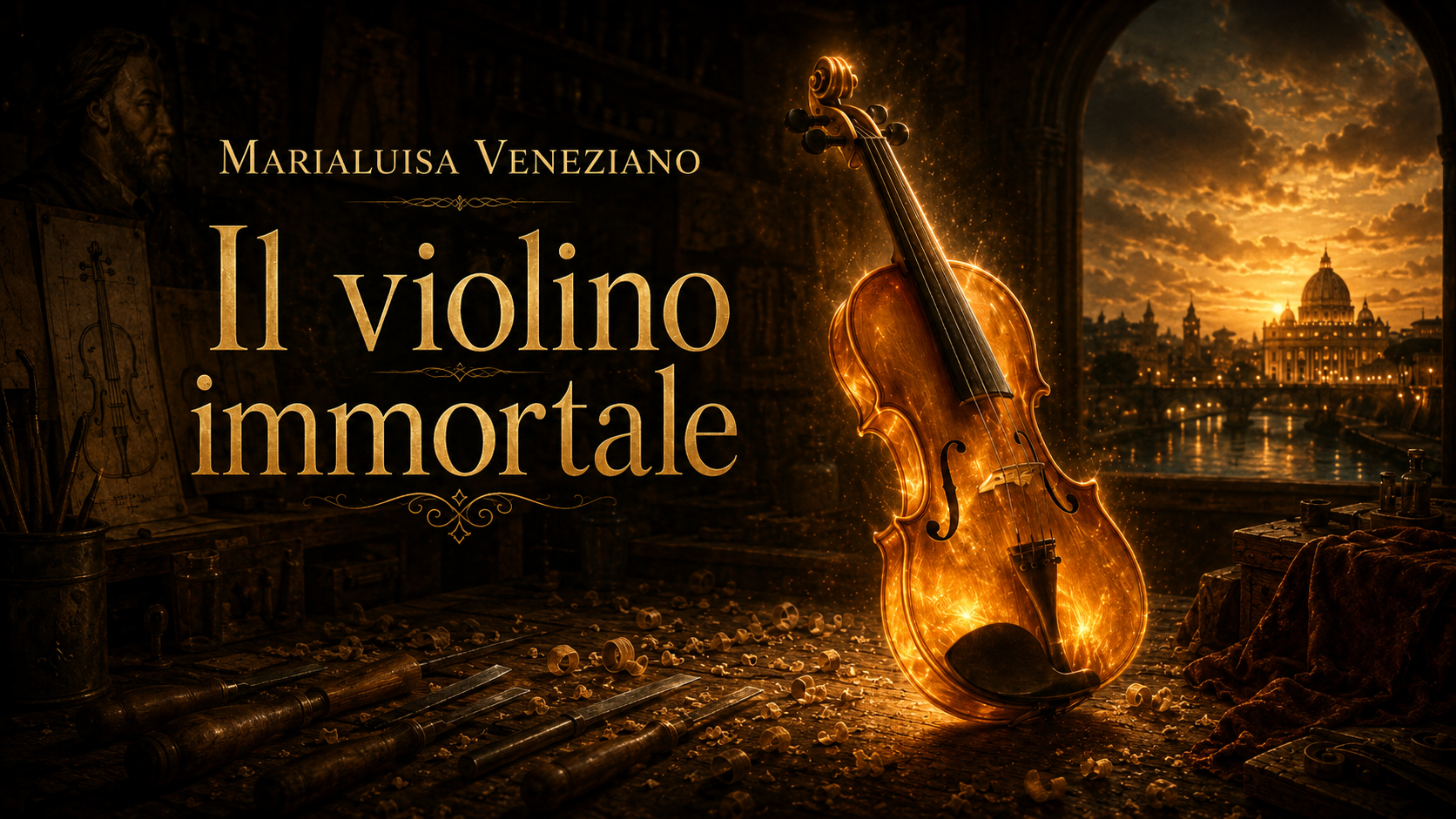
  • Legend of the immortal violin

    Legend of the immortal violin

    A fairy tale about time, memory and what makes us human.

    by Marialuisa Veneziano

    *********

    🎧 Music for reading
    Arvo Pärt, Spiegel im SpiegelFor violin and piano.
    A music suspended between the passing time and what mysteriously remains. Click on the arrow, start the music and start reading.


    Once upon a time, in the city of Valdombra, there was a violinmaker named Alvise, famous for the beauty of his violins and for the poor patience he showed towards those who played them.

    His workshop smelled fir, maple, resin and hot glue. On the walls there were harmonical crates still without strings; on the tables rested piroles, bridges and arches; in the cabinets, the wooden boards waited for years to make them suitable for music.

    Alvise knew every secret of his profession.

    He knew that the fir-tree, light and elastic, had to form the harmonic table, because it welcomed the vibration of the ropes. He knew that maple, harder, was suitable for bottom and bands. He knew how to cut the two effes with such precision that they looked like thin eyes open to the world.

    He even knew the soul of the violin: a small wooden cylinder hidden inside the instrument, invisible to the spectators but indispensable for the sound to vibrate with balance.

    — It's curious. — the young apprentice told him one day — that the part called soul is exactly what no one sees.

    — Important things often hide — answered Alvise.

    It was a very wise sentence; however, he immediately forgot it.

    The luthier wanted to build perfect tools. It did not tolerate an irregular vein, a drop of paint out of place or a scratch on the case.

    When a violinist brought him a repair tool, Alvise observed it with horror.

    — What did you do to him?

    — I played it — The musician answered.

    Alvise considered that very unconvincing explanation.

    One morning an old violinist entered the shop. He brought an instrument that Alvise had built many years before. The paint was consumed near the handle, the edge had some chipping and on the harmonic table appeared a small wax spot.

    — It's so bad! — exclaimed the luthier.

    — He played very much. — answered the old man.

    — I can remove the stain.

    The violinist squeezed the instrument to the chest.

    — That wax fell from a candle when my daughter was five. I played to make her fall asleep.

    — I can delete it without a trace.

    — That's why I won't trust you.

    Alvise looked at him out with disappointment.

    Men, he thought, spend their lives wanting perfect things and then, when they possess them, they become fond of their defects.

    A few days later, the luthier heard of an extraordinary fir tree growing beyond the mountains. He was told that he never lost a branch, that the snow could not bend it and that no insect had ever affected his bark.

    Alvise left immediately.

    After three days of walking he reached a dense and silent forest. The tree was raised in the middle of a clearing.

    It was very high, right and real. She didn't have a single dry leaf. No knots, cracks or scars appeared on the trunk.

    Next to the fir-tree, an old man sat.

    — Is this the tree that does not grow old? — asked Alvise.

    — So they say.

    — How long has she been growing here?

    — Before my grandfather learned to lie.

    — How old was your grandfather?

    — I don't know. He's lying about that too.

    Alvise caressed the bark of the tree.

    — With this wood I could build a violin that lasts forever.

    The guard pointed the branches.

    — No bird ever made you the nest.

    — They're too tall.

    — Birds, I think, can fly.

    — Maybe they're afraid to ruin them.

    The old smile.

    — Or they realized that certain branches cannot accommodate anything.

    Alvise didn't listen. Men are very happy to accept the advice, as long as I confirm what they have already decided.

    That night, without wind or storm, a great branch fell from the tree.

    Alvise considered it a gift.

    The guard considered it a warning.

    The next morning, the luthier loaded the branch on a wagon and returned to Valdombra.

    The wood was extraordinary. He did not deform with moisture, he did not sink with heat and showed no sign of time. However, it was difficult to work.

    When Alvise tried to bend him, he was right. When he tried to season him, he was identical.

    — It is stubborn — said the apprentice.

    — Perfect. — answered the liuthier. — Only imperfect things can be changed.

    Alvise spent seven years building the violin.

    He cast the harmonic table, modeled the bottom, cured the bands, carved the effes and necked the soul. He chose amber-colored paint and stretched it so carefully that on the surface not even the shadow of a brush remained.

    When the instrument was finished, it seemed made of light.

    The most famous violinist in the city, master Evaristo, came to prove it.

    He placed the violin on his shoulder, arranged the strings and swept the bow.

    The sound was pure. The sharps shone, the bass were full and each note was born clear, precise, perfectly equal to itself.

    — No resistance — Evaristo said.

    — Because it has no fault — answered Alvise.

    The musician acquired the violin for such a high sum that the violinmaker had to count the money three times, not for prudence but for pleasure.

    For years, Evaristo played in the courts and large theatres.

    The instrument was almost never forgotten, it did not suffer the heat, it did not fear the cold and did not preserve the sign of the hands.

    Critics were excited about it.

    One of them wrote:

    «In its sound there is no trace of human fatigue.»

    Alvise framed the review.

    Evaristo, instead, began to get restless.

    Each concert was impeccable, but identical to the previous one. The violin returned all the notes and did not seem to preserve any. It was not allowed to be transformed by the touch, tiredness, joy or pain of those who played it.

    One evening, leaving the theatre, an old viewer said:

    — The master didn't make a mistake.

    — That's true. — answered the friend. — But I didn't think he had something to tell.

    After some time, Evaristo sold the violin.

    He bought him a young officer and took him with him during a war.

    In the evening he played it for his companions in tents, hospitals and destroyed houses. His melodies reminded soldiers of mothers, brides, children and distant countries.

    When the war ended, the officer returned to Valdombra.

    The uniform was lace, the hair had become gray on the temples and a hand shook slightly.

    The violin, however, was unchanged.

    The soldier observed him for a long time.

    — You were with us — he said — And yet you haven't been anywhere.

    He sold it and bought a common tool, on whose bottom he engraved the names of the comrades who were not back.

    The immortal violin then passed into the hands of a mother, who gave it to his son.

    The boy wasn't a miracle. During the first lessons he produced so acute sounds that the cat moved spontaneously from the neighbors.

    He studied with impatience, often forgot to tend the bow and once he dropped the instrument.

    Her mother ran to pick him up.

    There wasn't even a scratch.

    — It's indestructible! — exclaimed the boy.

    From that moment he sounded without fear. Over the years he learned to draw ever deeper melodies. He put the chin at the same point every day, he shook the handle with the same hand and passed the bow on the ropes for hours.

    But the violin did not preserve any sign of him.

    The boy still died young.

    After the funeral, the mother took the instrument and sat next to the window. He sought on the paint the imprint of the fingers of his son, the sign left by the chin, a small abrasion, a stain, any trace of his passage.

    The violin was perfect.

    Looks like the kid never touched him.

    The woman brought him back to Alvise, who had become very old.

    — I don't want it anymore. — He said.

    — But it's still intact.

    — That's the problem.

    — Your son loved him.

    The mother caressed the wood smoothly.

    — I thought he wouldn't lose anything. I didn't realize he wouldn't remember anything.

    He left the violin on the counter and left.

    Alvise remained silent for a long time.

    That night a little girl went into the shop. He was wearing a poor, butchered violin. The bottom was smoothed, the tilted bridge and the paint almost completely consumed.

    — Can you fix it? — He asked.

    Alvise sighed.

    — It would be easier to build a new one.

    — But I want this.

    — It's full of flaws.

    The child indicated a small sign on the edge.

    — My father hit him against a chair.

    Then he showed a wax stain.

    — My mother did this one night when she missed the light.

    Finally he stroked the worn handle.

    — And that's me.

    Alvise took the immortal violin and gave it to him.

    — Try this.

    The girl put it on her shoulder and played a short melody.

    The workshop filled with a perfect, bright and clear sound.

    Then the child lowered the instrument.

    — Don't you like it? — asked Alvise.

    — It's beautiful.

    — It's the best violin ever built.

    The child returned it.

    — But when I play, he doesn't know who I am.

    — The violins know nothing.

    — Then why does mine know the weight of my hand?

    The luthier did not find an answer.

    — I give you this. — He said.

    The girl shook her head.

    — I prefer mine.

    — Your one day will break.

    — Then I'll have to take care of it.

    Alvise repaired the old violin without asking for money.

    When the child came out, he remained only with the immortal instrument.

    He took a knife and tried to hack a small line on the case. The sign disappears.

    There was a drop of wax on the harmonic table. He slipped away.

    He poisoned the violin to the fire. Wood didn't blacken.

    Finally he took the bow.

    Alvise knew every secret of the building, but he never really learned to play. His fingers embossed on the strings and produced some uncertain notes.

    Then he remembered a melody that his mother sang to him when he was a child.

    He played it slowly.

    For a moment, the violin seemed to tremble. The sound was neither clear nor perfect. He was fragile, hesitant and human.

    Alvise smiled.

    When he lowered the instrument, he sought the sign of his chin on the wood.

    There was nothing.

    After the death of the violinmaker, the violin was taken to the museum of Valdombra.

    Scholars tried to establish who built it and how old it was. But the wood did not have wear, the paint was intact and no owner had left an engraving or imprint.

    In the end, under the roof, a tag was placed:


    INCERTA
    DISCOUNTS

    Many years later, an old musician entered the museum, bringing a consunted violin and repaired countless times.

    She was the girl who visited Alvise's workshop.

    The edge still kept the sign of the chair, the harmonic table carried the wax stain and the handle was almost clear for the long passage of the fingers.

    A young keeper observed it.

    — Why not buy a better tool?

    The woman stroked her violin.

    — Because this knows all my music, even the one I don't remember anymore.

    Then he started playing.

    The melody wasn't perfect. Some notes trembled, others had the rough sound of aged wood. Yet, one after another, the visitors moved away from the skull of the immortal violin and gathered around the woman.

    When she finished, a long silence remained in the hall.

    The immortal violin still shone behind the glass. He had crossed loves, wars, departures and mourning without losing only one vein.

    But no hand could have left him a caress.

    No pain had given him a name.

    No life had been able to dwell in him.

    Living means letting yourself change. Those who claim to remain untouched can perhaps avoid wounds, but will also lose love, memory and everything that makes a life worthy of being remembered.

    Leave a comment

  • Partition by bell, organ and missing country

    Small civil requiem for Italy who knew how to listen.

    Before the country had a name, it had a sound

    by Marialuisa Veneziano


    9 July 2026

    ANDANTE. With MEMORIA.

    Before the country had a name, it had a sound.

    It was not written on the maps, it was not in the municipal registers, it was not engraved on the stone at the entrance of the square. It was in the air. It was enough to arrive from afar, perhaps along a white road, with the sea hidden behind a curve or hill leaning to the sky as an old shoulder, and the village began to appear not with the houses, but with a voice.

    The bell.

    She did not ask for permission. He descended from above and went through everything: roofs, kitchens, workshops, filthy hands of flour, chairs left out of the doors, children running without knowing yet that one day they would have even nostalgia for dust. The bell didn't sound to be heard by someone. It sounded because everyone, even without wanting, belonged for an instant at the same time.

    Today we look at it on a screen.

    Once the hour came to us from heaven.

    The difference is all here: tiny and immense.

    The screen informs. The bell summons.

    The screen says it's 12.

    The bell said, stop, you're in time, not out.

    The bell was not only an hour: he called a community to recognize himself

    ALLEGRETTO. OLD A LONTAN MARK.

    Then the band came.

    She felt it before she saw her. From a crossing, from a climb, from a narrow alley to contain all that popular solemnity. He arrived with clarinets a little feverish, the golden brass as saints of the province, the drum that gave the men a higher discipline than fatigue.

    The band was the theatre of the poor and the conservatory of the countries.

    The great music, before becoming elite, knew how to cross the squares

    It was Verdi who came out of the stakes and came to take air in the square. It was Rossini who took the frac and let himself be translated into dust, sweat, luminaries, processions, children clinging to the skirts of the mothers. It was opera without velvet, but not without nobility.

    In fact.

    Perhaps a melody, when it passes among people, loses something of its external elegance, but earns destiny.

    Not everyone knew the form-sonata, the counterpoint, the modulation, the structure of an opera symphony. Yet everyone understood when a theme came back, when music expanded, when a crescendo asked the heart to stand before even legs. Musicology, with its necessary words, would say that the band played a function of cultural mediation between the cultured repertoire and the popular community.

    The country would have said simply: today there is a feast.

    And it was the same thing.

    Because true culture is not the one that closes in a room not to contaminate. It is the one who knows how to cross the streets without becoming trivial. It is the one that allows a child to listen for the first time a theme of Verdi without knowing that it is Verdi, and yet feel growing inside a new room.

    ADAGIO.

    The organ, however, did not walk.

    She stayed.

    He was the still keeper of the breath. He lived churches like some old people live in houses: in silence, knowing everything. When the organizer leaned his hands on the keyboard, the air changed substance. The barrels did not only produce sound; they seemed to make visible the invisible. Every deal climbed along the aisles, touched the arches, touched the images of the saints, entangled for a moment in the light of the candles, then fell on people as a bigger question than them.

    The organ has a mysterious nature: it is human because it breathes, superhuman because it has no voice alone. Contains flute, trumpet, chorus, wind, lament, thunder. It is a tool and a city together. In it they coexist many voices, and none, alone, claims to be everything.

    Perhaps for this reason the organ is the most similar tool to a community. A healthy community is not made of a single voice that covers others, but of different registers that learn to stay in the same agreement. There are those who bring the theme, who supports it, who enters for a few jokes and then silent. There are those who seem marginal and instead gives color to the whole harmony. There are those who do not feel any more, but left a vibration that continues to hold everything else.

    The organ does not sound only: it breathes, sustains, consoles

    Every country had its organ, its bell, its band.

    So every country had its own score.

    Not always beautiful, not always plastered, not always right. The countries also have their dissonances: envy, silences, closed doors, bad words. But even dissonances, when they find resolution, belong to music. The problem of our time is not dissonance. It is acoustic indifference. We no longer fight in a common score; we play each on our own, with earphones and the world reduced to background.

    LENTO.

    There are sounds that do not belong to the history of music, yet they know the center.

    A laugh.

    One step.

    A voice that pronounced our name in an unrepeatable way.

    A song once heard, perhaps by chance, and then remained at the bottom of the memory as a dried flower among the pages of a book. We weren't looking for her, we didn't study her, we didn't give her importance. And instead, years later, it is enough to suffer a splinter, a range, a cadence, and something within us opens with the painful precision of a key.

    Memory is not an archive.

    It is an organ.

    He's got records we don't know we own. Some remain silent for years. Then a sound recalls them and suddenly respond.

    There are people who continue like this: not in the news, not in the explanation, not in the ordered account that we can do to others. They keep in a stamp. On a threshold of the soul. At that moment when a distant bell beats the evening and we, without apparent reason, feel joined.

    It's not just sadness.

    It is transformed presence.

    Like the last choral agreement: it ends, but it does not leave immediately. It remains in the air, in the stone, in the chest of those who listened. No one can grasp it, no one can prove it, but it would be foolish to say that it no longer exists only because we do not see it.

    Music teaches this better than any philosophy: what disappears does not always disappear.

    INTERMEZZO. WATER.

    We saved many things in Italy.

    We have restored facades, counted capitals, protected canvases, measured apses, cataloged archives. We discussed, and rightly, stones, frescoes, monuments, landscapes. But who will save the sound?

    Who will save the way a bell called a country to the party?

    Who will save the bands that brought the work to the squares before television brought the world to the living rooms?

    Who will save the small, tired, forgotten organs, which still guard the breath of generations in the barrels?

    Who will tell the boys that Italy was not only a civilization of gaze, but also of listening?

    Because a bell tower without bell is a tower.

    A church without organ is a building.

    A bandless party is a gathering.

    A country without common sounds is a set of houses that stopped being fate.

    GRAVE. But I didn't.

    It's not about nostalgia.

    Nostalgia alone is a closed room. It smells of lost things, but does not always generate future. Here, however, this is responsibility. Education in listening means educating in relation, measure and waiting. It means teaching that not everything that matters screams. That a fragile voice can be decisive. That silence is not empty, but space prepared.

    In the school, in culture, in the countries, we should go back to talking about soundscape as we speak of artistic landscape. The bells, bands, organs, popular songs are not folk frames for summer photographs. They're living archives. They are the way a community learned to cry together, celebrate together, wait together.

    And who can't wait together any more, sooner or later doesn't even know how to live together.

    Music does not save the world naively. It is not enough a march to make a society right, nor a coral to comfort every pain. It would be rhetoric, and rhetoric is always a music that has lost truth.

    But music can remind us of the form of salvation: breathing at the same time without becoming identical.

    This is already a huge lesson.

    Maybe even political.

    Certainly human.

    FINAL. I'm sorry.

    Next time a bell rings, let's not ask for hours.

    Let's ask who he's calling.

    Maybe he calls the child we've been sitting on a wall watching the gang pass. Maybe he calls a woman in front of the window, a man returning from work, an organist in a stone church, a slow procession under the lights, a whole country before the rush made him distracted.

    There are presences that remain in the timbre of things

    Maybe he also calls someone we can no longer reach with his hands, but that a sound, sometimes, returns us with a delicacy almost unbearable.

    Not to bring him back.

    To remind us that love, when it was true, changes register but does not stop playing.

    And then the missing country is no longer just a place of the past. It is a harmonic case within us. Every bell awakens it, every organ dilates it, every band far puts it on the way.

    We believe we hear a sound.

    Actually, we're listening to what's left.

    And what remains, when he was loved, is never little.

    It is the invisible part of music.

    It is the secret home of memory.

    It is the exact point where silence, not to hurt us too much, decides once again to sing.

    Leave a comment

  • The unhappy fate of Music in the Italian school

    The unhappy fate of Music in the Italian school

    When a country forgets to educate listening, it also stops listening to itself.

    By Marialuisa Veneziano


    29 June 2026

    Is there a question that silently crosses the Italian classrooms, often covered by the noise of the bells, the bureaucratic urgencies, the programs to finish, the checks to be administered, the grids to be compiled: what place really occupies the music in our school?

    Not the place that is recognized in ministerial documents, in solemn declarations, in late-year projects, in colorful inns of essays. Not the rhetorical, decorative, celebratory place. But the real place. What is measured in daily consideration, over time allocated, in the resources available, in the formation of teachers, in the perception of families, in the cultural dignity that a school community recognizes in a discipline.

    The answer, if said without infinity, is painful: music in the Italian school often lives an unhappy destiny. It is present, but not always recognized; nominated, but not always understood; required when it serves to "make a feast", but forgotten when speaking of knowledge; celebrated as a universal language, but treated too often as an accessory, light, side matter. A kind of graceful sound upholstery of formation, useful to move to the rituals, to rejoice ceremonies, to cover the institutional gaps, but rarely placed at the center of a deep educational vision.

    Yet, this marginality is one of the greatest cultural misunderstandings of our school system. Because music is not a pastime. It's not entertainment. It is not the aesthetic fiocchetto to affor on an educational building already built elsewhere. Music is thought organized over time. It's mathematics. It is philosophy embodied in sound. It is historical memory, discipline of listening, body education, exercise of relationship, grammar of emotion, construction of form. It is one of the oldest and most refined ways in which the human being has learned to give order to chaos.

    Already in the Greek world, mousiké did not only indicate what we call music in a narrow sense, but a broader horizon: word, rhythm, poetry, education of the soul. Plato, though with all his cautele towards the perturbanized power of sounds, knew well that music forms the character before even the intellect can defend itself. Aristotle recognized music as an educational, ethical, cathartic function. In the Middle Ages, it belonged to the quadrivius along with arithmetics, geometry and astronomy: it was not an ornament, but a science of order. Boezio distinguished the mundane music, human music and instrumental music, reminding us that sound is not just what it odes, but what structure the cosmos, man and practice.

    It is curious, and tragic, that a school civilization descended from this tradition ended up reducing music, in common perception, to "practical matter", often opposed to "series" disciplines. Like doing didn't think. Like the body didn't know. As if playing, singing, listening, reading a score, understanding a form, distinguishing a timbre, recognizing a harmonic function, placing a song in its historical context were minor activities than the analysis of a literary text or the resolution of a mathematical problem.

    The truth is that music contains all this: text, number, history, logic, gesture, memory, interpretation. A boy who learns to play with others learns a very high form of citizenship. He must listen, wait, enter the right moment, respect the common time, control his own impulse, agree, correct, support the part of others. In a school orchestra, even small, even imperfect, there is already a model of society: no one can shout over others without destroying the form; no one can silent completely without impoverishing the whole; no one is really alone, because every voice exists in the relationship.

    That is why the fate of music at school is not just about musicians. It concerns the democracy of listening. It concerns the human quality of formation. It concerns the ability to educate generations not only to produce, compete, respond, perform deliveries, but also to hear, interpret, distinguish, inhabit silence, give meaning to time.

    The Italian school, on the other hand, often seems to be a prisoner of a contradiction. On the one hand, in general principles, it recognizes the value of humanistic culture, creativity, artistic and musical heritage. On the other hand, in ordinary practice, it does not always build conditions because that declaration becomes daily life. Music is expected, yes. There are musical paths in the first degree secondary school, musical high school, design, art plans, possible collaborations with conservatives, institutions and associations. But the system still appears fragmentary, discontinuous, entrusted too often to the good will of the individual teachers, to the sensitivity of a manager, to the geographical fortune of being born in a culturally equipped territory.

    The result is an unequal geography of musical education. There are schools where music becomes living experience, orchestra, choir, laboratory, sound thinking theatre. And there are schools in which it remains confined to a few residual activities, perhaps carried out in unsuitable classrooms, with insufficient tools, seamlessly design. There are students who meet teachers who can open worlds, and students who go through years of school without really understanding what a musical form is, because Bach is not only "old music", because jazz is a revolution of time and freedom, so that rock has told the twentieth century more than many manuals, so that Gregorian chant is not a museum powder, but a cathedral of breath.

    The first knot is cultural: music is often perceived as an emotional experience, but not as knowledge. This is the original sin. Of course, the music excites. But he's excited about organizing. He switches because he builds. Turba because he has a deep grammar. No one would say that the Divine Comedy is important only because it "makes emotions"; no one would reduce Caravaggio to the fact that he "culpts the eye"; no one would evaluate Euclide on the basis of "likes" or "I don't like". For music, it happens all the time. It remains to the surface of the taste: beautiful, ugly, cheerful, sad, relaxing. As if the school's task was to confirm the immediate impressions and not to educate them.

    Education in music means teaching to move from undivided emotion to awareness. From "I like" to "because he talks to me." From rapid consumption to critical listening. From the background to the shape. We live in a time when music is everywhere and, precisely for this reason, it risks not being listened anywhere. Accompanies shopping, phone wait, videos, advertising, social media, gyms, travel. It has become environment, noise, permanent soundtrack of existence. The boys listen to a lot of music, but they are rarely guided to understand it. They have access to an ocean, but often without a compass. And a school that does not provide guidance tools let the algorithms educate taste.

    This is a decisive point. Today musical education cannot be limited to the necessary theoretical literacy, nor can it take refuge in a museum nostalgia. It must be measured with Spotify, YouTube, TikTok, with digital production, with rap, with trap, with soundtracks, with sound design, with music in video games, with artificial creative intelligence. But measuring does not mean giving. It means interpreting. The school must teach that every sound language has a history, a technique, a social function, a rhetoric, an aesthetic. It must make it clear that Beethoven and Kendrick Lamar, Monteverdi and Morricone, Hildegard von Bingen and Björk, Bach and the Beatles are not in the same shelf for banalization, but they can enter into dialogue if there is a mind capable of listening to structure, context, invention, breakage, memory.

    The second node is pedagogical. Too often school music oscillates between two equally dangerous extremes: sterile notionism and depthless entertainment. On the one hand, dates, names, definitions, instruments studied as figurines; on the other, pleasant but unstructured activities, in which "making music" simply means occupying time with something pleasant. In the middle should be the true musical teaching: guided listening, vocal and instrumental practice, movement, invention, reading, analysis, history, technology, improvisation, critical reflection.

    Music you learn by doing, but doing must be thought. You learn by listening, but listening must be educated. You also learn by studying, but the study must return to sound, gesture, experience. An effective lesson in music is neither a conservative conference nor an hour of animation. It's a sensitive intelligence lab. It is the place where an African rhythm can open a reflection on the community, a Bach escape can show the beauty of logic, a protest song can become historical education, a rap song can introduce metric, rhetoric, identity, social marginality, rhythmic word. This is where the teacher's competence becomes decisive: it is not enough to "know a little music". You need to know music, pedagogy, history, contemporary languages, evolutionary psychology, group management, interdisciplinary design.

    The third knot is professional. Music, to be taught well, requires specific skills. This should be obvious, but it's not enough. No one would entrust the teaching of mathematics to those who "love numbers" or to those who "read novels". For music, however, it sometimes survives the idea that a generic artistic sensibility can suffice. That's not enough. Sensitivity is precious, but without competence becomes educational impressionism. The primary school, in particular, would need a more stable and structured musical presence. It is right there, in the early years, that the child builds the relationship with voice, rhythm, body, listening, coordination, sound memory. Late intervention often means correcting what has not been cultivated before.

    A serious country should consider basic musical education not as a luxury, but as a formative right. Just like linguistic and mathematical literacy. Because there is also a sound illiteracy: the inability to listen, distinguish, appoint, recognize, respect the acoustic landscape. It is a less visible illiteracy, but not less serious. It produces citizens exposed to noise, incapable of concentration, poor hearing memory, weak in perception of time, less trained in fine cooperation. A noisy society is not necessarily a musical society. In fact, it is often the opposite: the more noise there is, the less listening remains.

    The fourth knot is social. Music at school could be an extraordinary instrument of equality. Many children and boys will never enter a conservatory, they will not take private lessons, they will not possess a tool, they will not have families able to bring them to concert, they will not spontaneously meet the musical heritage. For them the school is the only door. If that door remains closed, musical culture becomes privilege. And when culture becomes privilege, the school failed a part of its constitutional mission.

    Music, on the other hand, can reveal invisible talents. He can give voice to those who struggle with the word. It can help fragile students find a place in the group. It can offer those who live economic marginality or affect an ordered, shared, non-competitive beauty experience. It can transform a difficult class into a possible ensemble, at least for a few minutes: and those minutes, sometimes, are worth more than many disciplinary predictions. Musical practice does not eliminate problems, does not perform miracles as a pedagogical saint, but creates different conditions: it forces the group to breathe together. And breathing together for a class is already a small revolution.

    But for all this to happen, we need choices. Not enough slogans. It is not enough to invoke "creativity" as a magic word, good for every financial project. Creativity is not pretty chaos. It is freedom in a form. It is ability to generate something new knowing constraints, materials, techniques. In music, nobody really improvises if they don't have a vocabulary. Jazz, which seems to be pure freedom, is also a fierce discipline of listening, harmony, time and response. The school should teach this: not opposition between rule and invention, but their alliance.

    The proposals, then, must be concrete.

    The first: progressively introduce teachers music specialists in the primary school, at least through structural and continuing modules, not episodic. The voice, rhythm, listening and basic instrumental practice must soon enter the formation of the child. Not as an extracurricular activity for those who can, but as an ordinary part of school experience.

    The second: build a real vertical curricle, from childhood to second degree. Today the music is likely to proceed for fragments: a bit of song, a little flute, a bit of history, a project, a essay. On the other hand, it serves a clear trajectory: sound exploration, voice, rhythm, movement, listening; then reading, overall practice, tools, language history; then analysis, technology, composition, critical interpretation. Each segment should know what it receives and what it delivers to the next.

    The third: strengthen the paths to musical address in the secondary school of the first degree, ensuring territorial balance, adequate spaces, tools, continuity of the chair and centrality of the music of the whole. The musical address should not be a happy island for a few, but a workshop of good practices capable of contaminating the entire school.

    The fourth: creating stable networks between schools, conservatories, musical high schools, theatres, concert associations, bands, choirs, operatic bodies, festivals, musical libraries. The school cannot carry on its own all the weight of artistic training; but it must be the intelligent center of an educating community. Not occasional visits, not one-time events, but lasting cultural pacts.

    The fifth: renew the contents without denying the heritage. Tradition does not defend itself by embalming it. He's defending himself by speaking to the present. Bach does not need to be "simplified" until he becomes harmless; he needs to be told as living architecture. Verdi is not a national statue; it is political theater, popular breath, scenic word. Gregorian is not an ecclesiastical reperto; it is experience of suspended time, of sacred as a sound form. Similarly, rap should not be liquidated as a lower youth product: it should be analyzed, understood, discussed, even criticized, but with serious instruments. The school should not pursue students' tastes; it must take them seriously to expand them.

    Sixth: educating listening as a transversal competence. Listening to music means learning attention, memory, forecast, comparison, suspension of judgment. In a time of notifications and fragments, long listening is almost a political act. Bringing a class to really listen to a piece of five, ten, fifteen minutes is a huge challenge. But that's why it's necessary. He is not only educated by speaking to the boys; he also educates them by teaching them to stay within a duration.

    The seventh: enhancing music in evaluation and exams, not as folklore appendix, but as a discipline capable of dialogue with history, literature, art, technology, civic education, science. An interdisciplinary interview that crosses the 20th century without music is mutilated. To talk about totalitarismi without hymns and sound propaganda, of migration without popular songs, of cultural industry without song, of cinema without soundtrack, of technology without digital production means to tell the world with a stopped ear.

    The eighth: investing in teacher training. The school changes if the living skills of those who live there change. We need serious paths on labs teaching, inclusion through music, sound technologies, vocality, overall music, guided listening, history of contemporary repertoires, interdisciplinary design. A music teacher today must be together musician, historian, educator, director of collective processes, cultural mediator. A complex figure, not an entertainer with an electronic register.

    The ninth: rethink the spaces. Music needs places. Soundproof classrooms, accessible tools, digital devices, sound libraries, environments for overall practice. You can't preach the centrality of music and then relegate it to unsuitable rooms, where every sound becomes trouble for the next class. Even school architecture says the value we attach to knowledge.

    The tenth: publicly recognize the cultural role of music in the formation of the citizen. This is perhaps the deepest point. As long as the music is thought as an accessory, every reform will remain fragile. You have to change imagination. Music does not serve to "make all musicians", as mathematics does not serve to become all mathematicians and literature does not serve to make all writers. It serves to form a part of human intelligence. It serves to give tools to understand the world.

    The unhappy fate of music in Italian schools is therefore not a fatality. It is the product of choices, omissions, mental habits. And what was produced can be transformed. But the courage to say that a school without authentically lived music is a poorer school. It can also work, compile documents, achieve goals, produce measurable results. But she will miss something essential: the ability to educate invisible complexity. Because music teaches this: that not all that matters is seen. Time can't be seen, but it governs us. Harmony cannot be seen, but it holds relations. Listening is not seen, but decides the quality of a community. A wrong note, in a set, is not only an individual error: it changes the landscape of all. Maybe the school should start from here. From this simple and dizzying evidence: we are always part of a common score.

    Restoring dignity to music means giving back depth to the school. It means remembering that educating does not only mean transmitting information, but to grant the human being with himself, with others, with memory, with the future. A society that musically educates its children does not only produce better performers: it produces better listeners. And a good listener, in civil life, is already a less ferocious citizen, less manipulated, less alone.

    Music, in the Italian school, is still waiting to be taken seriously. Not like luxury. Not as a range. Not like a year-end party. But as one of the highest forms of knowledge.

    And perhaps the task of those who teach, play, study, write and still believe in the human power of art is precisely this: to prevent music from remaining a kind presence on the edge of the school. It is necessary to return it to the center, where it has always been in civilizations that have been able to think in great: next to the word, to the number, to the memory, to the formation of the soul. Because a school that does not teach to listen can also educate. But it'll be much harder to educate.

    Leave a comment

EnglishenEnglishEnglish