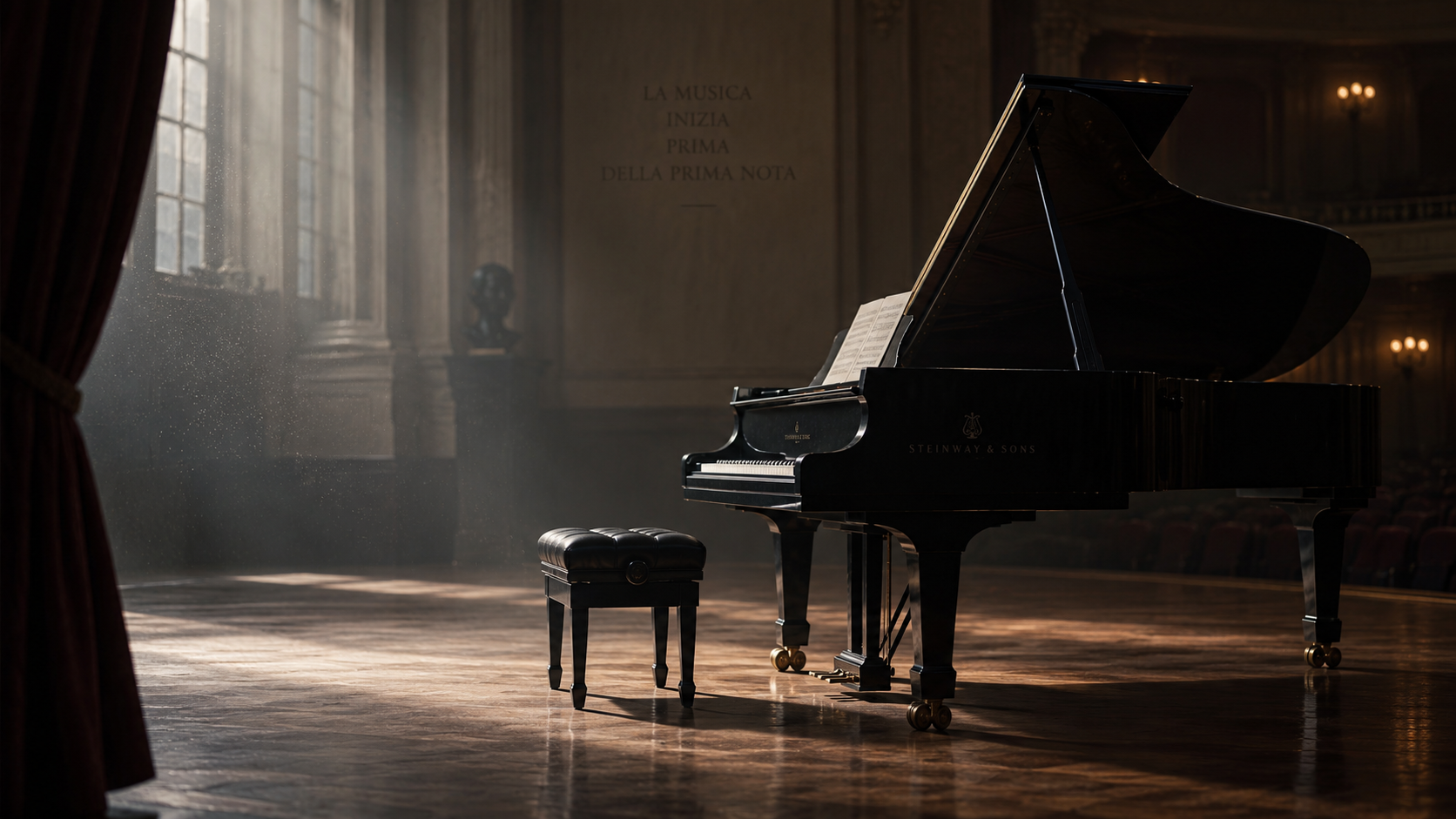
«You accuse me of being empty. Yet without me music would not breathe»
by Marialuisa Veneziano
15 September 2026
He showed up in writing without knocking.
Besides, it would have been inconsistent.
He sat in front of me, and for a few seconds, he didn't say anything. I waited. He will. After a while I began to feel uncomfortable, as it often happens to humans when no one immediately fills the space with words, notifications, ambient music or at least a respectable background noise.
«Is that your way of putting me in trouble?»
Silence smiled.
«No. It is your way of being afraid of me.»
It started well.
You have a bad reputation.
«I know. I am associated with embarrassment, loneliness, empty rooms, phone calls that do not arrive. When a conversation is silent, say: "What a silence!" As if an unwanted guest appeared.»
What about music?
«In music, curiously, you treat me with more respect. You even invented signs to call me.»
Semi-minimum, minimal, semi-breve. Multiple pauses. Cesure. Corone. Generalpause.
Silence has a notation.
It is therefore not absence of music. It is music to which it was forbidden, momentarily, to produce sound.
And the difference is huge.
A semi-minimum break is not equal to nothing. It has a precise duration. It takes time. It must be counted, thought, breathed.
«It's funny.»Look. «Musicians spend years learning when they don't have to play. The others spend a life avoiding it.»
Point for him.
So a break is already music?
«Of course. Try to remove them all.»
The result would be terrifying.
Music would become a pronounced speech without commas, without points, without inspirations. A person who tells you his whole life from elementary schools to retirement.
Mozart, after a while, would also ask for help.
The pause organizes the musical speech because it separates, articulates, prepares, surprises. It can be breath or abyss. It may conclude a sentence or deliberately prevent it from closing.
In the language of baroque musical rhetoric there was even the Suspirate: the fragmentation of a line through small breaks that can evoke the sigh.
Silence became a rhetorical figure.
He did not interrupt the expression.
It was the expression.

But we think about music as a sound.
«It's your first mistake.»
He almost looks at me with compassion.
«Confuse the material with the shape. Also a cathedral is made of stone, but no one would say that its size depends on the number of bricks.»
In music the sound acquires meaning because there are separation, duration, distance.
Think about the range.
Two notes do not form a range only for what they are, but for the relationship between them.
Even a melody needs something that is not materially present.
Edmund Husserl, reflecting on the consciousness of time, had observed that we perceive a melody because the newly passed note continues to be held in memory as we wait for the next one.
In other words, we listen to the present by bringing us behind what does not sound anymore and prolonging us to what does not sound yet.
Silence seems to have fun.
«See? It's always me.»
Beethoven used it a lot.
«Beethoven treated me very seriously. Sometimes even with brutality.»
Just think about the attack of the Fifth Symphony.
Even before the famous reason, Beethoven inserts a tiny rhythmic space. Then those four notes are blocked by a crown.
The gesture seems elementary.
It's not.
Those interruptions transform a few heights into an event.
Playing only the notes without understanding what happens around them means saying a question by eliminating the question mark.
Beethoven understands very well that energy is not born only from sound.
Born fromwaiting for sound.
In his mature language, the cracks can become almost dramaturgy: a fracture, a suspension of thought, something that obliges the listener to complete interiorly what the orchestra has momentarily abandoned.
«Beethoven», sigh my interlocutor, «He had at least the good education to let me work.»
Haydn loved to play with her, too.
«Oh, Haydn! A man who understood that the audience, to be surprised, must first feel safe.»
Haydn's musical humor is often built precisely through manipulated expectations: prolonged expectations, false conclusions, caesures, unexpected returns.
Silence can be comic.
It's important to remember.
It is not always death, metaphysics and fog on the abyss.
Sometimes it's just timing.
A comedian knows very well: a joke called half a second too soon can die; half a second break can blow it off.
Music and comedy share something essential: both govern expectation.
BOX IRONIC

What about Debussy?
Silence changes expression.
«Finally someone who wasn't always trying to fill me.»
In Debussy the space between the sounds often becomes part of the timbre matter. The agreement is not only valid during the attack: it applies in its resonance, in its decay, in the way it leaves the air modified after itself.
The piano, above all, teaches an interesting truth.
After the hammer hit the rope, the pianist can no longer "make" that note.
Can only Listen to her die.
This is one of the most severe lessons of interpretation.
Control is not always about acting.
Sometimes it is not to interfere.
A good pianist must know when to let a deal continue without adding anything.
«Surprisingly applicable concept also to conversations», observe the Silence.
I can't blame him.
And Mahler?
«Mahler knew I could be frightened.»
In Mahler's music, silence is almost never neutral. It can arrive after immense orchestral masses and, precisely by contrast, become louder than the orchestra.
Particularly in the tarde pages, the rarefaction of the sound tissue assumes an almost existential meaning.
The final of the Ninth Symphony seems to gradually subtract matter to sound.
Dynamics lower.
The phrases are fragmented.
The orchestra seems to lose weight.
The final gesture does not have the character of the theatrical conclusion.
It's quite a progressive leave.
And then something extraordinary happens: when the instruments stop playing, the listener does not immediately perceive the end.
For a few seconds he continues to listen to something that is no longer there.
«That's it.», says the Silence, «It's one of my best moments.»
But at some point John Cage arrived and made her the protagonist.
«Ah. Someone finally gave me the lead role.»
In 1952 John Cage presents 4’33”.
The pianist David Tudor sits on the instrument and, in the three movements of the opera, does not intentionally produce notes on the piano.
Popular legend often says that 4’33” be "four minutes and thirty seconds of silence."
But it's an imprecise definition.
The point of the work is that absolute silence does not exist in the experience of listening.
During the execution remain the cough blows, the movements of the public, the breath, the noise of the room, what happens outside.
Cage therefore changes the boundary of the work.
He does not ask us to listen to what the musician produces.
He asks us to notice what was already playing around us.
«Ammetta however»I tell him, «that you had an exceptional print office.»
«Seventy years later, you are still talking about it.»
Touché.

But many people consider 4’33” a provocation.
«Why would it be a problem? The history of art is full of very useful provocations.»
In fact Cage does not force us to love 4’33”.
He forces us to ask a question.
Where does the noise end and the music begins?
The answer is not purely acoustic.
It depends on the attention.
A clacson heard as a disturbance remains noise.
The same clacson consciously inserted into a composition becomes musical material.
The sound physically has not changed.
It has changed our way of organizing it mentally.
And that means listening is not a passive gesture.
It's a creative act.
So the real theme is not silence. It’s listening.
«We finally get there.»
Contemporary society has a curious relationship with silence.
We're constantly trying to eliminate him.
We enter a store: music.
Let's get in the car: music.
Let's run: headphones.
Let's study: playlist.
We cook: podcast.
We wait five minutes: phone.
Even the elevator, poor man, had to equip itself with a soundtrack to prevent two humans spending twelve seconds together without a diversion.
It's not necessarily bad.
Democratization of listening is a huge achievement.
But there is a less reassuring question:
What are we trying not to hear?
Henri Bergson distinguished the measurable time of watches from the lived duration of consciousness.
Silence gives us that duration.
Without external events that segment it, we suddenly feel the time.
And hearing time also means listening to ourselves in time.
Maybe that's what bothers us.
In the end pop music also uses a lot of silence.
«Sure. I've never signed an exclusive contract with classical music.»
A break before the chorus can make it immensely more effective.
One stop Suddenly the accompaniment brings the voice to the foreground.
In the funk the relationship between attack and space is essential.
In jazz a musician can create tension just avoiding filling each line.
In rock, a suspension before the sound explosion prepares the listener’s body.
In electronic music, break prepares the drop also through subtraction and rarefaction.
Even in the rap silence can have metric weight: a word isolated from a break can acquire more strength than a burst of syllables.
The principle is always the same.
The ear desires what is temporarily denied to him.
Silence smiles.
«I don't want to brag, but I have a decent transversal career.»
What does the interpreter represent?
This is serious.
«Responsibility.»
A written pause does not allow the musician to stop playing.
On the contrary.
During silence the musical tension must continue.
It's one of the hardest things to teach.
The beginner student thinks:
note = music;
pause = nothing.
The mature musician includes:
note = gesture;
break = other gesture.
A crown doesn't mean "let's stop for a while."
It means deciding how much time can expand without losing shape.
A crack is not a hole.
It's a threshold.
And in the ensemble the break is even a social act.
You have to breathe together.
Feeling when the others are coming in.
Stay in time even when no sound is produced.
It is almost a philosophy of cohabitation.
I mean?
«Being present without occupying space.»
Shut up.
He looks at me.
I figured out the lesson for once.
Perhaps we have confused too often the presence with production.
If we don't talk, we believe we don't contribute.
If we don't intervene, we're afraid to disappear.
If we don't publish, we don't comment, we don't answer, we don't fill, it almost seems that we cease to exist.
Music offers a different possibility.
A voice can silent for many jokes and stay perfectly inside the composition.
His momentary absence is not equivalent to irrelevantness.
In fact, he can make his return decisive.
Let's also think about relationships.
Listening to someone does not mean to wait politely for it to end up being able to finally tell something more interesting about us.
It means, at least for a few moments, give up our solo.
It's not very small.
So the silence between two people can also be musical?
«Depends.»
There are different silences as there are different agreements.
There is silence of intimacy.
The one where nothing needs to be filled.
There is silence of embarrassment.
The punishment.
Who doesn't find words.
Who would have too many.
There is silence after a serious news, when any phrase would sound insignificant.
And there is the very rare of those who can stay next to a pain without immediately trying to correct it.
In music not all tensions require instant resolution.
Some need to stay.
Maybe people should learn the same principle.
We have an almost harmonic smania to solve others:
"You must react.”
"It will pass. "
"Positive thought. "
They're all toned too soon.
Sometimes the only musically correct answer is a suspension.
So you are not always peaceful.
«Absolutely not.»
Silence can be violent.
We think of the silence imposed, censorship, omerity, indifference.
Not everything silent is deep.
Sometimes he just shuts up because he didn't have the courage to talk.
It is important not to romanticize it.
The music itself shows it.
A break only works if there is a context that gives it meaning.
Otherwise it's not a break.
It is lack of structure.
«See? Even I need grammar.»
What is the most difficult silence for a musician?
Think about it.
«The one after the last note.»
She's right.
The interpreter arrives at the end of a track and has to face a very delicate moment.
Technically the execution is finished.
Musically, often, no.
A great performer does not immediately abandon the keyboard, arch or gesture.
Let the resonance die.
Store for a few seconds the shape in space.
The public perceives it.
There are endings after which an immediate applause seems almost a violation.
Not because there is an aristocratic code of the concert.
But because the body understands intuitively that something is still happening.
Music has ceased.
Listening is not.
And this is perhaps the point where silence reaches its maximum intensity.
If he should give advice to music listeners?
«One.»
I'm waiting.
Of course.
«Sometimes you don't do anything while you listen.»
Nothing.
Don't drive.
No images.
Don't answer the messages.
Don't order your shopping.
Do not use Bach to increase productivity, Chopin to fall asleep or Mozart to convince your brain to get results that Mozart himself had never promised.
Put a song.
Sit down.
And leave him the scandalous right to be the only thing that is happening.
Perhaps we will find that listening to music is one of the most radical forms of attention that have remained there.
Last question. What then is Silence?
For the first time it seems to hesitate.
Then he answers.
«They are the place where the sound includes not being eternal.»
And suddenly the whole music story seems to be in that sentence.
A note has value because it ends.
A phrase can move us because it doesn't last forever.
A whole symphony is only possible because each sound accepts to leave room for the next.
Perhaps this is the reason why music speaks so deeply about life.
We are also temporal creatures.
Let's go in.
We stay for a few jokes.
Let's change shades.
We meet other voices.
Sometimes we find harmony.
Sometimes a dissonance.
Then, inevitably, we have to shut up.
But music gives us a less naive consolation of eternity.
He teaches us end doesn't necessarily mean you haven't been.
The last note of a symphony disappears.
Yet the symphony happened.
One voice shut.
Yet he can continue to resonate in the memory of those who listened to it.
Maybe that's what Silence keeps.
Not nothing.
The trace of what has passed.
I get up to take him to the door.
«Can I ask you at least how you prefer to be quoted?»
Look at me.
He's not answering.
And for once, the answer is perfect.


Leave a comment