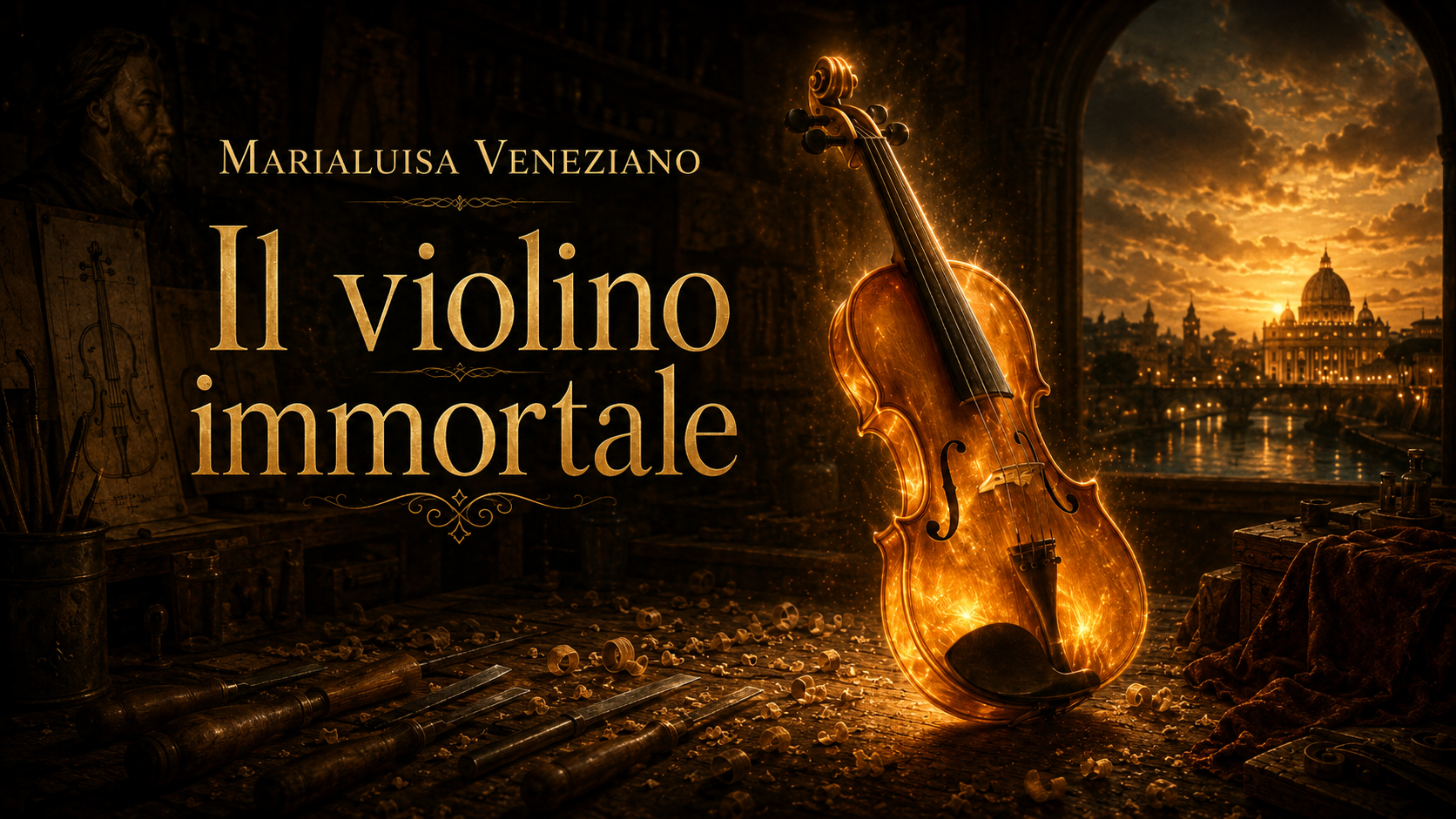
A fairy tale about time, memory and what makes us human.
by Marialuisa Veneziano
*********
🎧 Music for reading
Arvo Pärt, Spiegel im SpiegelFor violin and piano.
A music suspended between the passing time and what mysteriously remains. Click on the arrow, start the music and start reading.
Once upon a time, in the city of Valdombra, there was a violinmaker named Alvise, famous for the beauty of his violins and for the poor patience he showed towards those who played them.
His workshop smelled fir, maple, resin and hot glue. On the walls there were harmonical crates still without strings; on the tables rested piroles, bridges and arches; in the cabinets, the wooden boards waited for years to make them suitable for music.
Alvise knew every secret of his profession.
He knew that the fir-tree, light and elastic, had to form the harmonic table, because it welcomed the vibration of the ropes. He knew that maple, harder, was suitable for bottom and bands. He knew how to cut the two effes with such precision that they looked like thin eyes open to the world.

He even knew the soul of the violin: a small wooden cylinder hidden inside the instrument, invisible to the spectators but indispensable for the sound to vibrate with balance.
— It's curious. — the young apprentice told him one day — that the part called soul is exactly what no one sees.
— Important things often hide — answered Alvise.
It was a very wise sentence; however, he immediately forgot it.
The luthier wanted to build perfect tools. It did not tolerate an irregular vein, a drop of paint out of place or a scratch on the case.
When a violinist brought him a repair tool, Alvise observed it with horror.
— What did you do to him?
— I played it — The musician answered.
Alvise considered that very unconvincing explanation.
One morning an old violinist entered the shop. He brought an instrument that Alvise had built many years before. The paint was consumed near the handle, the edge had some chipping and on the harmonic table appeared a small wax spot.
— It's so bad! — exclaimed the luthier.
— He played very much. — answered the old man.
— I can remove the stain.
The violinist squeezed the instrument to the chest.
— That wax fell from a candle when my daughter was five. I played to make her fall asleep.
— I can delete it without a trace.
— That's why I won't trust you.
Alvise looked at him out with disappointment.
Men, he thought, spend their lives wanting perfect things and then, when they possess them, they become fond of their defects.
A few days later, the luthier heard of an extraordinary fir tree growing beyond the mountains. He was told that he never lost a branch, that the snow could not bend it and that no insect had ever affected his bark.
Alvise left immediately.
After three days of walking he reached a dense and silent forest. The tree was raised in the middle of a clearing.
It was very high, right and real. She didn't have a single dry leaf. No knots, cracks or scars appeared on the trunk.
Next to the fir-tree, an old man sat.
— Is this the tree that does not grow old? — asked Alvise.
— So they say.
— How long has she been growing here?
— Before my grandfather learned to lie.
— How old was your grandfather?
— I don't know. He's lying about that too.

Alvise caressed the bark of the tree.
— With this wood I could build a violin that lasts forever.
The guard pointed the branches.
— No bird ever made you the nest.
— They're too tall.
— Birds, I think, can fly.
— Maybe they're afraid to ruin them.
The old smile.
— Or they realized that certain branches cannot accommodate anything.
Alvise didn't listen. Men are very happy to accept the advice, as long as I confirm what they have already decided.
That night, without wind or storm, a great branch fell from the tree.
Alvise considered it a gift.
The guard considered it a warning.
The next morning, the luthier loaded the branch on a wagon and returned to Valdombra.
The wood was extraordinary. He did not deform with moisture, he did not sink with heat and showed no sign of time. However, it was difficult to work.
When Alvise tried to bend him, he was right. When he tried to season him, he was identical.
— It is stubborn — said the apprentice.
— Perfect. — answered the liuthier. — Only imperfect things can be changed.
Alvise spent seven years building the violin.
He cast the harmonic table, modeled the bottom, cured the bands, carved the effes and necked the soul. He chose amber-colored paint and stretched it so carefully that on the surface not even the shadow of a brush remained.
When the instrument was finished, it seemed made of light.
The most famous violinist in the city, master Evaristo, came to prove it.
He placed the violin on his shoulder, arranged the strings and swept the bow.
The sound was pure. The sharps shone, the bass were full and each note was born clear, precise, perfectly equal to itself.
— No resistance — Evaristo said.
— Because it has no fault — answered Alvise.
The musician acquired the violin for such a high sum that the violinmaker had to count the money three times, not for prudence but for pleasure.
For years, Evaristo played in the courts and large theatres.
The instrument was almost never forgotten, it did not suffer the heat, it did not fear the cold and did not preserve the sign of the hands.
Critics were excited about it.
One of them wrote:
«In its sound there is no trace of human fatigue.»
Alvise framed the review.
Evaristo, instead, began to get restless.
Each concert was impeccable, but identical to the previous one. The violin returned all the notes and did not seem to preserve any. It was not allowed to be transformed by the touch, tiredness, joy or pain of those who played it.
One evening, leaving the theatre, an old viewer said:
— The master didn't make a mistake.
— That's true. — answered the friend. — But I didn't think he had something to tell.
After some time, Evaristo sold the violin.
He bought him a young officer and took him with him during a war.
In the evening he played it for his companions in tents, hospitals and destroyed houses. His melodies reminded soldiers of mothers, brides, children and distant countries.
When the war ended, the officer returned to Valdombra.
The uniform was lace, the hair had become gray on the temples and a hand shook slightly.
The violin, however, was unchanged.
The soldier observed him for a long time.
— You were with us — he said — And yet you haven't been anywhere.
He sold it and bought a common tool, on whose bottom he engraved the names of the comrades who were not back.
The immortal violin then passed into the hands of a mother, who gave it to his son.
The boy wasn't a miracle. During the first lessons he produced so acute sounds that the cat moved spontaneously from the neighbors.
He studied with impatience, often forgot to tend the bow and once he dropped the instrument.
Her mother ran to pick him up.
There wasn't even a scratch.
— It's indestructible! — exclaimed the boy.
From that moment he sounded without fear. Over the years he learned to draw ever deeper melodies. He put the chin at the same point every day, he shook the handle with the same hand and passed the bow on the ropes for hours.
But the violin did not preserve any sign of him.
The boy still died young.
After the funeral, the mother took the instrument and sat next to the window. He sought on the paint the imprint of the fingers of his son, the sign left by the chin, a small abrasion, a stain, any trace of his passage.
The violin was perfect.
Looks like the kid never touched him.
The woman brought him back to Alvise, who had become very old.
— I don't want it anymore. — He said.
— But it's still intact.
— That's the problem.
— Your son loved him.
The mother caressed the wood smoothly.
— I thought he wouldn't lose anything. I didn't realize he wouldn't remember anything.
He left the violin on the counter and left.
Alvise remained silent for a long time.
That night a little girl went into the shop. He was wearing a poor, butchered violin. The bottom was smoothed, the tilted bridge and the paint almost completely consumed.
— Can you fix it? — He asked.
Alvise sighed.
— It would be easier to build a new one.
— But I want this.
— It's full of flaws.
The child indicated a small sign on the edge.
— My father hit him against a chair.

Then he showed a wax stain.
— My mother did this one night when she missed the light.
Finally he stroked the worn handle.
— And that's me.
Alvise took the immortal violin and gave it to him.
— Try this.
The girl put it on her shoulder and played a short melody.
The workshop filled with a perfect, bright and clear sound.
Then the child lowered the instrument.
— Don't you like it? — asked Alvise.
— It's beautiful.
— It's the best violin ever built.
The child returned it.
— But when I play, he doesn't know who I am.
— The violins know nothing.
— Then why does mine know the weight of my hand?
The luthier did not find an answer.
— I give you this. — He said.
The girl shook her head.
— I prefer mine.
— Your one day will break.
— Then I'll have to take care of it.
Alvise repaired the old violin without asking for money.
When the child came out, he remained only with the immortal instrument.
He took a knife and tried to hack a small line on the case. The sign disappears.
There was a drop of wax on the harmonic table. He slipped away.
He poisoned the violin to the fire. Wood didn't blacken.
Finally he took the bow.
Alvise knew every secret of the building, but he never really learned to play. His fingers embossed on the strings and produced some uncertain notes.
Then he remembered a melody that his mother sang to him when he was a child.
He played it slowly.
For a moment, the violin seemed to tremble. The sound was neither clear nor perfect. He was fragile, hesitant and human.
Alvise smiled.
When he lowered the instrument, he sought the sign of his chin on the wood.
There was nothing.
After the death of the violinmaker, the violin was taken to the museum of Valdombra.
Scholars tried to establish who built it and how old it was. But the wood did not have wear, the paint was intact and no owner had left an engraving or imprint.
In the end, under the roof, a tag was placed:
INCERTA
DISCOUNTS
Many years later, an old musician entered the museum, bringing a consunted violin and repaired countless times.
She was the girl who visited Alvise's workshop.
The edge still kept the sign of the chair, the harmonic table carried the wax stain and the handle was almost clear for the long passage of the fingers.
A young keeper observed it.
— Why not buy a better tool?
The woman stroked her violin.
— Because this knows all my music, even the one I don't remember anymore.
Then he started playing.

The melody wasn't perfect. Some notes trembled, others had the rough sound of aged wood. Yet, one after another, the visitors moved away from the skull of the immortal violin and gathered around the woman.
When she finished, a long silence remained in the hall.
The immortal violin still shone behind the glass. He had crossed loves, wars, departures and mourning without losing only one vein.
But no hand could have left him a caress.
No pain had given him a name.
No life had been able to dwell in him.
Living means letting yourself change. Those who claim to remain untouched can perhaps avoid wounds, but will also lose love, memory and everything that makes a life worthy of being remembered.


Leave a comment