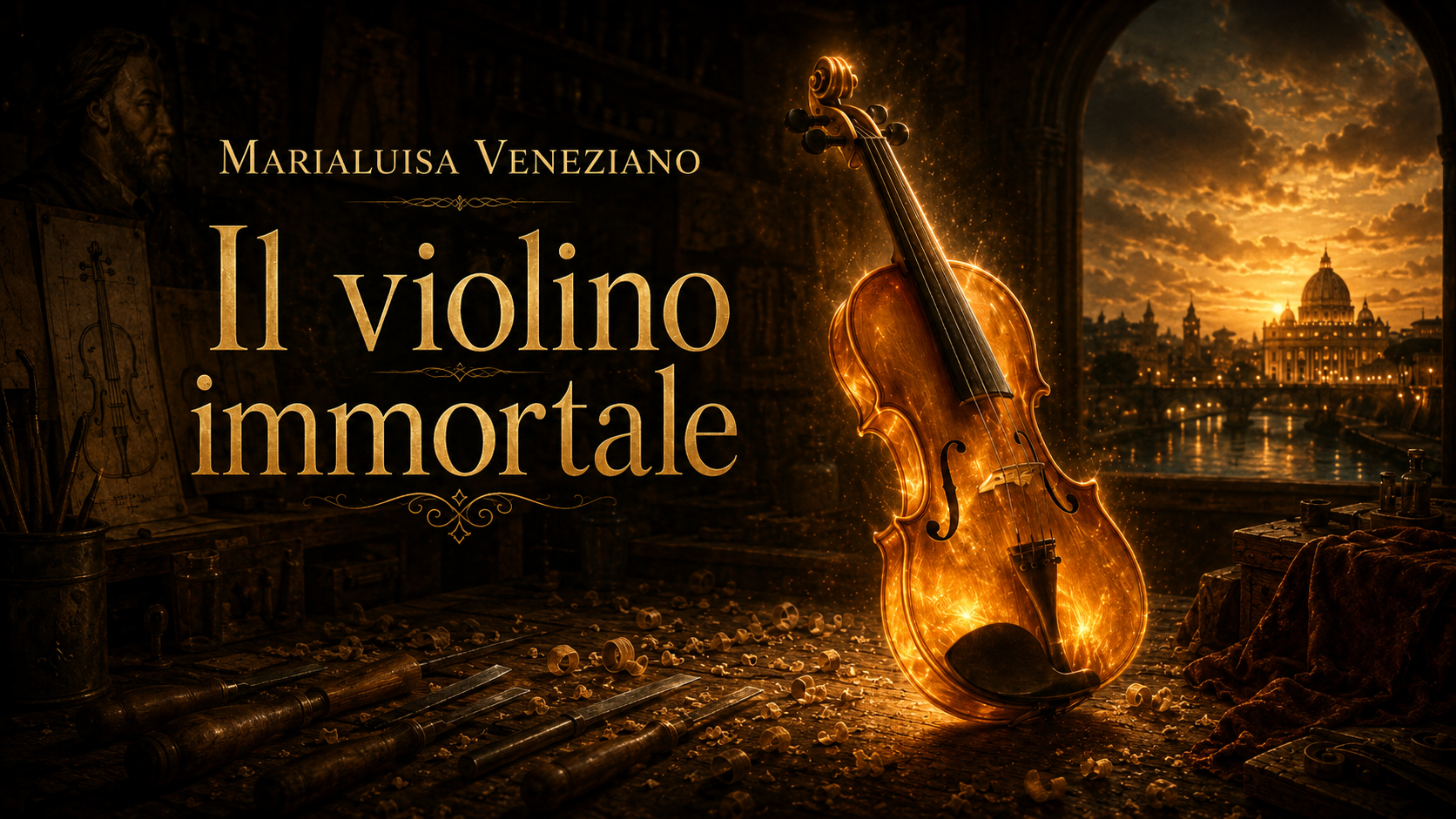
Year: 2026

  • The girl behind the curtain

    The girl behind the curtain

    Favola della notte in which Venice became a theatre.

    By Marialuisa Veneziano

    ************

    🎧 Music for reading
    To accompany The girl behind the curtain, we recommend listening to the Prologue, "L'Armonia", from the work The Ormindo by Francesco Cavalli, represented at the Teatro San Cassiano in 1644.
    A voice from the first Venetian musical theatre to follow Lucia behind the curtain, when the work began to open its doors to the city.
    Click on the arrow of the paragraph, start the track and immediately begin to read: music and fable will end almost together.

    Venice, in the winter of 1637, looked like a city built to deceive the eyes.

    The buildings floated on the water, the streets ended in the canals and people wore masks to show more freedom what they really were. At night, the lights of the windows broke on the lagoon and every gondola seemed to bring with it a secret.

    In a small workshop near San Cassiano worked Lucia, the daughter of a mask manufacturer.

    His father shaped papier-mâché faces for nobles, actors and ladies. He built smiles for sad people, severe noses for ridiculous men and innocent cheeks for those who had a lot to hide.

    — A good mask — he said, — You don't need to be someone else. It serves to find the courage to be yourself without being recognized.

    Lucia cut out fabrics, glued feathers and painted very thin eyebrows. He was fifteen years old and a curiosity his father considered together a gift and a disgrace.

    As a child he had heard about the shows organized in the palaces. Music, painted scenes, gods coming down from the sky, monsters emerging from the sea.

    But those shows were reserved for princes and guests.

    — Why can music only enter the palaces? — asked Lucia.

    — Because the rich believe that something becomes more precious when others cannot have it.

    Lucia watched the sun reflect on the channel.

    — Then the sun must be very poor.

    One morning there came an extraordinary news.

    In the San Cassiano Theatre, an open work was not only to guests of a court, but to anyone who could buy a ticket.

    It would be called Andromeda.

    The whole city began to talk about it. The nobles feared they had to breathe the same air as the merchants. The merchants hoped to sit next to the nobles to tell them they saw them yawn. Gondoliers already learned the melodies whistled by musicians during the tests.

    Lucia was hired as a helper behind the scenes.

    The first time he entered the theatre, he remained still.

    The stage was an unfinished world. There were painted columns that seemed to be stunned, clouds hanging on the ropes and waves built with wooden boards. Papers, carbides everywhere: they used to lift deities, change backdrops and make marine creatures appear.

    Lucia immediately realized that the theatre was the place where the truth was said using almost only fake things.

    He was wearing costumes, lighting them up and helping his father prepare the masks. He knew singers convinced that the world just ended up out of scene and musicians fighting for a note while the roof lost water.

    The oldest of the engineers was Bortolo.

    He knew every rope and every trap door. He knew how to fly a god without losing his wig and bringing the sun up even during a storm. But since new mechanisms came, no one listened to his advice.

    — Modern machines do everything by themselves — They said.

    — Even fools do many things themselves — Bortolo answered. — That's not why they work better.

    Among the financiers of the show was Messer Alvise Dandolo, an elegant nobleman, passionate about music and deeply distrustful towards ordinary people.

    — Art is like a gem — He repeated. — If he passes through too many hands, he loses his splendor.

    Lucia, who was carrying some masks, stopped.

    — A gem maybe. A song, on the other hand, grows every time someone remembers it.

    Messer Alvise observed it.

    — Who asked you to talk?

    — No one, sir.

    — Then why did you do it?

    — Because not always those who have something to say receive the invitation.

    The noble did not answer. He was used to the people who gave him reason and found disturbing what they offered him a thought.

    On the evening of the first, the theatre filled.

    There came nobles covered with velvet, merchants, strangers, artisans and young people who had spent almost all their savings to attend the show. They did not sit in the same places and did not pay the same price, but waited for the same curtain.

    Behind the scenes, however, the disaster reigned.

    The mask of the protagonist was broken.

    The car that was supposed to bring out the sea monster was blocked.

    Half the lights had turned off.

    And, even more serious, some strings that supported the bottom had been cut.

    — We have to cancel! — shouted the director.

    — I knew it. — said Messer Alvise. — A show for everyone could only end like this.

    Lucia examined the mechanisms. The knots had been dissolved by an expert hand.

    He saw Bortolo walk away in the hallway.

    He followed him to the warehouse.

    — Was it you?

    The old man didn't deny.

    — They wanted to replace me with those cars.

    — And you decided to destroy everyone's work?

    — I wanted to prove that without me the theater can't work.

    Lucia watched him for a long time.

    — If you need to make others incapable, you are not necessary. You're just a very experienced obstacle.

    Bortolo lowered his eyes.

    The protests of the public came from beyond the door. The curtain did not rise and someone had already begun to ask back the money, voice that in theater travels more and more quickly than music.

    Lucia took a large white cloth.

    — You can still help us.

    — After what I did?

    — I'm not asking you to pretend it didn't happen. I ask you to decide what to do with it.

    Lucia set the cloth at the bottom of the scene. Behind it he wore some light. With fabrics, rods and cardboard cutouts he built the silhouette of a huge sea monster.

    Bortolo observed the work.

    — The legs are too short.

    — Get them.

    — Your head won't be afraid.

    — Let her live.

    The old man took the ropes. His hands remembered what his pride almost destroyed.

    When the curtain finally opened, the audience saw an almost empty scene.

    Messer Alvise paleed.

    Then the music began.

    The instruments suggested the movement of the sea. Behind the cloth appeared waves of shadow. The monster grew up on the wall until it became larger than any machine built to represent it.

    A child in the audience shouted:

    — Here it comes!

    The mother tried to silence him, but by now the adults saw the creature.

    It wasn't real.

    Yet it was enough.

    The protagonist entered without the mask that had broken. For the first time the public could see his naked face: fear, breath, eyes facing Perseus.

    Sing.

    No ornament could hide the human being living in the character.

    Lucia, behind the scenes, moved shadows along with Bortolo.

    The machines didn't work, but the theater did.

    When Perseus freed Andromeda, the spectators held their breath. Nobles, merchants, servants and strangers forgot for a few moments the price of their place.

    No one had become the same as others.

    But everyone was looking in the same direction.

    At the end the curtain fell.

    For a few seconds there was silence.

    Then the theater exploded in such a strong applause that the masks hanging in the lab of Lucia seemed to tremble.

    Messer Alvise reached the girl.

    — Do you think they really understood the work?

    Lucia looked at the audience coming out.

    A gondolier imitated Perseus' song. A vegetable seller dries his eyes. The boy who cried moved his arms pretending to fight the monster.

    — They didn't understand the same thing. — He answered.

    — And you don't mind that?

    — No. Beauty is not an order. You don't have to get the same answer from everyone.

    — Then what should you get?

    Lucia smiled.

    — An open door.

    The next day, Venice only spoke about the show.

    The arias heard in the theatre passed through the shops, inns and gondolas. Some sang them well. Others turned them mercilessly. The composers would have preferred that everyone respected every note, but the music, once entered the streets, had begun to belong to those who misrepresented it.

    Bortolo returned to work. He taught young engineers what he knew, no longer hiding his secrets.

    He understood that knowledge does not lose value when it makes others capable. Only vanity needs pupils who remain small.

    Lucia continued to work behind the curtain. He did not become a famous singer or noblewoman.

    It became something more rare: a person capable of bringing beauty to others without pretending to appear at the center of the scene.

    And every time the theater opened the doors, it remembered the phrase of messer Alvise on the gem.

    Perhaps he was right: a precious stone, passing by hand in hand, could lose splendor.

    But the music was not a stone.

    It was a flame.

    And a flame does not become poorer when another light is lit.

    The preserved beauty for a few can make a magnificent palace; shared beauty can illuminate an entire city. The true value of art is not in separating those who own it from those who are excluded, but in creating, at least for an instant, a place where many different lives can look together in the same direction.
    Leave a comment

  • The world takes place in the audience

    The world takes place in the audience

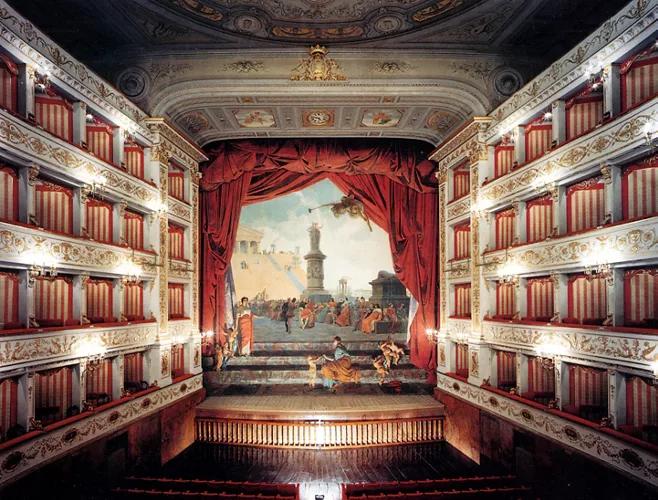
    The condominium theatres of central Italy enter the UNESCO World Heritage Site. Eight of the ten recognized rooms are Marches: the "region of theatres" rises on the stage of history.

    by Marialuisa Veneziano


    History has the defect, or perhaps the courtesy, not to always warn when it comes in. Don't knock, I don't ask for lights to light up. Sometimes it comes with the sober language of a deliberation, through a few lines destined to the archives; and yet, behind those lines, an entire land discovers that its name has just become a little larger.

    It happened on 26 July 2026.

    While the summer stretched out on the hills of Marche with its quiet air, almost convinced that nothing was too fast, in Busan, South Korea, the 48th session of the UNESCO World Heritage Committee enrolled in the World Heritage List "The system of Italian condominium theatres of the 18th and 19th century in central Italy".

    A compound phrase, almost austere. But inside there is an applause over two centuries.

    The UNESCO-recognized serial site includes ten theatres distributed between Marche, Emilia-Romagna and Umbria. Eight are the Marches: the Teatro Gentile da Fabriano, the Pergolesi di Jesi, the Ventidio Basso di Ascoli Piceno, the Serpente Aureo di Offida, the Teatro dell’Aquila di Fermo, the Lauro Rossi di Macerata, the Feronia di San Severino Marche and the Bramante di Urbania. The Teatro Angelo Mariani of Sant’Agata Feltria and the New Gian Carlo Menotti of Spoleto join them.

    The inscription, deliberated according to the UNESCO III criterion, recognizes in these buildings an exceptional testimony of the transformation of the theatre from aristocratic space to cultural and civil institution. With this result rise to sixty-two Italian sites listed in the World Heritage List.

    For one evening, therefore, the proverbial sobriety of Marche can afford the luxury to applaud standing.

    That building where civilization was built

    The word condo, it must be admitted, it does not today enjoy a particularly lyric reputation. Evoca administrators, thousandths, grondaies in discussion and assemblies in which humanity sometimes offers less noble evidence than those contemplated by UNESCO.

    Yet, between the eighteenth and nineteenth centuries, that term could designate a much more ambitious pact.

    Municipalities and private citizens — nobles, professionals, traders, representatives of the emerging bourgeoisie — They participated together in the construction of the theatre, supported its costs, owned its stakes and shared its management. Thus the theatre was born not only by the will of a ruler or by the magnificence of a court, but through a collective investment of the community.

    It was not yet cultural democracy as we would like to see it today. The poles kept social distinctions, the hierarchies settled on different orders and, in addition to the show, everyone willingly contemplated himself. The story, moreover, never proceeds with the nectity of the manuals: it advances for compromises, contradictions and closed doors.

    But one of those doors really opened.

    The theatre came out of the exclusive aristocratic domain and became a city institution, a meeting place, a representation and even a formation of public opinion. UNESCO has recognized precisely this passage: not only the beauty of the rooms, but the social idea that had created them. The condominium model, founded on the collaboration between public institutions and citizens, made possible the diffusion of theatres even in small and medium cities, transforming them into centres of cultural, economic and political life.

    Those buildings, therefore, were not simply containers of shows. It was citizenship laboratories.

    On the stage there were passions, crimes, loves and revolutions; in the audience, in the meantime, a new society learned hard to look at, to recognize itself, sometimes even to discuss itself. And it is not a small thing that the public consciousness has found one of its first dwellings right there where men pretended to be others: often the theatre says the truth by using a mask, while daily life is very good at lying without even bothering to wear one.

    An architecture that can hear

    The Italian theatre is not a building in which, fortunately, music is produced. It is itself a musical instrument.

    The plant, the superimposed orders of the poles, the curvature of the room, the relationship between scene and plate, the reduced, the foyer and the ancient scenic apparatuses make up a true architecture of listening. Each element organizes vision, governs distance, collects and distributes sound. UNESCO emphasizes the attention reserved to acoustics and visibility, together with the presence of common architectural features, mainly linked to Neoclassicism, but still crossed by late Baroque influences.

    Before the orchestra agrees, the room has already chosen its stamp.

    The stakes placed vertically seem the voices of an agreement; the audience is the foundation; the stage opens the unstable area in which the order can turn into drama. The viewer looks at the scene, but also sees other spectators: he listens to music and, at the same time, takes part in a community gathered by listening.

    In these theatres opera found a capillary network through which to reach cities and villages. The crescendo of Rossinian, the long bellinian melody, the theatrical nerve of Donizetti, Verdi's word lit were able to circulate far beyond the great centers, penetrating the living fabric of the provinces. Before Italy became fully a political nation, the melodrama had already taught her a common vocabulary of passions, conflicts, sacrifices and freedom.

    The province, in this system, was not suburbs. It was blood circulation.

    Le Marche, a region built in the form of theatre

    Recognition would be important for any territory. For the Marches, however, has a particular force, almost the precision of an agreement finally resolved.

    This land is not organized around a single dominant city. It lives of large, small and very small centres; of villages lying on the heights; of communities that for centuries have defended their identity with tenacity. In this plural geography, the theatre became the place where each city could publicly pronounce its name.

    Alongside churches and civic palaces, ornate halls, stages, waiters, foyers rose. Not for decorative whims, but because a community that built a theater declared it wanted to be something more than a set of houses. He said he had a memory, imagination and a future.

    The Marches preserve a network of sixty-two historical theatres and a theatrical density, related to the population and the number of Municipalities, which has no equal in the Italian territory. Not all are formally part of the UNESCO serial site: the award covers ten theatres, eight of which are Marches. But the light that is now on those eight rooms inevitably illuminates the entire regional constellation.

    The Pergolesi, the Lower Wind, the Aureo snake, the Eagle, the Lauro Rossi, the Feronia, the Gentile and Bramante are not eight isolated monuments. They are the usual voices of a much larger choir.

    And this is perhaps the most beautiful victory: UNESCO has not rewarded the greatness of a capital, but the cultural tenacity of communities. He acknowledged that beauty can also become public in the centers away from the metropolis; that culture does not belong only to the places where power is concentrated, but also to those in which men decide to build together a space for listening.

    UNESCO is not a funeral crown

    It is at this point, just as the applause grows, that it is necessary to ask him to stop for the time of a breath.

    For every authentic feast bears with it a responsibility; and such a solemn recognition would risk taking a bitter irony if it celebrated as a living heritage what, in daily life, is left slowly to die.

    Alongside the large theatres with regular seasons, too many historic Marche theatres remain closed, inactive or entrusted to an occasional opening. Others are only on for a few appointments a year, devoid of continuous programming, stable staff, adequate resources and an artistic project able to really return them to the communities.

    We saved the stucco, but we risk losing our voice. We have restored the stakes, but we don't always let you back the public. We defended the facades from time, while silence, much more patient than moisture, continued to work inside.

    It must be said without celebratory attenuation: a restored theater is not necessarily a live theater. Open it once a year for a guided tour is not equivalent to living it; lighting the lights for a ceremony does not mean giving it back to the city; hosting some summer events does not replace a season thought, recognizable, capable of forming an audience.

    A theatre lives when the curtain rises regularly. When it offers work to artists and technicians. When he welcomes orchestras, companies, schools, conservatories, associations and young interpreters. When a child enters for the first time and understands, perhaps without knowing yet, that beauty is not a luxury reserved for adults or big cities.

    It is precisely the continuity of the theatrical function to constitute one of the essential elements recognized by UNESCO. The decision also recalls the need to involve local communities in the daily heritage management. This is not an accessory recommendation: these theatres were born through the participation of citizens and only through a new participation will survive.

    The recognition of 26 July must therefore become a reprimand for the institutions. It is not enough to finance the restorations: management, maintenance, personnel and especially programming must be supported. It is not enough to promote cinemas photographically: you have to fill them with shows. It is not enough to call them "cultural requirements" in the official speeches, if then, after the speeches, turn off the lights and close the door.

    The same regional cultural programming indicates among the objectives the support for fruition, integrated management, residential activities and the relationship between small theatres, conservatories and subjects of live show. This is where it is necessary to share: transforming the intent into calendars, projects into openings, resources into continuous cultural work.

    Municipalities must also be put in the conditions of collaborating, overcoming fragmentation and building a real regional network: shared productions, artists' circuiting, musical and theatrical residences, school projects, common ticketing, cultural itineraries. Sixty-two isolated theatres are likely to be sixty-two fragility; linked together they can become one of the most extraordinary cultural infrastructures in Europe.

    And a responsibility also belongs to the public. The theatres are not only saved by funding, but they cannot be abandoned by a few volunteers. They need citizens who frequent them, schools who know them, young people who feel their own. Culture is a right; but, like all the rights they want to remain alive, also ask for participation.

    UNESCO does not become a golden plate on a closed door. It is not the prestigious certification of a greatness spent, neither — worse — a funeral crown laid on beauty while it is still breathing.

    An extinguished theater is not a monument to rest. It's a betrayal promise.

    For this reason the recognition must mark the beginning of a new season: not only more visitors, but more shows; not only tourism, but cultural production; not only memory, but work, study, education and future.

    Otherwise we will have got the privilege of being admired from the world just as we stop listening to ourselves.

    An applause for the future

    On 26 July there was not simply an institutional path promoted by the Marche Region together with the Ministry of Culture, with the participation of Emilia-Romagna, Umbria and the Municipalities involved. It opened a new time.

    It's fair to celebrate. It is right to light the chandeliers, open the doors, tell this story to the boys, invite the audience to enter. It is right to thank those who have built the candidacy, scholars, administrators, restorers, technicians, artists and all the people who, often far from the spotlight, continued to believe that a provincial theatre was not a luxury of the past, but a necessity of the present.

    Above all, it is right to recognize the merits of the communities that have preserved these places over the centuries. The stones are not preserved by themselves. Velvets do not resist spontaneous devotion. Every heritage that has come to us is the result of someone who, at a time often difficult, decided not to abandon it.

    This time recognition not only celebrates what the Marches possess. It celebrates what the Marches are: a plural, laborious, discreet land; a region that has scattered theatres among hills, squares and villages because it has never considered beauty a privilege reserved to capital.

    But on July 26 it will really be a historical date only if, after the applause, someone will return to open all those doors.

    The world took place in the audience.

    He looked towards these small and great cities of central Italy and recognized in them a universal history: that of men and women who, putting together resources, ambitions and hopes, decided to build not only a building, but a space in which a community could imagine itself better.

    Now the lights go down. The caterpillar is silent.

    The curtain does not fall: it rises.

    And for the Marche region of the theatres, the story begins right from here.

    Leave a comment

  • When Verdi burns time

    When Verdi burns time

    The Finder at the Sferisterio of Macerata (MC) between the orchestral color of FORM and the ghosts of memory

    by Marialuisa Veneziano

    In the refurbishment of Francisco Negrin, taken up by Angela Saroglou, the Verdian masterpiece becomes a tragedy of time. Dmitri Jurowski and the FORM-Orchestra Filarmonica Marchigiana preserve its current obscurity, while voices attempt in vain to escape a past that has already taken possession of the future.


    The night at the Sferisterio seems to begin before the sky. It gathers against the large wall, follows its immense surface, penetrates into the corners of the stage and remains motionless, as if it waited not the beginning of a show, but the return of something that for a long time has no peace. When the first figures flow from the dark, one does not have the impression that they are entering the scene: they seem rather returned, for a few hours, to a story that has not yet finished using them.

    The first character of the FinderIt's not Ferrando, it's not Leonora, it's not the Count of Luna. It's the past. He does not have his own voice, yet he speaks through all voices; he does not hold arms, yet he prepares every crime; he does not appear in the inn, but governs the work with the silent authority of those rulers who do not need to show themselves why no one dares disobey.

    On the stage, two long black structures cross the space. At first glance they might look like tables, walks, boundaries; maybe they are all these things together. They run parallel, without ever joining, and force the characters to advance and reverse along an already established direction. They seek, pursue, promise one tomorrow; but every step of them seems to lead them back to what they would want to escape. In this geometry created by Francisco Negrin and resumed by Angela Saroglou, fate does not fall from above, as in ancient tragedies: it was built by men and then left in inheritance to their children. Who had come to the Sferisterio waiting for medieval Spain, with its towers, encampments, armours and all that dignified system of ironwork to which the romantic work has generously accustomed us, could on the first to believe that something is missing. But it would be a short impression. The walls did not disappear: they entered the characters. The war does not occupy the scene: it crosses its consciences. As for the fire, when it finally turns on, it immediately appears clear that it was not called to warm the eye.

    In the Finder the future does not come: damp. It has already been delivered to the flames before someone can live it.

    The story, as it is known, brings with it an almost bulky reputation as its music. For more than a century and a half it is accused of being obscure, inverosimile, intricate to the point that, to tell it without losing a child, to confuse a mother or unintentionally resurrect a dead person, a family register would seem necessary, the acts of two trials and the patience of a notary immune from dizziness. There are two brothers who do not know that they are, a kidnapped child, another thrown into the fire by a frightening mistake, a mother burned alive and a guarded revenge for so long that she had finished, as often happens to the very devout sellers herself, to assume the most respectable name of justice.

    It would be easy to liquidate all this with a smile; and it is precisely therefore that many have done so. Indeed, when it belongs to the misfortunes of others, it is increasingly easier to recognize. Green, however, does not ask the viewer to believe the probability of the facts: the question of recognizing the truth of their effects. Because an event can be exceptional, even absurd, and yet generate terribly common feelings: hate transmitted as an inheritance, love confused with possession, pain that, not finding consolation, seeks a guilty; and finally the children called to weld debts contracted before their birth.

    Almost everything that decides the fate of the protagonists happened before the music begins. The work opens when the catastrophe has already taken place, but no one fully knows its shape. Ferrando sends a story received from others; Azucena tells what he saw and what trauma forces her to review; Manrico seeks himself in the words of a mother who loves him and, at the same time, binds him to his obsession; the Count of Moon fights against an enemy without knowing that in him the same blood flows. Leonora, alone among all, attempts to stop that long administration of hatred. But the truth comes to her when she can no longer save: she can only illuminate the ruin.

    Nobody, in this work, is entirely where he thinks he is. No one knows enough of his past; no one receives the future he had imagined. Everyone comes a moment after the revelation that could change their lives. The real protagonist of Finder, therefore, is not the finder. It is a memory that ceased to guard and became command; an ancient creditor who perhaps lost the documents, but not the address of the descendants.

    And it's so late. — before even from weapons, from flames and blood — that the green tragedy receives its most terrible light.

    THE ANTICA FORMA AND THE NEW URGENCE

    When The Founder On 19 January 1853, Giuseppe Verdi had already recorded many of the certainties on which the Italian melodrama had built its fortunes. Rigoletto had appeared less than two years before; La traviata She would have been on stage a few weeks later. The posterity would bring together the three titles under the formula, comfortable and now inevitable, of "popular trilogy"; but in the three works there is not a single mold, but a common impatience towards everything that in the theatre had become habit without being needed.

    Just the Finder, between the three, it was sometimes judged the most tied to the past. There are the great two-part arias, choirs, caballets, concerted, that succession of moments that musicology defines "usual form" and that some criticism, eager to find progress only where the scaffolds are demolished, exchanged for a retreat. He's a curious misunderstanding. Verdi does not preserve those forms so that he can not get rid of it; he keeps them because he understood that in this history the form itself can become destiny.

    The cantabile gives the characters the illusion that time can stop; the cabal breaks that grace and reopens the wound of events. "Ah yes, well mine" shows the man that Manrico would like to be, "of that apira" brings him back to war; "Tacea la notte placida" makes the memory a refuge, "Di così amor che dire" converts it into decision. "The balen of his smile" even gives a soul to the Count, without fulfilling it.

    The score therefore lives on oppositions: immobility and race, explained chant and hammering rhythm, intimacy and collective violence. Its famous energy is not only the amount of memorable melodies, but the way they are placed against each other. Verdi lights up the vocal line on sometimes essential accompaniments, even dismissals; it puts on music a pulsation that does not give the characters the time necessary to understand. The debated figures, military calls, the ribbing of the brass and percussions are not limited to coloring the war: they introduce the law into human relations.

    The highest point of this dramaturgy is Mixing. On the one hand the choir of religious, severe and impersonal; on the other Leonora, alone with his own terror; far, almost removed from the visible space, the voice of Manrico. Three sound planes coexist without confusing: rite, individual pain, announced death. We are no longer in front of an air, nor a set in the usual sense, but to an authentic theater of simultaneity. What happens, what is feared and what is already lost sound at the same time. Long before the 20th century, Verdi had already understood that the theatrical time can be divided without stopping being one.

    The exhibition conceived by Francisco Negrin for the Macerata Opera Festival in 2013, redesigned in 2016 and today entrusted to Angela Saroglou, meets this musical structure without attempting to illustrate it. It does not show us what the booklet appoints; it makes visible what music hides. The scenes and costumes of Louis Désiré give up the picturesque and concentrate the entire universe of the work in a few elements: two tables, a tower, a catwalk, seven lamps, the dark and the fire. Few, he will say; but also a sentence is made of few words, and not for this it weighs less. The two black tables run the stage for about seventy meters. One runs on the right side and in the front; the other, placed on the left side, retracts from the first. The center is parallel. Their outer sides are now illuminated by white, red time, as if the time itself had a secret circulation, capable of cooling in light or lighting in blood. The right table represents the future: not an open place, but a line already outlined. On the opposite side, close to the large bottom wall, rises a black square tower. It is accessed through a lateral opening; it is the point in which past and present come together, and therefore the place from which no one really comes out. The ghost of Azucena's mother lives there, the gypsy led to the stake. Along the wall there is also a walkway that crosses the entrance of the tower: on it the protagonists advance and reverse, as creatures persuaded to walk towards tomorrow while

    Black, white and red are almost the whole palette. Black belongs to mourning and to a night that seems to have no morning; white to ghost faces, to death become presence; red to ties, veils, flames and to all that characters believe passion when it is already condemnation. The lights of Bruno Poet, filmed by Marc Heimendinger, do not just make the bodies visible: they establish at which time they belong. The large wall of the Sferisterio, left naked, thus stops being a backdrop and becomes the surface on which the memory projects its debts. Saroglou preserves the severity of the project without embalming it and reasserts it to the new interpreters. Leonora is not a disputed award, but the only creature able to choose in the present against the law of ghosts. The direction mainly includes that Leonora is not a disputed prize between two men, nor the luminous ornament of a story dominated by warriors and sold. It is the only creature that understands the possibility of subtracting from the law received. He loves in the present, chooses in the present, attempts to save a man not for what he represents, but for what he is. If it fails, it is not because his love is weak: it is because it comes to a world in which all others have already promised obedience to their ghosts.

    Such an essential scene gives the music a greater responsibility. When the eye is not distracted by abundance, the ear no longer has alibi; and in Finder, that a bad habit can easily reduce to an anthology of famous arias connected by some opportune misfortune, the quality of the concertation decides whether the drama should advance or simply follow.

    Dmitri Jurowski addresses the score with control, clarity and evident attention to the overall hold. Its direction avoids both the military emphasis, which makes rough what should be incalciating, and the lyrical satisfaction, which risks transforming the cantables into decorative supports. It holds together stage, choir and hole in the vastness of the Sferisterio, where distances also test the best intentions and precision, before even becoming aesthetic virtue, is a material necessity.

    The FORM- Orchestra Filarmonica Marchigiana responds with discipline, compactness and theatrical sensitivity. It would be unfair to consider it a simple presence in the inn: it is the connective fabric of the show, which allows the different temperatures of the score to belong to the same night. The attacks keep clear; the overall pages find cohesion; the accompaniment supports the voices without covering the word. Above all, the orchestra can change function: it is step in the marches, blade in the rhythmic shots, brace under the confessions of Azucena, breath when Leonora's singing demands space. This aspect deserves attention, because the green orchestra is not yet, in Finder, the great symphonic-dramatic organism of the works tarde; yet it is not at all a helpful accompanying machine. He comments less than he does. Prepare the shocks, put a direction in time, reveals in rhythm what the characters try to hide in words. The FORM makes it perceptible to function without inflating sound, keeping that transparency that allows the vocal line to remain the main place of truth.

    Precious Choir Relic Marchigiano "Vincenzo Bellini", prepared by Christian Starinieri: the Gypsies avoid folklore and become a multitude of spectra, while hammers and incudins forge destiny and condemnation. Sauce compactness, precision and projection. The AMS–Helvia Recina Ensemble builds the spatial depth that in Mixing becomes dramaturgy.

    THE VOCI, WHERE THE DRAM DECEMES THE TRUE

    It is handed down to The Founder the four best singers in the world. The statement, attributed with the usual generosity to at least a few great tenors, contains an exaggeration and a truth. The exaggeration is evident: the world is vast and rarely its four best singers have the courtesy of being free in the same evening. The truth is that Verdi entrusts to the four protagonists very different and equally demanding scriptures, in which the technique cannot be separated from the character without the entire construction losing credibility.

    Marta Torbidoni offers a Leonora accomplished: brightness, mobility, tied and musical thought weld belcanto and green weight. "Tacea la notte placida" comes from a silence really listened; in "D'amor sull'ali rosee" the sound becomes thin without losing substance, as a prayer now uncertain of being accepted. Agility becomes will, making Leonora the morally more free character.

    Sofija Petrović puts Azucena in the dark centre: a broad and brunito stamp, severe sustained and richness of light remove it to the left effect. In "Stride la vampa" does not tell the trauma: it falls inside. With Manrico, a motherhood contaminated by revenge. Petrović makes audible the crack between mother, daughter and involuntary murderer of his child.

    Haiyang Guo faces Manrico with frank stamp, focused emission and musicality. In "Ah yes, well mine" find vulnerabilities; The "of that apira" is governed with prudence more than hurled like an ordigno. The famous acute do, popular court son of tradition more than the page, does not sum up the character. You want a more engraved word, but the evidence grows.

    Vito Priante gives the Count softness and authority, without reducing it to the necessary bad. "The balen" discovers the wounded man under pride: evil, in Verdi, is not a mask, but often a pain ruled badly. The line acquires nobility; some acute tension does not compromise a coherent and human figure.

    Dongho Kim, round Ferrando, homogeneous and well projected, returns to the initial account the weight of the horror portal. Alessia Camarin gives freshness to Ines; Simone Fenotti is a Ruiz participant; Mauro Sagripanti successfully completes the company as put.

    This Finder convinces because it does not claim to make Verdi present by overlapping the topicality. You do not need to add chronicles, occasional symbols or preventive explanations. It liberates, rather, the contemporary force already contained in the work: the guilt that passes through generations, the memory transformed into identity, the pain that prefers revenge instead of knowing oneself. The nineteenth century forms, with their returns, symmetries and repetitions, become the very model of obsession. Extreme vocality is not an athletic performance, but the measure of passions incapable of tone means.

    When the last flame is lowered and the big wall returns to be stone and night, the question remains. It is no longer just about Azucena, Manrico or the Count of Luna. It concerns every pain which, not knowing how to burial, we continue to offer descendants; every memory we say to guard while, in secret, it is she who guards us.

    The theater, when it is big, does not deliver a moral ready. It does something less comfortable: it takes away an alibi.

    And it is then that the fire of Negrin, Saroglou and Désiré stops being scene. It illuminates the public for an instant; and, with that light, it begins to concern us.

    Macerata Opera Festival 19 July 2026 – The Founder

    Four parts. Libretto by Salvadore Cammarano, completed by Leone Emanuele Bardare. Music by Giuseppe Verdi.

    Photo credits: Macerata Opera Festival

    Leave a comment

  • The castle without eco

    The castle without eco

    A musical fairy tale about memory and the courage to listen.

    By Marialuisa Veneziano

    ************

    🎧 MUSIC FOR LETTURE
    To accompany The castle without eco, we recommend listening to Prélude à l’après-midi d’un faune by Claude Debussy. About ten minutes in which the sound seems to be born from afar, appear and dissolve, as if each sentence leaves behind a trace impossible to grasp. From the famous entry of the flute, Debussy's music proceeds through colors, suspensions and calls: it does not tell, suggests; it does not define, lets resound.
    It is the ideal listening to enter the Castle, where the true mystery is not only what you feel, but what should come back and silence. As in the fairy tale, Debussy also seems to ask how far a sound really disappears, when something he continues to live in the memory of those who listened to it.
    Click on the arrow of the logo "cuffie", press play and start reading.


    Once upon a time, on the top of a hill surrounded by beech woods, a castle so great that no one had ever been able to count all its windows.

    He had thin towers, slate roofs, paved courtyards and long corridors in which one hundred people could walk side by side without venting.

    Yet that castle had a very strange peculiarity.

    He had no echo.

    If someone beat their hands in the throne room, the sound died immediately.

    If a lady laughed under the vaults of stone, her laughter did not go back.

    Even the bells, which on serene days should have been heard to distant villages, produced short and opaque intones, as if they were wrapped in wool.

    The king, who was called Theodore the Risoluto, considered all this a fortune.

    — Educational people — he said, — They never repeat what they have already said. I don't see why the walls should.

    The courtiers nodded, as the courtiers often do when they did not understand anything but wish to keep their lunch.

    In the castle lived Princess Eliana, daughter of the king.

    Eliana was twelve years old, dark hair, careful eyes and the annoying habit of asking questions just when adults preferred not to answer.

    He loved music more than anything.

    He studied the flute with the old master Isidoro, who taught her that a sound was born from a vibration and travels in the air as a small invisible wave.

    — When he meets a wall — I'll explain. — can be absorbed or go back.

    — Like a person when it's not accepted?

    The master remained silent for a few moments.

    — More or less — he finally said. — But the walls are generally less complicated.

    Eliana also learned that echo was not exactly the same as resonance.

    The echo repeated a sound after a short interval. The resonance, however, welcomed it, amplified it and made it last longer.

    In a good concert hall, the notes should not vanish too soon or be confused with each other. They had to have time to be born, live and then turn off.

    In the castle, however, nothing happened.

    The sounds just fell out of the instruments.

    — It's like the castle was afraid to remember — once said Eliana.

    Master Isidoro lowered his eyes.

    — Castles are not afraid.

    — What about the men?

    — Men build castles just to hide their fears.

    After saying those words, Isidoro closed the score and declared the lesson 20 minutes in advance. It was the usual method of adults when they realized they had told the truth.

    One autumn night Eliana woke up suddenly.

    The wind was shaking the windows and the rain was beating on the windows. In the fireplace, the fire almost turned off.

    It was then that the princess heard three flute notes.

    They were subtle and distant notes.

    First saliva.

    The second one was suspended.

    The third seemed to look for something he couldn't find.

    Eliana rose from the bed.

    The notes came from the northern part of the castle, where a tower was closed for many years.

    Waiting.

    The melody did not continue.

    The next night, at the stroke of midnight, the three notes returned.

    This time it was five.

    The first were the same; the other two formed a small musical phrase, but they interrupted just when they seemed at the point of ending.

    Eliana knew that feeling well.

    Teacher Isidoro explained to her that an incomplete musical phrase generates tension. The ear awaits a note capable of bringing back balance, just as one expects the end of a question.

    But that answer never came.

    The princess went to her father.

    — In the northern tower someone plays the flute.

    King Theodore, who was signing a decree against the excessive growth of weeds, broke the pen.

    — It's the wind.

    — The wind does not always sound the same notes.

    — This is an ordered wind.

    — And why does he always stop at the same point?

    — Because it is also respectful of times.

    Eliana fixed it.

    — Can I get into the tower?

    — No.

    — Why?

    — Because it's closed.

    — And why is it closed?

    — Because nobody has to come in.

    — And why should no one come in?

    The king rose.

    — Because I am the king and I have exhausted the "because" available for today.

    That night the melody returned again.

    Seven notes.

    Then nine.

    Every night it became longer and more restless. Sometimes it seemed like a song; sometimes a prayer. But it always ended before the last note.

    Eliana began to ask questions to the inhabitants of the castle.

    The cook said he knew nothing and poured salt into the cake instead of in the soup.

    The ruler said that the tower was uninhabited, but the sign of the cross was made.

    The bellman claimed to be deaf for many years, although he heard very well when someone talked about his pay.

    Finally, Eliana interviewed the gardener, a very old man who knew the history of every tree.

    — What is in the northern tower?

    The gardener continued to prune a rose.

    — The dust.

    — And under the dust?

    — Other dust.

    — And under the other powder?

    Man sighed.

    — A memory the king tried to lock up.

    — What memory?

    — It's not up to me to tell.

    — Who's up to?

    — Who will have the courage to listen to him.

    The next day, as he walked out of the walls, Eliana met a blind beggar. The woman sat next to a fountain and held a small drum on her knees.

    — Princess — he said without raising his head.

    Eliana stopped.

    — How do you know who I am?

    — Important people walk as if the road belonged to them. You walk like you want to know where he leads.

    The child smiled.

    — Do you know the northern tower?

    The beggar beat a finger on the drum. The sound spread in the square and slightly returned from the houses.

    — In your castle the echo did not die — He said. — She was imprisoned.

    Eliana sat next to her.

    The woman told that many years before, when the queen was still alive, a young musician worked at court. His name was Lorian and he played the flute with so sweet that, when he played a melody, even the curtains seemed to move to listen to him.

    During the long illness of the queen, Lorian composed a song for her.

    It wasn't sad music. He was talking about the beloved things that continue to live in the memory of those who remain.

    The queen died before the song was finished.

    The shocked king ordered no one to play it again.

    He locked in the tower the flute, the incomplete partition and every object belonging to the queen. He saw the courtiers say their name and forbid the musicians to perform melodies that could remember it.

    — He thought, if no one talked about the pain, the pain would disappear. — said the beggar.

    — What about?

    — Pain is a very rude guest. If he doesn't open the door, get in the basement.

    From that day the castle had stopped returning the sounds.

    — Why?

    — Because the echo is memory. And a house to which it is forbidden to remember ends up not answering anyone anymore.

    Eliana returned to the castle.

    For three days he sought the key to the tower.

    It was made in the cases, in the cabinets and in the drawers of the royal wardrobe. He eliminated the pockets of his father's coats while he slept during the Council meetings, a habit that the king called "strategic meditation".

    He eventually found the key hidden in the old metronome of master Isidoro.

    The master surprised her when she opened it.

    — You shouldn't.

    — Did you know everything?

    Isidore sat slowly.

    — I played in the orchestra when the queen was alive.

    — Why didn't you tell me anything?

    — For fear.

    — My father?

    — Also. But above all to remember.

    Eliana took the key.

    — I will enter the tower.

    — The king will forbid you.

    — Then I'll go in before I have time to do it.

    That night a storm fell on the castle.

    Eliana crossed the corridors with a candle. His steps, as always, did not produce echoes.

    He reached the northern tower and placed the key in the lock.

    The door opened with a moan.

    The scale spiraled into the dark.

    At every step, Eliana had the impression of hearing something: a breath, a word, perhaps a cry. But as soon as he stopped, everything was silent.

    On top he found a round room.

    In the middle there was a lemur with a yellowed score. A silver flute rested on a table.

    The walls were covered by veiled portraits.

    Eliana lifted one of the cloths and saw the face of his mother.

    He never knew her. The king had shown her only a small official portrait, in which the queen appeared still and severe.

    In that of the tower, instead, he laughed.

    Eliana took the flute.

    The three notes of the melody sounded alone.

    Then three more.

    Finally, the whole sentence that was interrupted every night.

    The last line was missing on the score.

    Eliana brought the instrument to the lips and tried to continue.

    It sounded too high.

    The walls trembled.

    Somewhere in the castle a door was heard and, for the first time after many years, the noise returned.

    Eliana tried again.

    This time the note was too low.

    From the walls there were confused voices: names, laughter, words that someone had pronounced long before.

    The castle was returning what he held.

    The princess tried a third time.

    At that time the tower door opened.

    The king entered, followed by master Isidoro.

    — Stop! — shouted.

    His voice bounced on the walls.

    «Stop... stop... stop...»

    The king paleed.

    — If you complete that music, everything will come back.

    — What?

    — The pain.

    Eliana lowered the flute.

    — Pain never left.

    The king looked at the portrait of the queen.

    — I wanted to forget.

    — You only forced everyone to remember silently.

    — You don't understand.

    — Maybe not. But you haven't understood for many years.

    Eliana observed the score.

    Then he thought of the incomplete musical phrase. Every sound needed to find its place. Not always the right note was the most beautiful or the strongest: it was able to make sense to all the preceding.

    He brought the flute to his lips.

    The last note.

    Nothing happened for a moment.

    Then the note returned.

    First weak, like a whisper.

    Then clearer.

    Finally a hundred times, from every wall, from every staircase, from every room.

    The bells started ringing.

    The steps of the guards filled the corridors.

    From the kitchens came the titinnium of the pots and the voice of the cook, which for the emotion climbed again the cake.

    People pronounced the names of those who had lost. Somebody laugh. Someone cried.

    The king heard the melody for the queen.

    At first he remained still.

    Then a tear passed through his face.

    Of course, the next day he declared that there was a lot of dust in the tower. Kings can recognize pain, but admitting a mistake often requires a more robust constitution.

    The northern tower was no longer closed.

    The flute remained in the room, next to the portrait of the queen. Every year Eliana performed the complete melody.

    The castle regained its voice.

    The bells were heard to the villages. The laughs ran under the vaults. Even the smallest steps left behind a brief answer.

    Since then no one was more forced to forget what he loved.

    And when someone suffered, others didn't tell him to shut up or be strong.

    They sat next door.

    And they listened.

    What is not heard does not disappear. He remains within us until he finds a voice capable of freeing him.

    An answer to "The Castle Without Echo"

    1. Avatar saladclearly 9723
      saladclearly 9723

      The castle without eco is a fantastic musical fairytale!!

    Leave a comment

  • Legend of the immortal violin

    Legend of the immortal violin

    A fairy tale about time, memory and what makes us human.

    by Marialuisa Veneziano

    *********

    🎧 Music for reading
    Arvo Pärt, Spiegel im SpiegelFor violin and piano.
    A music suspended between the passing time and what mysteriously remains. Click on the arrow, start the music and start reading.


    Once upon a time, in the city of Valdombra, there was a violinmaker named Alvise, famous for the beauty of his violins and for the poor patience he showed towards those who played them.

    His workshop smelled fir, maple, resin and hot glue. On the walls there were harmonical crates still without strings; on the tables rested piroles, bridges and arches; in the cabinets, the wooden boards waited for years to make them suitable for music.

    Alvise knew every secret of his profession.

    He knew that the fir-tree, light and elastic, had to form the harmonic table, because it welcomed the vibration of the ropes. He knew that maple, harder, was suitable for bottom and bands. He knew how to cut the two effes with such precision that they looked like thin eyes open to the world.

    He even knew the soul of the violin: a small wooden cylinder hidden inside the instrument, invisible to the spectators but indispensable for the sound to vibrate with balance.

    — It's curious. — the young apprentice told him one day — that the part called soul is exactly what no one sees.

    — Important things often hide — answered Alvise.

    It was a very wise sentence; however, he immediately forgot it.

    The luthier wanted to build perfect tools. It did not tolerate an irregular vein, a drop of paint out of place or a scratch on the case.

    When a violinist brought him a repair tool, Alvise observed it with horror.

    — What did you do to him?

    — I played it — The musician answered.

    Alvise considered that very unconvincing explanation.

    One morning an old violinist entered the shop. He brought an instrument that Alvise had built many years before. The paint was consumed near the handle, the edge had some chipping and on the harmonic table appeared a small wax spot.

    — It's so bad! — exclaimed the luthier.

    — He played very much. — answered the old man.

    — I can remove the stain.

    The violinist squeezed the instrument to the chest.

    — That wax fell from a candle when my daughter was five. I played to make her fall asleep.

    — I can delete it without a trace.

    — That's why I won't trust you.

    Alvise looked at him out with disappointment.

    Men, he thought, spend their lives wanting perfect things and then, when they possess them, they become fond of their defects.

    A few days later, the luthier heard of an extraordinary fir tree growing beyond the mountains. He was told that he never lost a branch, that the snow could not bend it and that no insect had ever affected his bark.

    Alvise left immediately.

    After three days of walking he reached a dense and silent forest. The tree was raised in the middle of a clearing.

    It was very high, right and real. She didn't have a single dry leaf. No knots, cracks or scars appeared on the trunk.

    Next to the fir-tree, an old man sat.

    — Is this the tree that does not grow old? — asked Alvise.

    — So they say.

    — How long has she been growing here?

    — Before my grandfather learned to lie.

    — How old was your grandfather?

    — I don't know. He's lying about that too.

    Alvise caressed the bark of the tree.

    — With this wood I could build a violin that lasts forever.

    The guard pointed the branches.

    — No bird ever made you the nest.

    — They're too tall.

    — Birds, I think, can fly.

    — Maybe they're afraid to ruin them.

    The old smile.

    — Or they realized that certain branches cannot accommodate anything.

    Alvise didn't listen. Men are very happy to accept the advice, as long as I confirm what they have already decided.

    That night, without wind or storm, a great branch fell from the tree.

    Alvise considered it a gift.

    The guard considered it a warning.

    The next morning, the luthier loaded the branch on a wagon and returned to Valdombra.

    The wood was extraordinary. He did not deform with moisture, he did not sink with heat and showed no sign of time. However, it was difficult to work.

    When Alvise tried to bend him, he was right. When he tried to season him, he was identical.

    — It is stubborn — said the apprentice.

    — Perfect. — answered the liuthier. — Only imperfect things can be changed.

    Alvise spent seven years building the violin.

    He cast the harmonic table, modeled the bottom, cured the bands, carved the effes and necked the soul. He chose amber-colored paint and stretched it so carefully that on the surface not even the shadow of a brush remained.

    When the instrument was finished, it seemed made of light.

    The most famous violinist in the city, master Evaristo, came to prove it.

    He placed the violin on his shoulder, arranged the strings and swept the bow.

    The sound was pure. The sharps shone, the bass were full and each note was born clear, precise, perfectly equal to itself.

    — No resistance — Evaristo said.

    — Because it has no fault — answered Alvise.

    The musician acquired the violin for such a high sum that the violinmaker had to count the money three times, not for prudence but for pleasure.

    For years, Evaristo played in the courts and large theatres.

    The instrument was almost never forgotten, it did not suffer the heat, it did not fear the cold and did not preserve the sign of the hands.

    Critics were excited about it.

    One of them wrote:

    «In its sound there is no trace of human fatigue.»

    Alvise framed the review.

    Evaristo, instead, began to get restless.

    Each concert was impeccable, but identical to the previous one. The violin returned all the notes and did not seem to preserve any. It was not allowed to be transformed by the touch, tiredness, joy or pain of those who played it.

    One evening, leaving the theatre, an old viewer said:

    — The master didn't make a mistake.

    — That's true. — answered the friend. — But I didn't think he had something to tell.

    After some time, Evaristo sold the violin.

    He bought him a young officer and took him with him during a war.

    In the evening he played it for his companions in tents, hospitals and destroyed houses. His melodies reminded soldiers of mothers, brides, children and distant countries.

    When the war ended, the officer returned to Valdombra.

    The uniform was lace, the hair had become gray on the temples and a hand shook slightly.

    The violin, however, was unchanged.

    The soldier observed him for a long time.

    — You were with us — he said — And yet you haven't been anywhere.

    He sold it and bought a common tool, on whose bottom he engraved the names of the comrades who were not back.

    The immortal violin then passed into the hands of a mother, who gave it to his son.

    The boy wasn't a miracle. During the first lessons he produced so acute sounds that the cat moved spontaneously from the neighbors.

    He studied with impatience, often forgot to tend the bow and once he dropped the instrument.

    Her mother ran to pick him up.

    There wasn't even a scratch.

    — It's indestructible! — exclaimed the boy.

    From that moment he sounded without fear. Over the years he learned to draw ever deeper melodies. He put the chin at the same point every day, he shook the handle with the same hand and passed the bow on the ropes for hours.

    But the violin did not preserve any sign of him.

    The boy still died young.

    After the funeral, the mother took the instrument and sat next to the window. He sought on the paint the imprint of the fingers of his son, the sign left by the chin, a small abrasion, a stain, any trace of his passage.

    The violin was perfect.

    Looks like the kid never touched him.

    The woman brought him back to Alvise, who had become very old.

    — I don't want it anymore. — He said.

    — But it's still intact.

    — That's the problem.

    — Your son loved him.

    The mother caressed the wood smoothly.

    — I thought he wouldn't lose anything. I didn't realize he wouldn't remember anything.

    He left the violin on the counter and left.

    Alvise remained silent for a long time.

    That night a little girl went into the shop. He was wearing a poor, butchered violin. The bottom was smoothed, the tilted bridge and the paint almost completely consumed.

    — Can you fix it? — He asked.

    Alvise sighed.

    — It would be easier to build a new one.

    — But I want this.

    — It's full of flaws.

    The child indicated a small sign on the edge.

    — My father hit him against a chair.

    Then he showed a wax stain.

    — My mother did this one night when she missed the light.

    Finally he stroked the worn handle.

    — And that's me.

    Alvise took the immortal violin and gave it to him.

    — Try this.

    The girl put it on her shoulder and played a short melody.

    The workshop filled with a perfect, bright and clear sound.

    Then the child lowered the instrument.

    — Don't you like it? — asked Alvise.

    — It's beautiful.

    — It's the best violin ever built.

    The child returned it.

    — But when I play, he doesn't know who I am.

    — The violins know nothing.

    — Then why does mine know the weight of my hand?

    The luthier did not find an answer.

    — I give you this. — He said.

    The girl shook her head.

    — I prefer mine.

    — Your one day will break.

    — Then I'll have to take care of it.

    Alvise repaired the old violin without asking for money.

    When the child came out, he remained only with the immortal instrument.

    He took a knife and tried to hack a small line on the case. The sign disappears.

    There was a drop of wax on the harmonic table. He slipped away.

    He poisoned the violin to the fire. Wood didn't blacken.

    Finally he took the bow.

    Alvise knew every secret of the building, but he never really learned to play. His fingers embossed on the strings and produced some uncertain notes.

    Then he remembered a melody that his mother sang to him when he was a child.

    He played it slowly.

    For a moment, the violin seemed to tremble. The sound was neither clear nor perfect. He was fragile, hesitant and human.

    Alvise smiled.

    When he lowered the instrument, he sought the sign of his chin on the wood.

    There was nothing.

    After the death of the violinmaker, the violin was taken to the museum of Valdombra.

    Scholars tried to establish who built it and how old it was. But the wood did not have wear, the paint was intact and no owner had left an engraving or imprint.

    In the end, under the roof, a tag was placed:


    INCERTA
    DISCOUNTS

    Many years later, an old musician entered the museum, bringing a consunted violin and repaired countless times.

    She was the girl who visited Alvise's workshop.

    The edge still kept the sign of the chair, the harmonic table carried the wax stain and the handle was almost clear for the long passage of the fingers.

    A young keeper observed it.

    — Why not buy a better tool?

    The woman stroked her violin.

    — Because this knows all my music, even the one I don't remember anymore.

    Then he started playing.

    The melody wasn't perfect. Some notes trembled, others had the rough sound of aged wood. Yet, one after another, the visitors moved away from the skull of the immortal violin and gathered around the woman.

    When she finished, a long silence remained in the hall.

    The immortal violin still shone behind the glass. He had crossed loves, wars, departures and mourning without losing only one vein.

    But no hand could have left him a caress.

    No pain had given him a name.

    No life had been able to dwell in him.

    Living means letting yourself change. Those who claim to remain untouched can perhaps avoid wounds, but will also lose love, memory and everything that makes a life worthy of being remembered.

    Leave a comment

  • Partition by bell, organ and missing country

    Small civil requiem for Italy who knew how to listen.

    Before the country had a name, it had a sound

    by Marialuisa Veneziano


    9 July 2026

    ANDANTE. With MEMORIA.

    Before the country had a name, it had a sound.

    It was not written on the maps, it was not in the municipal registers, it was not engraved on the stone at the entrance of the square. It was in the air. It was enough to arrive from afar, perhaps along a white road, with the sea hidden behind a curve or hill leaning to the sky as an old shoulder, and the village began to appear not with the houses, but with a voice.

    The bell.

    She did not ask for permission. He descended from above and went through everything: roofs, kitchens, workshops, filthy hands of flour, chairs left out of the doors, children running without knowing yet that one day they would have even nostalgia for dust. The bell didn't sound to be heard by someone. It sounded because everyone, even without wanting, belonged for an instant at the same time.

    Today we look at it on a screen.

    Once the hour came to us from heaven.

    The difference is all here: tiny and immense.

    The screen informs. The bell summons.

    The screen says it's 12.

    The bell said, stop, you're in time, not out.

    The bell was not only an hour: he called a community to recognize himself

    ALLEGRETTO. OLD A LONTAN MARK.

    Then the band came.

    She felt it before she saw her. From a crossing, from a climb, from a narrow alley to contain all that popular solemnity. He arrived with clarinets a little feverish, the golden brass as saints of the province, the drum that gave the men a higher discipline than fatigue.

    The band was the theatre of the poor and the conservatory of the countries.

    The great music, before becoming elite, knew how to cross the squares

    It was Verdi who came out of the stakes and came to take air in the square. It was Rossini who took the frac and let himself be translated into dust, sweat, luminaries, processions, children clinging to the skirts of the mothers. It was opera without velvet, but not without nobility.

    In fact.

    Perhaps a melody, when it passes among people, loses something of its external elegance, but earns destiny.

    Not everyone knew the form-sonata, the counterpoint, the modulation, the structure of an opera symphony. Yet everyone understood when a theme came back, when music expanded, when a crescendo asked the heart to stand before even legs. Musicology, with its necessary words, would say that the band played a function of cultural mediation between the cultured repertoire and the popular community.

    The country would have said simply: today there is a feast.

    And it was the same thing.

    Because true culture is not the one that closes in a room not to contaminate. It is the one who knows how to cross the streets without becoming trivial. It is the one that allows a child to listen for the first time a theme of Verdi without knowing that it is Verdi, and yet feel growing inside a new room.

    ADAGIO.

    The organ, however, did not walk.

    She stayed.

    He was the still keeper of the breath. He lived churches like some old people live in houses: in silence, knowing everything. When the organizer leaned his hands on the keyboard, the air changed substance. The barrels did not only produce sound; they seemed to make visible the invisible. Every deal climbed along the aisles, touched the arches, touched the images of the saints, entangled for a moment in the light of the candles, then fell on people as a bigger question than them.

    The organ has a mysterious nature: it is human because it breathes, superhuman because it has no voice alone. Contains flute, trumpet, chorus, wind, lament, thunder. It is a tool and a city together. In it they coexist many voices, and none, alone, claims to be everything.

    Perhaps for this reason the organ is the most similar tool to a community. A healthy community is not made of a single voice that covers others, but of different registers that learn to stay in the same agreement. There are those who bring the theme, who supports it, who enters for a few jokes and then silent. There are those who seem marginal and instead gives color to the whole harmony. There are those who do not feel any more, but left a vibration that continues to hold everything else.

    The organ does not sound only: it breathes, sustains, consoles

    Every country had its organ, its bell, its band.

    So every country had its own score.

    Not always beautiful, not always plastered, not always right. The countries also have their dissonances: envy, silences, closed doors, bad words. But even dissonances, when they find resolution, belong to music. The problem of our time is not dissonance. It is acoustic indifference. We no longer fight in a common score; we play each on our own, with earphones and the world reduced to background.

    LENTO.

    There are sounds that do not belong to the history of music, yet they know the center.

    A laugh.

    One step.

    A voice that pronounced our name in an unrepeatable way.

    A song once heard, perhaps by chance, and then remained at the bottom of the memory as a dried flower among the pages of a book. We weren't looking for her, we didn't study her, we didn't give her importance. And instead, years later, it is enough to suffer a splinter, a range, a cadence, and something within us opens with the painful precision of a key.

    Memory is not an archive.

    It is an organ.

    He's got records we don't know we own. Some remain silent for years. Then a sound recalls them and suddenly respond.

    There are people who continue like this: not in the news, not in the explanation, not in the ordered account that we can do to others. They keep in a stamp. On a threshold of the soul. At that moment when a distant bell beats the evening and we, without apparent reason, feel joined.

    It's not just sadness.

    It is transformed presence.

    Like the last choral agreement: it ends, but it does not leave immediately. It remains in the air, in the stone, in the chest of those who listened. No one can grasp it, no one can prove it, but it would be foolish to say that it no longer exists only because we do not see it.

    Music teaches this better than any philosophy: what disappears does not always disappear.

    INTERMEZZO. WATER.

    We saved many things in Italy.

    We have restored facades, counted capitals, protected canvases, measured apses, cataloged archives. We discussed, and rightly, stones, frescoes, monuments, landscapes. But who will save the sound?

    Who will save the way a bell called a country to the party?

    Who will save the bands that brought the work to the squares before television brought the world to the living rooms?

    Who will save the small, tired, forgotten organs, which still guard the breath of generations in the barrels?

    Who will tell the boys that Italy was not only a civilization of gaze, but also of listening?

    Because a bell tower without bell is a tower.

    A church without organ is a building.

    A bandless party is a gathering.

    A country without common sounds is a set of houses that stopped being fate.

    GRAVE. But I didn't.

    It's not about nostalgia.

    Nostalgia alone is a closed room. It smells of lost things, but does not always generate future. Here, however, this is responsibility. Education in listening means educating in relation, measure and waiting. It means teaching that not everything that matters screams. That a fragile voice can be decisive. That silence is not empty, but space prepared.

    In the school, in culture, in the countries, we should go back to talking about soundscape as we speak of artistic landscape. The bells, bands, organs, popular songs are not folk frames for summer photographs. They're living archives. They are the way a community learned to cry together, celebrate together, wait together.

    And who can't wait together any more, sooner or later doesn't even know how to live together.

    Music does not save the world naively. It is not enough a march to make a society right, nor a coral to comfort every pain. It would be rhetoric, and rhetoric is always a music that has lost truth.

    But music can remind us of the form of salvation: breathing at the same time without becoming identical.

    This is already a huge lesson.

    Maybe even political.

    Certainly human.

    FINAL. I'm sorry.

    Next time a bell rings, let's not ask for hours.

    Let's ask who he's calling.

    Maybe he calls the child we've been sitting on a wall watching the gang pass. Maybe he calls a woman in front of the window, a man returning from work, an organist in a stone church, a slow procession under the lights, a whole country before the rush made him distracted.

    There are presences that remain in the timbre of things

    Maybe he also calls someone we can no longer reach with his hands, but that a sound, sometimes, returns us with a delicacy almost unbearable.

    Not to bring him back.

    To remind us that love, when it was true, changes register but does not stop playing.

    And then the missing country is no longer just a place of the past. It is a harmonic case within us. Every bell awakens it, every organ dilates it, every band far puts it on the way.

    We believe we hear a sound.

    Actually, we're listening to what's left.

    And what remains, when he was loved, is never little.

    It is the invisible part of music.

    It is the secret home of memory.

    It is the exact point where silence, not to hurt us too much, decides once again to sing.

    Leave a comment

  • The unhappy fate of Music in the Italian school

    The unhappy fate of Music in the Italian school

    When a country forgets to educate listening, it also stops listening to itself.

    By Marialuisa Veneziano


    29 June 2026

    Is there a question that silently crosses the Italian classrooms, often covered by the noise of the bells, the bureaucratic urgencies, the programs to finish, the checks to be administered, the grids to be compiled: what place really occupies the music in our school?

    Not the place that is recognized in ministerial documents, in solemn declarations, in late-year projects, in colorful inns of essays. Not the rhetorical, decorative, celebratory place. But the real place. What is measured in daily consideration, over time allocated, in the resources available, in the formation of teachers, in the perception of families, in the cultural dignity that a school community recognizes in a discipline.

    The answer, if said without infinity, is painful: music in the Italian school often lives an unhappy destiny. It is present, but not always recognized; nominated, but not always understood; required when it serves to "make a feast", but forgotten when speaking of knowledge; celebrated as a universal language, but treated too often as an accessory, light, side matter. A kind of graceful sound upholstery of formation, useful to move to the rituals, to rejoice ceremonies, to cover the institutional gaps, but rarely placed at the center of a deep educational vision.

    Yet, this marginality is one of the greatest cultural misunderstandings of our school system. Because music is not a pastime. It's not entertainment. It is not the aesthetic fiocchetto to affor on an educational building already built elsewhere. Music is thought organized over time. It's mathematics. It is philosophy embodied in sound. It is historical memory, discipline of listening, body education, exercise of relationship, grammar of emotion, construction of form. It is one of the oldest and most refined ways in which the human being has learned to give order to chaos.

    Already in the Greek world, mousiké did not only indicate what we call music in a narrow sense, but a broader horizon: word, rhythm, poetry, education of the soul. Plato, though with all his cautele towards the perturbanized power of sounds, knew well that music forms the character before even the intellect can defend itself. Aristotle recognized music as an educational, ethical, cathartic function. In the Middle Ages, it belonged to the quadrivius along with arithmetics, geometry and astronomy: it was not an ornament, but a science of order. Boezio distinguished the mundane music, human music and instrumental music, reminding us that sound is not just what it odes, but what structure the cosmos, man and practice.

    It is curious, and tragic, that a school civilization descended from this tradition ended up reducing music, in common perception, to "practical matter", often opposed to "series" disciplines. Like doing didn't think. Like the body didn't know. As if playing, singing, listening, reading a score, understanding a form, distinguishing a timbre, recognizing a harmonic function, placing a song in its historical context were minor activities than the analysis of a literary text or the resolution of a mathematical problem.

    The truth is that music contains all this: text, number, history, logic, gesture, memory, interpretation. A boy who learns to play with others learns a very high form of citizenship. He must listen, wait, enter the right moment, respect the common time, control his own impulse, agree, correct, support the part of others. In a school orchestra, even small, even imperfect, there is already a model of society: no one can shout over others without destroying the form; no one can silent completely without impoverishing the whole; no one is really alone, because every voice exists in the relationship.

    That is why the fate of music at school is not just about musicians. It concerns the democracy of listening. It concerns the human quality of formation. It concerns the ability to educate generations not only to produce, compete, respond, perform deliveries, but also to hear, interpret, distinguish, inhabit silence, give meaning to time.

    The Italian school, on the other hand, often seems to be a prisoner of a contradiction. On the one hand, in general principles, it recognizes the value of humanistic culture, creativity, artistic and musical heritage. On the other hand, in ordinary practice, it does not always build conditions because that declaration becomes daily life. Music is expected, yes. There are musical paths in the first degree secondary school, musical high school, design, art plans, possible collaborations with conservatives, institutions and associations. But the system still appears fragmentary, discontinuous, entrusted too often to the good will of the individual teachers, to the sensitivity of a manager, to the geographical fortune of being born in a culturally equipped territory.

    The result is an unequal geography of musical education. There are schools where music becomes living experience, orchestra, choir, laboratory, sound thinking theatre. And there are schools in which it remains confined to a few residual activities, perhaps carried out in unsuitable classrooms, with insufficient tools, seamlessly design. There are students who meet teachers who can open worlds, and students who go through years of school without really understanding what a musical form is, because Bach is not only "old music", because jazz is a revolution of time and freedom, so that rock has told the twentieth century more than many manuals, so that Gregorian chant is not a museum powder, but a cathedral of breath.

    The first knot is cultural: music is often perceived as an emotional experience, but not as knowledge. This is the original sin. Of course, the music excites. But he's excited about organizing. He switches because he builds. Turba because he has a deep grammar. No one would say that the Divine Comedy is important only because it "makes emotions"; no one would reduce Caravaggio to the fact that he "culpts the eye"; no one would evaluate Euclide on the basis of "likes" or "I don't like". For music, it happens all the time. It remains to the surface of the taste: beautiful, ugly, cheerful, sad, relaxing. As if the school's task was to confirm the immediate impressions and not to educate them.

    Education in music means teaching to move from undivided emotion to awareness. From "I like" to "because he talks to me." From rapid consumption to critical listening. From the background to the shape. We live in a time when music is everywhere and, precisely for this reason, it risks not being listened anywhere. Accompanies shopping, phone wait, videos, advertising, social media, gyms, travel. It has become environment, noise, permanent soundtrack of existence. The boys listen to a lot of music, but they are rarely guided to understand it. They have access to an ocean, but often without a compass. And a school that does not provide guidance tools let the algorithms educate taste.

    This is a decisive point. Today musical education cannot be limited to the necessary theoretical literacy, nor can it take refuge in a museum nostalgia. It must be measured with Spotify, YouTube, TikTok, with digital production, with rap, with trap, with soundtracks, with sound design, with music in video games, with artificial creative intelligence. But measuring does not mean giving. It means interpreting. The school must teach that every sound language has a history, a technique, a social function, a rhetoric, an aesthetic. It must make it clear that Beethoven and Kendrick Lamar, Monteverdi and Morricone, Hildegard von Bingen and Björk, Bach and the Beatles are not in the same shelf for banalization, but they can enter into dialogue if there is a mind capable of listening to structure, context, invention, breakage, memory.

    The second node is pedagogical. Too often school music oscillates between two equally dangerous extremes: sterile notionism and depthless entertainment. On the one hand, dates, names, definitions, instruments studied as figurines; on the other, pleasant but unstructured activities, in which "making music" simply means occupying time with something pleasant. In the middle should be the true musical teaching: guided listening, vocal and instrumental practice, movement, invention, reading, analysis, history, technology, improvisation, critical reflection.

    Music you learn by doing, but doing must be thought. You learn by listening, but listening must be educated. You also learn by studying, but the study must return to sound, gesture, experience. An effective lesson in music is neither a conservative conference nor an hour of animation. It's a sensitive intelligence lab. It is the place where an African rhythm can open a reflection on the community, a Bach escape can show the beauty of logic, a protest song can become historical education, a rap song can introduce metric, rhetoric, identity, social marginality, rhythmic word. This is where the teacher's competence becomes decisive: it is not enough to "know a little music". You need to know music, pedagogy, history, contemporary languages, evolutionary psychology, group management, interdisciplinary design.

    The third knot is professional. Music, to be taught well, requires specific skills. This should be obvious, but it's not enough. No one would entrust the teaching of mathematics to those who "love numbers" or to those who "read novels". For music, however, it sometimes survives the idea that a generic artistic sensibility can suffice. That's not enough. Sensitivity is precious, but without competence becomes educational impressionism. The primary school, in particular, would need a more stable and structured musical presence. It is right there, in the early years, that the child builds the relationship with voice, rhythm, body, listening, coordination, sound memory. Late intervention often means correcting what has not been cultivated before.

    A serious country should consider basic musical education not as a luxury, but as a formative right. Just like linguistic and mathematical literacy. Because there is also a sound illiteracy: the inability to listen, distinguish, appoint, recognize, respect the acoustic landscape. It is a less visible illiteracy, but not less serious. It produces citizens exposed to noise, incapable of concentration, poor hearing memory, weak in perception of time, less trained in fine cooperation. A noisy society is not necessarily a musical society. In fact, it is often the opposite: the more noise there is, the less listening remains.

    The fourth knot is social. Music at school could be an extraordinary instrument of equality. Many children and boys will never enter a conservatory, they will not take private lessons, they will not possess a tool, they will not have families able to bring them to concert, they will not spontaneously meet the musical heritage. For them the school is the only door. If that door remains closed, musical culture becomes privilege. And when culture becomes privilege, the school failed a part of its constitutional mission.

    Music, on the other hand, can reveal invisible talents. He can give voice to those who struggle with the word. It can help fragile students find a place in the group. It can offer those who live economic marginality or affect an ordered, shared, non-competitive beauty experience. It can transform a difficult class into a possible ensemble, at least for a few minutes: and those minutes, sometimes, are worth more than many disciplinary predictions. Musical practice does not eliminate problems, does not perform miracles as a pedagogical saint, but creates different conditions: it forces the group to breathe together. And breathing together for a class is already a small revolution.

    But for all this to happen, we need choices. Not enough slogans. It is not enough to invoke "creativity" as a magic word, good for every financial project. Creativity is not pretty chaos. It is freedom in a form. It is ability to generate something new knowing constraints, materials, techniques. In music, nobody really improvises if they don't have a vocabulary. Jazz, which seems to be pure freedom, is also a fierce discipline of listening, harmony, time and response. The school should teach this: not opposition between rule and invention, but their alliance.

    The proposals, then, must be concrete.

    The first: progressively introduce teachers music specialists in the primary school, at least through structural and continuing modules, not episodic. The voice, rhythm, listening and basic instrumental practice must soon enter the formation of the child. Not as an extracurricular activity for those who can, but as an ordinary part of school experience.

    The second: build a real vertical curricle, from childhood to second degree. Today the music is likely to proceed for fragments: a bit of song, a little flute, a bit of history, a project, a essay. On the other hand, it serves a clear trajectory: sound exploration, voice, rhythm, movement, listening; then reading, overall practice, tools, language history; then analysis, technology, composition, critical interpretation. Each segment should know what it receives and what it delivers to the next.

    The third: strengthen the paths to musical address in the secondary school of the first degree, ensuring territorial balance, adequate spaces, tools, continuity of the chair and centrality of the music of the whole. The musical address should not be a happy island for a few, but a workshop of good practices capable of contaminating the entire school.

    The fourth: creating stable networks between schools, conservatories, musical high schools, theatres, concert associations, bands, choirs, operatic bodies, festivals, musical libraries. The school cannot carry on its own all the weight of artistic training; but it must be the intelligent center of an educating community. Not occasional visits, not one-time events, but lasting cultural pacts.

    The fifth: renew the contents without denying the heritage. Tradition does not defend itself by embalming it. He's defending himself by speaking to the present. Bach does not need to be "simplified" until he becomes harmless; he needs to be told as living architecture. Verdi is not a national statue; it is political theater, popular breath, scenic word. Gregorian is not an ecclesiastical reperto; it is experience of suspended time, of sacred as a sound form. Similarly, rap should not be liquidated as a lower youth product: it should be analyzed, understood, discussed, even criticized, but with serious instruments. The school should not pursue students' tastes; it must take them seriously to expand them.

    Sixth: educating listening as a transversal competence. Listening to music means learning attention, memory, forecast, comparison, suspension of judgment. In a time of notifications and fragments, long listening is almost a political act. Bringing a class to really listen to a piece of five, ten, fifteen minutes is a huge challenge. But that's why it's necessary. He is not only educated by speaking to the boys; he also educates them by teaching them to stay within a duration.

    The seventh: enhancing music in evaluation and exams, not as folklore appendix, but as a discipline capable of dialogue with history, literature, art, technology, civic education, science. An interdisciplinary interview that crosses the 20th century without music is mutilated. To talk about totalitarismi without hymns and sound propaganda, of migration without popular songs, of cultural industry without song, of cinema without soundtrack, of technology without digital production means to tell the world with a stopped ear.

    The eighth: investing in teacher training. The school changes if the living skills of those who live there change. We need serious paths on labs teaching, inclusion through music, sound technologies, vocality, overall music, guided listening, history of contemporary repertoires, interdisciplinary design. A music teacher today must be together musician, historian, educator, director of collective processes, cultural mediator. A complex figure, not an entertainer with an electronic register.

    The ninth: rethink the spaces. Music needs places. Soundproof classrooms, accessible tools, digital devices, sound libraries, environments for overall practice. You can't preach the centrality of music and then relegate it to unsuitable rooms, where every sound becomes trouble for the next class. Even school architecture says the value we attach to knowledge.

    The tenth: publicly recognize the cultural role of music in the formation of the citizen. This is perhaps the deepest point. As long as the music is thought as an accessory, every reform will remain fragile. You have to change imagination. Music does not serve to "make all musicians", as mathematics does not serve to become all mathematicians and literature does not serve to make all writers. It serves to form a part of human intelligence. It serves to give tools to understand the world.

    The unhappy fate of music in Italian schools is therefore not a fatality. It is the product of choices, omissions, mental habits. And what was produced can be transformed. But the courage to say that a school without authentically lived music is a poorer school. It can also work, compile documents, achieve goals, produce measurable results. But she will miss something essential: the ability to educate invisible complexity. Because music teaches this: that not all that matters is seen. Time can't be seen, but it governs us. Harmony cannot be seen, but it holds relations. Listening is not seen, but decides the quality of a community. A wrong note, in a set, is not only an individual error: it changes the landscape of all. Maybe the school should start from here. From this simple and dizzying evidence: we are always part of a common score.

    Restoring dignity to music means giving back depth to the school. It means remembering that educating does not only mean transmitting information, but to grant the human being with himself, with others, with memory, with the future. A society that musically educates its children does not only produce better performers: it produces better listeners. And a good listener, in civil life, is already a less ferocious citizen, less manipulated, less alone.

    Music, in the Italian school, is still waiting to be taken seriously. Not like luxury. Not as a range. Not like a year-end party. But as one of the highest forms of knowledge.

    And perhaps the task of those who teach, play, study, write and still believe in the human power of art is precisely this: to prevent music from remaining a kind presence on the edge of the school. It is necessary to return it to the center, where it has always been in civilizations that have been able to think in great: next to the word, to the number, to the memory, to the formation of the soul. Because a school that does not teach to listen can also educate. But it'll be much harder to educate.

    Leave a comment

EnglishenEnglishEnglish