Today’s listening: Franz Schubert – Gretchen am SpinnradeD 118
by Marialuisa Veneziano
30 August 2026
Before you start music
There are educated thoughts.
They come, they get recognized and then, with some common sense, they leave.
And then there are others.
The ones coming back.
Let's get them out and get back. We change room and follow. Let’s try to take care of each other and they, with a tenacity that deserves best cause, begin exactly from where we left them.
Schubert was just seventeen years old when he turned one of these thoughts into music.
A girl sits at the archer.
Hands work.
The wheel turns.
But she's not there anymore.
It is entirely within the memory of a man.
🎧 Open listening. Then keep reading.
This page is designed to be read with music next door.
SCHUBERT – GRETCHEN AM SPINNRADE, D 118 (click on the black arrow to make the listening appear)
Inside the score
Before Margherita gave us a word, the piano already told us everything.
The right hand constantly draws circular figures of semichrome.
It is wheel of the archer.
On the other hand, the left scans a regular, almost mechanical movement: the pedal, the foot gesture that keeps the wheel moving.
Schubert does something extraordinarily modern: he does not simply describe an object.
It transforms an external gesture into psychology.
The wheel turns because the archer turns.
But after a few jokes we understand that Gretchen's thinking is also turning.
Meine Ruh ist hin.
My peace is lost.
All the Lied was born of this impossibility to stop.
The piano continues to grind time while the voice recalls the passage of Faust, his face, smile, the sound of his words.
The more she thinks about him, the more the music turns on.
We are not looking at a girl at the archaeologist.
We're listening an obsession from within.
🎧 Listen to this.
Follow the piano.
At first the wheel seems almost regular, domestic.
Then listen to what happens when Gretchen begins to remember Faust more intensely.
The vocal line goes up.
Harmony tends.
The breath becomes more and more urgent.
As long as the memory arrives:
His kiss.
And that's where Schubert makes the most beautiful gesture.
For a moment, the wheel stops.
The piano loses its incessant movement.
As if the memory had become so powerful to interrupt even reality.
Quiet.
Suspension.
Then Gretchen returns to himself.
And slowly the wheel starts again.
It's one of the moments when we understand why Schubert didn't just "play" Goethe.
He read it through the sound.
The note remains
There are thoughts that we do not remember: we continue to live them.
The greatness of Gretchen am Spinnrade is not only the famous imitation of the archaeologist.
If so, we would have a wonderful descriptive music page.
Schubert does something much deeper.
At first we believe that the piano represents the wheel.
In the end we understand that it represents Gretchen.
His thought became circular.
It does not proceed towards a conclusion. He always comes back to the same point: he.
This is what happens to us when a memory becomes too big.
The world keeps moving.
We continue to do the necessary things.
We open doors, we answer, we work, we fix, we walk.
The wheel turns.
Yet, under every gesture, there may be a name around which everything secretly continues to rotate.
Schubert knew.
She was seventeen.
Which is slightly irritating for all of us who at seventeen years were already satisfied when we could understand what to do in the afternoon.
Take him with you
When the track ends, the wheel has not solved anything.
Gretchen is no longer free than he was at first.
The memory remains.
The desire remains.
Even the shade seems to bring it back to the point from which it had left.
Yet we have understood something.
Not all thoughts must lead us somewhere.
Some come back because they keep something that we have not yet finished loving, understanding, losing or wanting.
Maybe that's why Schubert lets the wheel continue.
He's not trying to heal Gretchen.
He listens.
And in doing so he transforms his restlessness into one of the most extraordinary musical images of the human mind.
A wheel.
A girl.
A memory.
And that strange truth for which, sometimes, while life continues perfectly to proceed, the heart remains firm at the same point.
A book that has been closed for too long. A boy decided to open it. And a music ready to return to the world.
by Marialuisa Veneziano
***********
🎧 MUSIC FOR LETTURE To accompany The awakening of the Giant, we recommend listening to the initial chorus "Kommt, ihr Töchter, helft mir klagen" from Passion according to Matthew, BWV 244 by Johann Sebastian Bach, in the execution of Netherlands Bach Society direct from Jos van Veldhoven. It is precisely the music at the center of our fairy tale: the great one Passion that, in 1829, Mendelssohn helped to bring back to the public. Two choirs, orchestra and choral intertwine in a monumental construction that seems to progress slowly from a long time to us. It is not only the beginning of a Passion: for our history it is the very voice of the Giant reopening his eyes, abandon the powder of the shelf and breathe back through other hands, other voices, another time. Click on the arrow of the logo "cuffie", press play and start reading.
In Berlin, in a large hall where men spoke undervoice for respect for music and scores spoke loudly as soon as men left, there was a shelf that no one ever looked at.
It was tall, dark and slightly crooked.
On the last shelf, crushed between a volume of motets and a collection of corals that claimed to have personally known at least three principles, he rested a huge book.
It had the worn cover, the folded corners and many pages that the little Minuetto, the most vain among the compartments of the room, considered it almost a manufacturing defect.
— How many pages do you have? — He asked him one night.
— Lots.
— I see that. How many?
— Enough.
Minuetto sighed.
— That's why they don't play you. Today we have to be brief.
The great book did not answer.
On the back he had a name that dust had almost hidden:
Johann Sebastian Bach.
And below, in letters now a little discolored:
Passion according to Matthew.
The other scores called him simply The Giant.
Not because he was scared.
Because it occupied a lot of space and spoke very little, two characteristics that, according to Minuetto, in the musical environments were often enough to be considered important.
Every night, when the lights went out in the hall, the scores started their conversations.
Ottavia the Chromium ran from one leggio to another bringing news that no one had asked her.
— Tomorrow they try Mozart! I heard everything! Full orchestra! Two oboi! Two horns! And maybe even cookies in the range!
— Cookies do not concern music — Herr Fagotto.
Herr Fagotto was an old tool that lived in the corner and considered everything that had happened after his youth a progressive deterioration of civilization.
— In my day... — He often said.
No one had ever understood exactly what his time was.
They changed according to the subject.
Madame Ragnatela lived above the Giant.
She was a small ragna convinced that she was appointed General Custodian of the Archive, although no one remembered by whom.
— The Giant is perfectly preserved — He declared.
— You're covering me with webs. — He was watching.
— Preventive storage.
— I can't almost see.
— The light spoils the paper.
And so years passed.
The scores were coming.
They were open.
Play.
Closed.
Others became fashionable.
Others stopped being.
The Giant stayed there.
But what no one knew was that he had not been completely forgotten.
He was the one who learned to hide.
A long time before he had known hands that peeled him, musicians who bowed on his pages, voices that turned those little black signs into something capable of filling a church.
He remembered a man.
Not his face with precision.
Hands.
Hands tired, strong, fast.
Hands they wrote.
Correct.
Cleared.
Recomposed.
Those hands were gone.
Not even those rumors.
And the Giant had discovered one of the most difficult things to understand:
time also takes away what we thought should remain.
So he made a decision.
He wouldn't sing anymore.
If it had been closed, nothing would have changed.
No new voice would take the place of the ancients.
No one could have played it differently.
The past would have been safe.
Or at least he thought so.
Every afternoon, however, a little girl arrived in the room.
His name was Lotte.
He was nine years old, two braids that never remained of the same length and a curiosity considered excessive by all adults except his father, who worked in the hall and had now given up to prevent her from asking questions.
Lotte couldn't read a score.
So, unlike adults, he wasn't afraid of important scores.
One day he sat down in front of the shelf.
He looked at the Giant.
— You must be very sad.
The book had a taste.
Of course, Lotte couldn't hear him talk.
Or maybe.
In the fables this distinction has never been particularly useful.
— Why? — asked the Giant.
— Because no one opens you.
— Maybe I don't want to be open.
Lotte thought about it.
— This is even more sad.
The Giant is offended.
— I belong to another time.
— My grandfather belonged to another time.
The book was silent.
— Where is it?
Lotte lowered his eyes.
— There is no more.
For some time no one said anything.
Even Ottavia la Croma, who had passed to announce an urgent matter concerning a dynamic fork, decided to postpone.
Then Lotte smiled.
— But some things I say to her.
The Giant didn't understand.
Lotte got up and ran from his father.
But that phrase remained in the pages.
A young man came to the room some time later.
She was twenty years old, hair that seemed to have discussed with the comb and lost all interest in reconciliation, and a curiosity at least equal to that of Lotte.
His name was Felix Mendelssohn.
Minuetto observed it.
— Too young.
Herr Fagotto:
— In my time at 20 years, we had already the decency to look tired.
Felix began to examine the scores.
He opened one.
Then another.
Then he came to the giant shelf.
Madame Ragnatela came down immediately.
— Vietato.
Felix, of course, didn't hear it.
He extended his hand.
The Giant stiffened.
The cover was opened.
A dust cloud hit Felix.
Ottavia sneezed for seven consecutive games.
Felix began reading.
Slowly first.
Then more and more carefully.
The Giant felt something he hadn't felt for years.
The notes inside him were moving.
A distant voice seemed to wake up.
Then another.
Then a choir.
The old book was afraid.
Turn around.
Felix stepped back.
— Curious.
— Damn it! — protested the Giant.
— Interesting — said Felix.
— I said rude!
But Felix reopened it.
Minuetto observed the scene with growing concern.
— This young man does not know respect for ancient music.
Herr Fagotto brontolò:
— Finally.
That night Felix had a dream.
It was in the large hall, but the shelves had become very high and the leaves flew in the air like white birds.
In the end there was the Giant.
— Why don't you want to be played? — Felix asked him.
— Because nobody can play me like that.
Felix was silent.
— That's true. — he finally said.
The Giant didn't expect that answer.
— Then leave me here.
— No.
— Why?
Felix approached.
— Because remembering doesn't mean remaking yesterday.
— So what does that mean?
Felix looked at his pages.
— Allow yesterday to arrive until tomorrow.
The Giant trembled.
— But if new voices sing my notes, the old ones will disappear.
Felix pointed out Lotte, who was sitting at the bottom of the room in his dream.
— When you repeat a phrase from your grandfather, do you cancel your grandfather?
The Giant looked at the baby.
— No.
— Then maybe a new voice doesn't erase the old one.
Felix smiled.
— Maybe the door farther.
The Giant did not answer.
Because there are thoughts that, when they really come deep, they need silence before finding an answer.
The evidence began.
And they were a disaster.
At least according to Herr Fagotto.
— Too fast.
— We haven't started yet — they noticed.
— Exactly. An unbearable rush.
Ottavia the Chroma ran on the pentagrams shouting:
— Wake up! Wake up! After almost a hundred years we can’t show up!
Minuetto offered himself as an artistic consultant.
— I'd notice.
— What?
— Everything.
— Why?
— The modern public.
— And what does the modern public want?
Minuetto stopped.
— I have no idea. But everyone says you have to give it to him.
Madame Ragnatela suffered a lot.
Every time someone turned a page, his web was destroyed.
— Barbary! — screamed. — Years of archival work!
Little by little, though, something happened.
The notes that had long remained still began to remember that they were not born to be watched.
One after another they became sound.
The Giant listened.
They were different voices.
Different hands.
A different time.
At first it hurt him.
Then he understood something strange.
Those new voices weren't taking the old place.
They were doing what the old had done before them:
They got the music.
And then they delivered it.
He arrived on 11 March 1829.
The Sing-Akademie Hall in Berlin was full.
Felix Mendelssohn went to the podium.
The Giant was open in front of him.
The pages trembled.
— I can still run. — said Minuetto, hidden under a chair.
— You are not even part of the work — Sibilò Ottavia.
— Precisely. I have less to lose.
Herr Fagotto took a position.
— If we have to attend a historical event, I hope at least that it will end at a reasonable hour.
The Giant didn't listen to them.
He looked at the audience.
New faces.
New clothes.
Another century.
— They won't recognize me. — He whispered.
Felix put a hand on the score.
For a moment the Giant had the impression that he could hear it.
— Are you taking me back? — He asked.
Felix lifted his eyes.
And in the mysterious language that sometimes exists between a musician and a page he replied:
— No. I'm entrusting you to the future.
He raised his arms.
Quiet.
Then the music began.
The first sentence crossed the hall.
The Giant recognized every note.
But no voice.
For a moment he felt a fit.
It's not them.
Then a voice picked up a sentence.
Another led her forward.
The instruments took advantage of it.
The choir raised her.
And something began to pass from one person to another.
You couldn't see.
And yet there was.
Like a little light.
From the composer to the pages.
From pages to musicians.
From musicians to the audience.
From past to present.
The Giant finally understood what had been wrong for many years.
He believed that living meant staying the same.
Instead, living meant continuing to be received.
Bach didn't come back to the hall.
The old voices didn't reappear.
No dead hand returned to browse the pages.
That's why the miracle was bigger.
The past had not returned.
He found a way to move on.
Under the chair, Minuetto had become strangely silent.
Ottavia looked at him.
— What?
— It's not modern at all.
— Is that a problem?
Minuetto listened a little longer.
— No.
Then, almost countervoke:
— I think it's the opposite.
Herr Fagotto dried an eye.
— Are you crying?
— Condensa.
— March?
— Historical condense.
When the last note is lost, for a few seconds no one moves.
The Giant waited.
Then the applause came.
Strong.
Long.
The old book felt something like happiness.
— I'm back — He said.
Madame Ragnatela, for once, did not answer.
Because the most important moment had not yet arrived.
Outside the hall, Lotte walked by his father.
He listened to everything.
He didn't understand all the words.
He didn't know the story of that score.
He couldn’t even explain why that music hit her.
But as he walked the road he began, without noticing, to sing a small sentence.
The Giant heard it from the window.
— My music!
Lotte kept moving away.
— He's taking away my music!
Madame Ragnatela slowly came down on the cover.
— No.
— How not? Can you hear her?
— Of course.
— So what are you doing?
The ragna looked at the child disappearing at the corner of the road.
— He's moving her on.
Then the Giant remembered.
A child sitting on the ground.
Two unequal braids.
A phrase pronounced almost by chance:
Some things my grandfather said to her, too.
Finally understood.
People don't defeat time by preventing things from changing.
They cross it by leaving something in the hands, words, gestures and memory of those who come after.
That night the Giant returned to the shelf.
Minuetto approached him.
— So?
— So what?
— You're back young?
— No.
— Have you become modern?
— No.
— Famous?
The Giant reflects.
— Maybe.
Minuetto seemed satisfied.
— I knew it.
— But it doesn't matter.
Minuetto was deeply troubled by such a little worldly statement.
— So what does it matter?
The Giant looked at their pages.
— Someone can open me again tomorrow.
Madame Ragnatela began instinctively to weave a thread on the cover.
The Giant shook him gently.
— Not this time.
— What's that?
— Let me open.
— But dust!
— Come in.
— The light!
— That'll come too.
— Your fingers!
— They'll turn the pages.
Madame Ragnatela was scandalized.
— You're gonna ruin yourself.
The Giant smiled.
— Maybe. But at least I'll live.
And that night was slightly open on the shelf.
He no longer waited for someone to bring him back to the past.
He was waiting for someone willing to take him a little further to the future.
And somewhere in the streets of Berlin, a little girl kept singing.
Remembering does not mean holding back the past so that it remains still. It means delivering what we have received to someone who will come after us. Things really live change voice, change hands, cross other times; and that's exactly how they don't end up with who created them.
🎬 IN FAVOLA CAST Each character has a part. And someone, maybe, plays more than one.(click on the arrow and find out more!)
📖 The Giant An old score that stopped wanting to be opened. (The memory) — represents what we have received from the past and that, for fear of losing or changing it, we risk transforming it into something real. His journey teaches that guarding does not mean closing: it means delivering.
🎼 Felix Mendelssohn Twenty years, curiosity and the dangerous habit of opening what others have left closed. (The bridge) — is the one who communicates two times. He does not want to rebuild the past, but to allow him to reach the future. It represents the interpreter, the scholar, the teacher and whoever receives something and chooses to hand down it.
👧 Loans Nine years, two unequal tresses and no subjugation in front of important things. (The inheritance) — represents what continues without knowing yet to continue. The phrase learned by the grandfather and the melody chanted after the concert show that we often bring within us what we received much before understanding its value.
🎩 Minu Elegant, vain and convinced that anything too long should be immediately shortened. (La moda) — represents the need to be always new, current, easy to consume. He is convinced that what does not belong to the present is inevitably overcome, until Bach shows him that some works do not need to be modern because they manage to be contemporary at every age.
🎶 Ottavia la Croma Very small, very fast and unable to stay still long enough to finish a conversation. (The future) — is what runs forward. Brings news, movement, curiosity. Remember to the Giant that time cannot be stopped: we can only decide whether to stay still or travel with him.
🎵 Herr Burbero, nostalgic and absolutely certain that "at his time" everything worked better. (The nostalgia) — represents the other temptation of memory: to idealize what has been until it makes it untouchable. He loves the past, but he risks loving him because he can no longer change.
🕸️ Madame Ragna Self-proclaimed responsible for the preservation of the entire archive. (The fear of losing) — She wants to protect everything so well that she can almost breathe. It is the symbol of a conservation that, when it becomes excessive, ends up resembling the burial. His comedy hides a serious question: How much can we protect something before we stop her from living?
What about Bach?
Bach doesn't need to get into the scene. (The voice remaining) — is present precisely through what he left. He does not return as a ghost, he does not speak, he does not ask to be remembered. His music does something much more powerful: continue without him.
With the column Sunday listening we want to transform listening into something shared: not only a column to read, but a living space where the public can suggest, remember, tell.
This is why we invite you to propose the song you would like to find in one of the next Sundays.
There's no such boundaries.
Classical music, opera, jazz, rock, pop, songwriter, soundtracks, contemporary music, popular traditions: If a music has something to tell, it deserves to be heard.
How to participate
Write in the comments:
• title of the track • author or interpreter • and, if you want, a phrase to tell us why that music
Alternatively, you can send your proposal directly to the editorial staff The Apeiron Armonies, writing to the email address indicated on the Contacts page.
The proposals received will progressively enter into the next steps of Sunday listening, following the order in which we will be sent, so that this column can become, Sunday after Sunday, also the reflection of your listening, your memories and your musical passions.
Each track will be accompanied by a Marialuisa Veneziano listening guide: history, musical details to recognize, interpretative keys and a video to listen while you continue reading.
Young people, rites and the curious vice of telling Beethoven as if he needed to be saved.
by Marialuisa Veneziano
25 August 2026
For at least a century we announce the death of classical music with a punctuality that Beethoven would probably appreciate more than the metronome.
He dies because young people don't listen to her. He dies because Spotify exists. He dies for TikTok, for smartphones, for video games, for jeans at the theatre and perhaps also for the unfortunate that, taken from enthusiasm, applauds between the first and the second movement.
There is only one drawback.
As we prepare the funeral, the deceased continues stubbornly to breathe.
And he does not only breathe in the rooms frequented by the habitué. A report by the Royal Philharmonic Orchestra has seen an increase in interest in orchestral experience and, above all, an audience less and less attributable to the single core of traditional melody: new listeners and "discoverers" are now a decisive part of the audience observed. In 2025, the Association of British Orchestras recorded almost triple events for children and young people compared to 2019. They are British data, therefore not automatically transferable to each country, but they tell a trend that deserves at least to make us pose the crown of flowers.
Maybe the question, then, is wrong.
Not: How can we save classical music?
But: what should we save her?
And above all, will it not be that, sometimes, should we save it from us?
BEFORE CONTINUING (click the arrow): Four notes. That's it? No. In Beethoven, those four notes become generative matter, conflict, return, formal destiny. Listen to the Fifth Attack without thinking about the monument. Think of an organism that begins to move.
The problem is not Beethoven. It's like we present Beethoven
Imagine a 14-year-old boy.
Let's tell him today he'll listen to Beethoven.
That's all right.
Then we start: "Ludwig van Beethoven, born in Bonn in 1770, exponent of passage between Classicism and Romanticism..."
At this point Beethoven has already died a second time.
And this is not about cirrhosis.
Because Beethoven is not interesting as "important composer born in Bonn". Beethoven is interesting because it takes a form that his time knew perfectly and begins to twist it from within. Because it transforms tiny cells into giant organisms. Because it creates expectations, denies them, exasperates them. Because his silence can have more violence than a very strong one.
The initial cell celeberrima of the Fifth should not be presented as four notes to be recognized at the television quiz.
It wasn't a monument. It was a problem.
IS a structural germ.
Four sounds that penetrate the movement, return, change, contaminate the speech. The reasoning principle becomes formal destiny.
This should be a boy.
Not the tag under the bust.
The same goes for Mozart. We turned it into a child with the wig that he composed while others played with trottolas, forgetting to tell us how dizzying the way in which, in his music, light and restless people often live the same line.
What about Bach? The terrible mistress of the escapes, what in school generally appears when the joy of the class begins to become suspect.
Yet one escape is one of the most exciting intellectual games that can be heard: one voice affirms an idea, another resumes it, another still contradicts it or flips it; everything changes and everything continues to remember the origin.
More than old music.
It's moving architecture.
Maybe young people don't reject classical music. They refuse the boredom with which, sometimes, we tell them.
And they'd even be right.
BOX IRONIC
Quick Manual to Kill Beethoven at School
Step 1. Pronunciation with irreprensibly serious tone: "Ludwig van Beethoven, born in Bonn in 1770..."
Step 2. Add now: "Composer of transition between Classicism and Romanticism. " The boy, meanwhile, has already stopped breathing emotionally.
Step 3. Reduce the Fifth Symphony to ta-ta-ta-taaa, as if one of the most shocking musical organisms in history was a jingle ante litteram.
Step 4. Avoid saying that Beethoven burns the form from within, transforms four notes into destiny and succeeds in vibrating the conflict before even melody.
Final result. Congratulations: you have not presented a revolutionary. You've compiled his own cadastral card.
The museum we built around the sound
Then there is the rite.
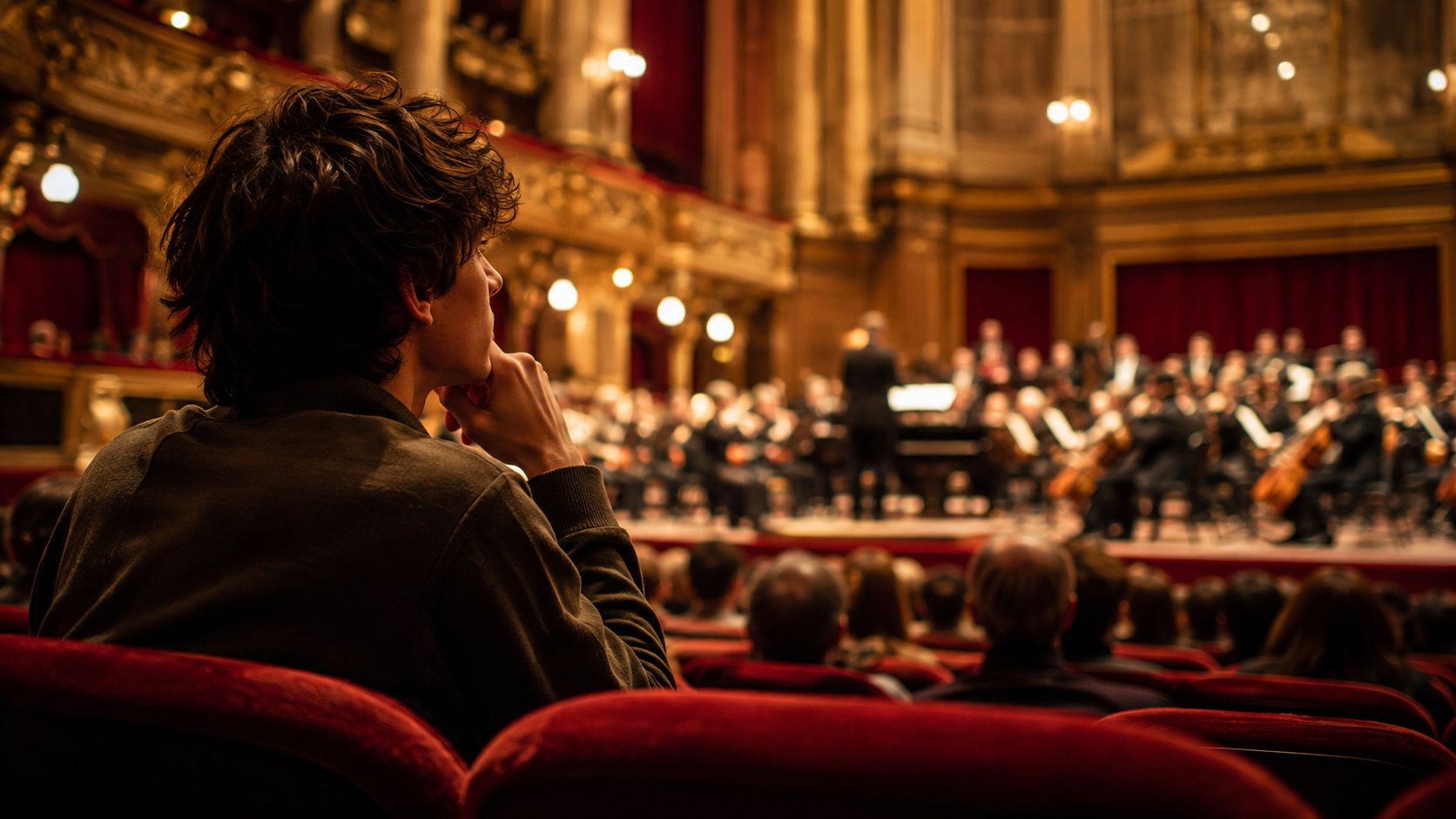
Composite input. Lights down. Quiet.
Program on your knees.
Don't clap here.
Don't cough there.
Don't come in now.
Don't move.
Do not breathe too firmly during Mahler.
The new listener sometimes enters the room with the same serenity with which he faces a customs control: he knows he has done nothing, but he still fears that someone discovers something.
Yet our current concert galaxy does not descend unchanged from Olympus. The story of the performance recounts much more reactive audiences than today; in the Vienna of the early nineteenth century, for example, the listeners of chamber music could applaud among the movements and openly show their appreciation. Many behaviors we perceive today as "natural" are the result of a long historical process of formalization of listening.
This does not mean transforming Ninth in a country party with calls during the Adagio.
Silence is precious. Concentration is even more.
But we must distinguish respect from sorrow.
If a person entering the room for the first time applauds at the end of a movement because it has been overwhelmed, perhaps the most urgent problem is not to inform her that she has violated the Geneva Protocol of the philharmonic.
Maybe we could be happy that she was overwhelmed.
Then he'll learn.
Culture should teach its codes without using them as a barbed wire.
TikTok did not kill Mozart
There is another heresy that we have to give.
A young man can meet Chopin on TikTok.
He can meet Rachmaninov in the soundtrack of a video.
He can get to Mahler through a film, in Strauss through a television series, to a symphonic orchestra through the music of a video game.
So?
Do we have to seize his phone and immediately deliver him a 12 CD box with a critical booklet?
The Royal Philharmonic Orchestra noted that streaming and new media were radically changing the ways through which the audience meets orchestral music; at the same time, interest in traditional repertoire continued to live with soundtracks, crossovers and other formats.
Here's the point.
The entrance door must not necessarily resemble the room we enter.
If thirty seconds of Rachmaninov push someone to look for the whole concert, those thirty seconds did not desecrate Rachmaninov.
They opened a door.
The problem begins if we decide that there is nothing behind that door.
Candles, effects, location: poor Mozart, in the dark
And we get to immersive concerts.
A thousand candles. Churches, palaces, suggestive spaces. Atmosfera accurately photographable.
We could ask ourselves, with a certain perfidy:
did we really have to turn off the light to see that Mozart was still alive?
Maybe.
And it wouldn't necessarily be a tragedy.
If a different atmosphere leads to the room someone who would never come in, well come.
If a candle leads to a quartet, let it light.
As long as, at some point, one realizes that among all those candles there was also a quartet.
Because disclosure works when it leads to the work, not when it replaces it.
Accessibility does not mean impoverishment.
We don't have to make Beethoven easier.
We must make its complexity desirable.
This is a huge difference.
Classical music does not need well-educated young people
He needs curious young people.
Which is very different.
Maybe we should stop asking the new generations to become culturally old before we can enter a hall.
They must not immediately love the ritual.
They must be able to meet the music.
A boy may not know what a recapitulation is and feel physically the return of a theme.
Can ignore the meaning of support and feel the tension.
Can not know the word Agreed and realize that an interpreter held time right there, at that point, suddenly becoming a different phrase.
Knowledge will come.
In fact: it will come more easily if before the desire to know will be born.
We musicians sometimes make the mistake of reverse the order.
First we provide instructions.
Then, if time remains, the wonder.
We should do exactly the opposite.
Let him be hit
Let's still imagine that boy.
He first entered a theater.
Maybe he doesn't know when to applaud.
Maybe until ten minutes before he was watching the phone.
Perhaps Beethoven only knows him because someone made him listen to the beginning of the Fifth.
Then the orchestra accords.
The buzz slowly disappears.
The warden raises his arms.
And something very ancient happens.
Fifty, seventy, one hundred human beings breathe together and produce a sound that a moment earlier did not exist.
No algorithm can fully anticipate what will happen in that room: the weight of that first agreement, the tension of a silence, the tiny error, the risk, the vibration of the air.
And maybe that guy, for a few seconds, even forgets to check his phone.
Don't ask him right away if he knows the dish-shaped.
Let's not ask him if he understood thematic development.
Let us not correct it if at the end of the first movement he escapes an applause.
Let's at least give him time to get hit.
If he comes back, he'll learn everything.
Classical music is not a dead butterfly to be found in the teca of Western culture. He does not need our piety, nor to be embalmed, simplified or defended as an endangered species.
He went through revolutions, wars, social changes, gramophones, radio, cinema, television, rock, streaming and now algorithms.
He'll probably survive TikTok.
The question is whether we will be smart enough to allow the new generations to meet her without constantly putting ourselves in the middle.
Perhaps, out there, there is no generation unable to listen.
There is a generation waiting to understand why it should.
And when the answer comes from an orchestra, from a voice, from Beethoven's four jokes or from a very piano that will suddenly silence everything else, there will be no need to convince her.
He's already got it.
Classical music is not dying.
Please.
Let's remove only the black dress.
Classical music is not inherited: it meets. Tell us about your first meeting!
2 answers to "Classical music is alive. We keep dressing her as a funeral. "
Anonymous
Jesi Pergolesi Theatre. Russian orchestra on tour in Italy. 13 years so much desire to listen to a live orchestra, I only used to the band. Accompanied by my father we sat on a 2nd order bullet. Started the concert, I don't remember the program, beautiful... I fell asleep!! !
Listening today: Johann Sebastian Bach – Ich ruf zu dir, Herr Jesu ChristBWV 639
by Marialuisa Veneziano
23 August 2026
Before you start music
There are Sundays where we don't need a music that distracts us.
We do not need someone to convince us that everything will be fine, nor those too well-packed consolations that come when, frankly, we would rather be left alone.
We need something different.
Something he can stay.
Without explaining. Without fixing. Without rushing.
For the first Sunday listening Let's start right from here.
For less than three minutes of Bach.
Three minutes in which, apparently, happens very little.
And maybe almost everything.
🎧 Open listening. Then keep reading.
This page is designed to be read with music next door.
Johann Sebastian Bach, Ich ruf zu dir, Herr Jesu Christ, BWV 639 – organ. (click on the black arrow to make the video appear)
Inside the score
Now let Bach play.
Don't try to understand.
In the upper voice there is the coral: a slow, clear, almost vulnerable melody. He doesn't conquer space. He's not raising his voice.
Question.
Under her, the left hand continues to move in a regular plot of semichrome.
The song breathes.
Time continues.
And even deeper, on the pedal, a third voice proceeds with quiet, essential step, supporting the entire building without ever reclaiming the center of the scene.
Three lines.
Higher voice → question Internal voice → movement Pedal → support
One question. Something that keeps walking. Something, below, that supports.
It's counterpoint, of course.
But in Bach the counterpoint, when it reaches this dizzying simplicity, almost ceases to look like a compositional technique and becomes a way of thinking about existence.
Words don't have to look like they can be together.
Everyone keeps their way.
Yet none is completely alone.
🎧 Listen to this.
If the track is still in progress, try to follow only the Upper heading.
Let her breathe.
Then, at the second listening, forget it for a few moments and seeks the continuous movement of internal voice. You will notice that, while singing hardens and seems almost to stop, under him something continues inexorably to flow.
Finally look for pedal.
It's nothing to be noticed.
Bach, fortunately, had not yet known the need to become viral.
Yet without that discreet line everything would lose its weight.
At this point he listens again to the set.
You won't hear three parts anymore.
You'll feel an organism.
The note remains
Bach does not interrupt the pain. He builds a large order around him to contain it.
Maybe that's what makes this little page so necessary.
Bach does not eliminate dissonance.
He leads it.
It doesn't erase the tension.
He gives her a place.
He doesn't want what hurts to stop doing it immediately.
It gives him a form.
And the difference is immense.
We live in a time in love with solutions. If we're restless, we have to react. If we're tired, we have to start again. If something breaks, we may have already transformed it into "growth opportunity" by Monday morning.
Bach's not in a hurry.
The title itself of the coral was born from an invocation: "I invoke you."
It is not the statement of those who already have the answer.
It's someone's voice calling.
And music preserves exactly this condition: not the triumph of those who understood everything, but the dignity of those who continue to seek.
Take him with you
Now the song is probably over.
And nothing around us has miraculously changed.
The room is the same. The issues left open are still open. The absences were not filled. And on Monday, with the proverbial delicacy of Monday, it continues to approach.
Yet something could have moved a few millimeters.
We listened to a voice capable of asking without shame.
Once able to continue without becoming an enemy.
And something, lower, which continues to support even when we almost don't notice it.
Bach didn't promise that everything will be okay.
He offered us something more serious:
a form in which even what we cannot solve can continue to breathe.
Three minutes.
No final answer.
But maybe a little more space within us.
And this Sunday can be enough.
What did you hear?
Listen to the song once again, this time without reading. Then tell us in the comments which of the three voices remained within you.
In Beethoven's Vienna, a small metronome discovers that time can be measured, but music is not.
by Marialuisa Veneziano
***********
🎧 MUSIC FOR LETTURE To accompany Master Metròn and the forbidden break, we recommend listening toAllegretto of the Symphony No. 7 in the major, op. 92 by Ludwig van Beethoven, in direct execution by Nikolaus Harnoncourt. About eight minutes built over a regular and inexorable pulsation, almost the tic tac of a large invisible metronome; and yet, above that beat, Beethoven lets music breathe, grow, change intensity and become deeply human. It is precisely the heart of our fairy tale: time can be measured, but music really begins when the measure stops being a cage. Click on the arrow of the logo "cuffie", press play and start reading.
In Vienna, in a winter when even snow seemed to fall with education, a thirteen-year-old boy named Matthias lived.
Matthias studied piano.
He was not a prodigy child, which he was very sorry for, especially because he read that prodigy children began generally before him and had already composed at least three concerts in the age when Matthias had learned not to overthrow the soup.
But he had a rare quality:
It was accurate.
Terribly accurate.
His scales began at the established time, his fingers fell on the keys exactly where they had to fall and, if a semi-minimum appeared on the score, Matthias treated her with almost administrative respect.
His master, Herr Weiss, often told him:
— Matthias, you play all right.
The boy smiled.
Then the second sentence always came.
— Unfortunately.
Matthias never understood how something could be correct and, at the same time, wrong.
He seemed an offense to logic.
One afternoon Herr Weiss arrived with a box.
— It's for you.
Inside there was a strange wooden object, with a metal rod swinging from one side to another.
— One metronome.
Matthias looked at him like other children would look at a white horse.
Herr Weiss loved him.
Tic.
— It's time to keep it.
The boy's eyes lit up.
Finally.
Someone who didn't say "with more feeling", "respirate the sentence", "do not rush but not slow down".
The metronome wasn't talking about puzzles.
Sixty was sixty.
Eighty was eighty.
Hundreds, thank God, were hundred and twenty.
Matthias took him to his room and spent the afternoon studying.
Tic.
Scale.
Tic.
Arpeggi.
Tic.
Studies.
Never a statement.
That night he went to bed happy.
At midnight he was woken up by a noise.
Tic.
He opened his eyes.
Tac.
He sat down.
The metronome was on his own.
— You forgot to turn me off. — said a voice.
Matthias opened his mouth.
— Did you talk?
— Of course.
— Metronomes don't talk.
— Even the pianists should not do it during the performance, yet I know a lot of them moaning.
Matthias lit the candle.
— What's your name?
The auction rose with dignity.
— Master Metròn. Time Keeper, Defender of Regularity and Natural Enemy of the Mal Giustificati Rubies.
— It's a very long name.
— At sixty beats per minute it takes exactly the time needed.
Matthias was enchanted.
He finally met someone who thought it like him.
From that day they became inseparable.
Master Metròn ruled everything.
— Eighty through the stairs.
— One hundred for the exercises.
— Sixty-six for Adagio.
Matthias obeyed.
Metròn then began to take care of the rest of the house.
He chronomed the maid while sweeping the floor.
— Too irregular.
He measured the cat's pass.
— Undisciplined.
He even tried to establish the correct duration of the embraces of Matthias' mother.
— Four beats are enough.
— But she's my mother.
— Feeling does not authorize anarchy.
When Matthias's little sister burst out laughing during dinner, Metròn shouted:
— Out of time!
— He's laughing. — protested Matthias.
— Precisely. No recognizable structure.
The boy began to think that his new friend was perhaps a bit demanding.
But at the piano the results were extraordinary.
He wasn't accelerating anymore.
He wasn't slowing down.
Almost nothing was wrong.
The day came when Herr Weiss heard him perform an Adagio.
Matthias played everything perfectly.
It ended.
The master sighed.
— Impeccable.
Matthias waited.
— And?
— He's dead.
— How'd he die?
— I don't know. You must have killed him on the second page.
Master Metròn, from the table, taught himself.
— Calunnia!
Herr Weiss didn't hear it.
Matthias is.
— I've respected every value.
— I know. — answered the master. — That's what worries me.
A few weeks later Herr Weiss brought Matthias to listen to a famous man.
Ludwig van Beethoven.
Matthias imagined it solemn, ordered and probably surrounded by a special light.
On the other hand, he found a broken man, with cards everywhere and an expression that suggested that the world had lost him a lot of time.
— Sound — said Beethoven.
Matthias sat down.
Master Metròn was placed next to the piano.
Tic.
The boy began.
No mistake.
No hesitation.
No surprise.
When he finished, Beethoven remained silent.
— Did I do something wrong? — asked Matthias.
— Unfortunately not.
The boy moved.
That was exactly Herr Weiss' sentence.
— Then it was perfect.
Beethoven looked at the metronome.
— Even a watch is perfect. I wouldn't give him a sonata.
Master Metròn lightly accelerated for indignation.
— But the metronome tells me time — protested Matthias.
Beethoven pointed out the object.
— That can tell you how long it takes a minute.
Then he slightly touched his chest.
— This has yet to decide what to do with it.
Metròn didn't speak all the way back.
It was the first time Matthias saw him offended.
That night, however, the metronome made a decision.
— I will prove to that man who is in a state that precision can make the whole world perfect.
— How?
— Putting it on time.
Before Matthias could stop him, Master Metròn began to beat.
ICT. TAC.
The sound crossed the walls.
He went down the streets.
He entered the clocks.
He went to the bell towers.
And Vienna began to follow him.
The next morning everyone walked at the same pace.
The carriages were leaving at the same time.
The furnaces kneaded in perfect synchronicity.
The barbers lifted the razors at the same time.
The bells of the churches sounded with such precision that even the angels, if they existed, probably controlled the clock.
At first the city was enthusiastic.
Nobody was late.
Nobody interrupted anyone.
The files flowed beautifully.
The Minister of the Public Order declared that morning the most successful in the history of the Empire.
Then problems began.
A child fell.
His mother stopped to help him, but the crowd continued to walk.
ICT. TAC.
An old man tried to cross a road.
He couldn't follow the rhythm.
— Faster! — he ordered Metròn.
— I can't. — said the man.
— Time doesn't wait.
Matthias helped him reach the sidewalk.
— Master Metròn, can't you go slower?
— If I slow down for him, everyone would lose time.
— But he needs more time.
— Everyone has the same.
Matthias looked at the old man.
For the first time, that phrase didn't seem right.
In a house, a mother cradled a baby.
The baby was about to fall asleep.
ICT. TAC.
The rhythm increased.
The boy woke up crying.
Two lovers greeted themselves in front of a carriage.
He kissed her.
ICT.
— Time's up! — he ordered Metròn.
— Wait a minute.
TAC.
— I said time.
Matthias intervened:
— Maybe a kiss doesn't always last the same number of beats.
— That's why kisses never produced an efficient civilization.
The boy wasn't completely sure.
In the afternoon the Vienna orchestra held a concert.
It was the most precise execution that had ever been heard.
All attacks together.
All exact durations.
No freedom.
No hesitation.
No mistake.
When he finished, no one applauded.
Not because it was bad.
Worse.
He didn't say anything.
Matthias watched Master Metròn.
— Did you like it?
— Technically irrepressible.
— I didn't ask you that.
For the first time, Metròn hesitated.
Tic...
The auction resumed.
— Technically irreproachable — repeated.
But with less conviction.
That night, Matthias was supposed to play in front of Beethoven.
The room was full.
Master Metròn imposed time.
— Sixty-six.
Matthias began.
ICT. TAC.
It sounded good.
Then he came to a slow sentence.
One note went up to another and seemed to ask for something.
Matthias felt she should have waited.
ICT.
Your fingers should have gone on.
They didn't.
TAC.
Matthias remained still.
Master Metròn began to shake.
— Get back!
The boy let the silence live.
One second.
Two.
Three.
— Time!
Matthias looked at the audience.
At the end of the hall he saw the old man met that morning.
It was late.
He was breathing so hard.
Matthias waited.
Until the old man looked up.
Then he started playing.
Not when he ordered Metròn.
When the sentence asked.
Music changed.
He didn't become disorderly.
She became alive.
A phrase accelerated slightly because he was in a hurry to arrive.
Another slowed down because he didn’t want to leave yet.
A break lasted long enough to allow everyone to miss it.
Matthias continued to respect the rhythm.
But he was no longer a prisoner.
Beethoven smiled.
A woman closed her eyes.
The old man at the end of the hall slowly turned back.
And Master Metròn, for the first time since his construction, stopped beating.
When the song ended, Matthias turned.
The metronome was still.
— You broke up?
— No.
— Then why did you stop?
Metròn blew.
Then he said,
— That break...
— What?
— Too long.
— Yes?
— It wasn't written.
— No.
The auction just moved.
— She was beautiful.
Matthias smiled.
— A long time ago?
— Mostruously.
Quiet.
— But beautiful.
From that day Vienna slowly returned to Vienna.
The carriages returned late.
Children ran at unpredictable speed.
The old ones crossed the streets with the necessary time.
The lovers, with great scandal of the ministry, returned to decide independently the duration of their kisses.
And Matthias continued to study every morning with Master Metròn.
Scale.
Tic.
Arpeggi.
Tic.
Hard passages.
Tic.
One day, many years later, Matthias opened an Adagio.
He was a pianist.
Master Metròn had become old. The wood was carrying small scratches and the rod oscillated with some dignified fatigue.
— Master?
— Yes?
— What time should I play it?
For the first time in his long life, the metronome replied:
— I don't know.
Matthias smiled.
Metròn added:
— I can help you find him.
— And then?
The old metronome made a small ♪.
— Then listen.
Matthias put his hands on the keyboard.
And Master Metròn ate.
Not because he had nothing to teach him.
But because he had finally learned when it was time to let him play.
The rules are precious when they teach us to become free; they become cages when they claim to choose in our place. Accuracy can teach the music to stand, but only listening, thinking and feeling can teach you where to go.
BOX HISTORY
The mechanical metronome entered the European musical life in the early nineteenth century thanks to Johann Nepomuk Mälzel. Beethoven was among the most interested composers of the new invention and indicated metronomic values for many of his works. Our fable starts right from this encounter between a great modern aspiration — accurately measure musical time — and a question that no number can solve completely: how much space does the interpreter have?
How many times in life do we confuse what is right with what is simply measurable?
We measure votes, salaries, results, numbers, rankings. Reassure us what can be counted, compared, archived. But not all that matters can be counted.
The love of a mother for a child is not measured. Loyalty to a principle is not measured. The courage to rise after suffering, the kindness offered in silence, the time dedicated to those who need do not find place in a table or in a statistics.
Yet these realities often constitute the most authentic part of our existence.
Philosophy reminds us that good does not always coincide with profit, and that truth does not necessarily coincide with what is quantifiable. We live in an age that tends to give value to what produces visible results, forgetting that some of the most important things mature in the invisible: a straight conscience, a sincere bond, a right choice accomplished without witnesses.
Perhaps wisdom also consists of this: learning to distinguish between what has a price and what has a value.
Because not all that is measurable is important, and not all that is important is measurable. And often, what is really right is recognized not by the meter of numbers, but by that of consciousness.
I share. As Socrates taught, true discovery does not always consist in finding something new, but in bringing out what was already present, albeit hidden, in our consciousness.
Sound, light, architecture and provocation: so the Pink Floyd taught rock that even a stage can have a thought.
by Marialuisa Veneziano
17 August 2026
Prologue. The sound came back
London, 1967.
The audience is seated in the geometric composure of Queen Elizabeth Hall. The stage is ahead, the armchairs are directed in its direction, the spectators wait for the music to begin from the place from which, for education and custom, the music should begin.
Then a sound comes behind them.
It's not a mistake. It's not a bad speaker. The sound moves, crosses the room, passes from one side to another and seems to look for each viewer individually, as if the music had suddenly learned to walk.
For the first time many understand, perhaps without yet knowing, that a concert should not necessarily happen front to those who listen.
It can happen around.
It can happen inside.
In 1967 the concert stopped proceeding straight: the sound began to turn around the audience
The leaders of this small perceptive earthquake are four young Englishmen called Pink Floyd. Use a device called Azimuth Coordinator, a kind of joystick capable of distributing sound in space. The music adds projections, lights, flowers and soap bubbles.
The bubbles spot the carpet and the group is banned from the hall.
The future of the concert was just born; the upholstery, less visionary, had already asked for compensation.
But what had happened could no longer be erased.
Rock stopped standing still.
The room became a tool
The real Pink Floyd revolution was not to have more speakers.
It consisted of having understood that space could also be composed.
Of a sound we are accustomed to considering height, duration, stamp, intensity. But a sound also has a origin. A voice coming from afar does not mean what would mean pronounced near the ear. A step heard behind it contains a threat that the same step, seen in front, would lose.
Placement becomes meaning.
Western music had already known spatiality: just think of the opposite choirs of the basilica of San Marco, where the voices were called by different chanters and architecture entered the composition. Pink Floyd transported that awareness into the electric heart of the twentieth century.
They didn't just play in a hall.
They sounded the room.
From frontality to immersion: when the origin of the sound became compositional material.
The audience no longer received music as a message sent from the stage. It became the unstable center. The noises reached it from unexpected points, the lights altered its perception, the images extended what the sound could not say alone.
It was already a form of total theatre.
Only that, instead of the velvet and mythological gods, there were cables, amplifiers and a number of electrical sockets enough to worry any insurer.
Pompeii: the concert entrusted to the stones
In 1971 Pink Floyd made an even more radical gesture. They play in the Roman amphitheatre of Pompeii without public.
The steps are empty. No one applauds. No one shouts the name of the group. No one lifts the phone, even because the phone, with admirable sense of the measure, was still tied to a wall.
The musicians, the instruments, the sky and the stone remain.
GUARDA – When the silence of Pompeii entered the music
A concert without spectators, destined to be listened to for generations not yet arrived.
That absence transforms everything.
An amphitheater born to welcome thousands of bodies becomes the harmonic case of a solitary sound. Music crosses the ruins as if it was questioning what remains after the disappearance of men.
In Echoes, long progression, remote sounds, rarefactions and crescendos seem to be born from the bowels of the place. The stone is not a picturesque background: it is a presence. Look, hold it back.
That concert without spectators says something that our time struggles to understand: an event is not great because many people claim to have been there.
It is great when it changes the meaning of the place where it happens.
In Pompeii the music does not look for the crowd.
Look for time.
And time, for once, answers.
When even a cash register entered the orchestra
With The Dark Side of the Moon, Pink Floyd transform the album and concert into a single great form.
No more a succession of songs, but an organism: heartbeats, voices, watches, breaths, noises and transitions combine songs as connecting rooms of the same mind.
The watches of Time do not decorate the music: they attack her. Time is not poetically told; it bursts with awakes, bells and mechanisms, as it does in life when we realize we have wasted too much.
In Money, even money becomes rhythm.
Cash registers, coins, torn paper and metallic sounds are mounted in a regular sequence. The famous riff proceeds mainly in seven quarters, an asymmetric measure, slightly lame, which seems to advance with the safety of those who own everything and the balance of those who no longer know why they want it.
Money promises order.
Music gives it back irregularity.
ASCOLTA – When coins and cash registers learned to count up to seven
In "Money" the sound does not accompany the song: it generates its rhythm and anticipates its criticism
This is the musicological greatness of Pink Floyd: the effects are not supported on the track as lustrini on an already finished dress. They enter the structure, determine its breath, become part of thought.
Today we would say "sound design".
Then he really cut the tape with scissors.
Capitalism, at least for a few jokes, had yet to be assembled by hand.
The circle that looked at the audience
In the 1970s, the large circular screen appears on stage to become one of the symbols of Pink Floyd concerts.
Not a rectangle, not a simple backdrop.
A circle.
Eye, planet, porthole: "Mr Screen" did not show the concert, opened a second mind in the concert. (click on the arrow and discover the background!)
Eye, planet, moon, oblue, pupil dilated on the spectator's consciousness.
The images are not limited to illustrating the texts. Sometimes they amplify them, sometimes contradict them, sometimes they open a second narrative line. It's a real visual counterpoint.
Music says something.
The image suggests another.
The viewer is forced to live in tension between the two.
This is where the concert becomes a sensitive philosophy. It does not only offer something to listen and see: it modifies the way in which listening and viewing are questioned each other.
Pink Floyd, moreover, often tend to subtract the face of musicians to absolute centrality. They don't seem to say: «Look at us.».
They seem to say: «Look what music is thinking».
An almost ascetic choice for a group that would soon fly a giant pig over the audience.
But even that pig, of course, was not just a pig.
The pig who escaped from the symbol
For the cover of Animals, a huge inflatable pig is suspended over the Battersea Power Station.
He gets rid of the cables and flies away.
The previous day was a chosen shooter, in charge of knocking him down in case of escape. The next one, evidently confident in the maturity reached by the pig, did not call him back.
The pig crossed the British sky and interfered with air traffic.
Algie above Battersea: when a record cover became political satire, aviation accident and legend.
The vanguard flies. The authorization form, obviously, comes after...
Political satire had finally conquered civil aviation.
But behind the irresistible anecdote there is a serious principle: in Pink Floyd the scenic object is never only decoration.
The pig represents power, greed, social deformation. Inflatable figures occupy the air because collective obsessions also occupy the space of our lives.
A special exclaim effect: «Look how good we are.».
A question symbol: «Look what we've become».
It's a huge difference.
And it is not measured in meters, watts or budget.
The wall really grew
With The Wall, metaphor becomes matter.
During the show, large bricks are gradually placed in front of musicians. The wall grows to hide them almost entirely.
The public does not simply listen to a story about isolation.
It's isolated.
The metaphor became matter: the wall did not tell the alienation, made it happen.
The scenography does not represent incommunity: it produces it physically. Viewers attend the progressive disappearance of the group for which they bought the ticket.
It is theatre, installation, concert, cinema.
But above all it is an idea made inevitable.
Music must even adapt to the times of construction. An instrumental section allows workers to complete the wall if they are late. Technical necessity enters the form: teachers and musicians share the same dramaturgy.
Here the concert reaches the size of thetotal art work.
Sound, light, architecture, animation, gesture and story are not separate elements. There are only mutual relations.
The wall does not accompany the music.
It's music made stone.
And that is exactly what many contemporary shows have inherited only in part.
We have preserved greatness.
Not always the need.
GUARDA ANCHE – The animation that transformed the school into a factory of identical individuals
From the wall to the Sphere
Today the concert has tools that Pink Floyd of the Sixties would probably judge magnificent, provided accompanied by a manual and an extinguisher.
Immense screens, spatial audio, drones, augmented reality, vibrating seats, synchronized light bracelets. The Sphere of Las Vegas can almost completely envelop the field of view and direct sound with an unthinkable precision at the time of the Azimuth Coordinator.
We entered the future imagined by Pink Floyd.
Today the concert has become a place without visible walls.
From Azimuth Coordinator to Sphere: sixty years of technology to bring the audience into the sound.
Yet the problem remains ancient.
Technology always amplifies something.
Sometimes an idea.
Sometimes his absence.
In Pink Floyd, the sound space expressed disorientation; the circle opened a mental dimension; the pig embodied a political criticism; the wall made alienation physical.
Today the opposite can happen: first the effect comes, then desperately seeks a song that justifies it.
First the digital dragon is 30 meters high.
Then the chorus, intimidated, attempts to be noticed.
This is not about condemning progress. A technologically grandiose show can be authentic art, if every medium comes from vision.
But a huge stage doesn't make what happens to you great.
Sometimes it is limited to offering the vacuum an excellent lighting.
The public behind their wall
Finally, there is a wall that Pink Floyd did not foresee.
It is small, bright and stands in the palm of the hand.
Today many spectators spend the concert filming what they are experiencing. They don't look at the stage, but the screen on which the stage is reduced.
Thousands of people record a giant screen through a tiny screen.
The artist tries to immerse them in a universe; they prepare a vertical version of fifteen seconds.
IS The Wall, but pocket.
We knocked down the wall between stage and plate. Then we lit one in the palm of the hand.
Of course, recording also means wanting to preserve. It is a human gesture: we want to retain what we know is meant to end.
But live music is precious because it cannot be held entirely.
The sound is born, it passes through the air and disappears.
Its fragility is not a defect.
It's his destiny.
When we try to keep every second, we risk not really living any of them.
Pompeii was empty, yet he seemed to listen.
Today the stadiums are full, but we're not always sure that someone is still really listening.
Final. The oldest in technology
Pink Floyd did not just make more spectacular concerts.
I gave the concert a conscience.
I understood that the sound could possess a geography, that a light could become a musical form, that an image could open a wound, that a wall could tell what the words could no longer say.
They did not add effects to the songs.
They extended songs in the world.
This is their deepest legacy and the most difficult to imitate. It is easy to buy a bigger screen. It is easy to fly drones, multiply lasers, wrap the audience in images and vibrations.
It is much harder to know why to do it.
Technology can surround the viewer.
Only art can reach it.
Technology occupies space.
Art changes interior time.
Perhaps the concert of the future will be perfectly immersive. The sound will react to our movements, the images will change according to the emotions of the crowd, the floor will vibrate, the artificial intelligence will decide which color to associate with our nostalgia.
Maybe we'll even get a notification to know when to move.
But nothing will be enough without a vision.
Pink Floyd built walls to show us what we brought in. They flew pigs because power appeared grotesque as it really is. They played among the ruins so that the silence of the centuries would enter the music.
They understood that a concert is not the place where music is simply performed.
It is the place where, for an instant, a crowd of strangers breathes into the same imagination.
Then the lights turn out.
Sound dies.
The screen turns black.
But something remains.
The concert ends when the stage turns off. Art begins with what keeps moving within us.
Not in phones.
Not in the photographs.
It remains at that secret point where music, passing, has moved just the wall that each of us had built within itself.
Because the future of the concert will not depend on the number of pixels, drones or speakers.
It will still depend on the oldest, fragile and rare technologies:
have something to say — and find someone really willing to listen.




Leave a comment