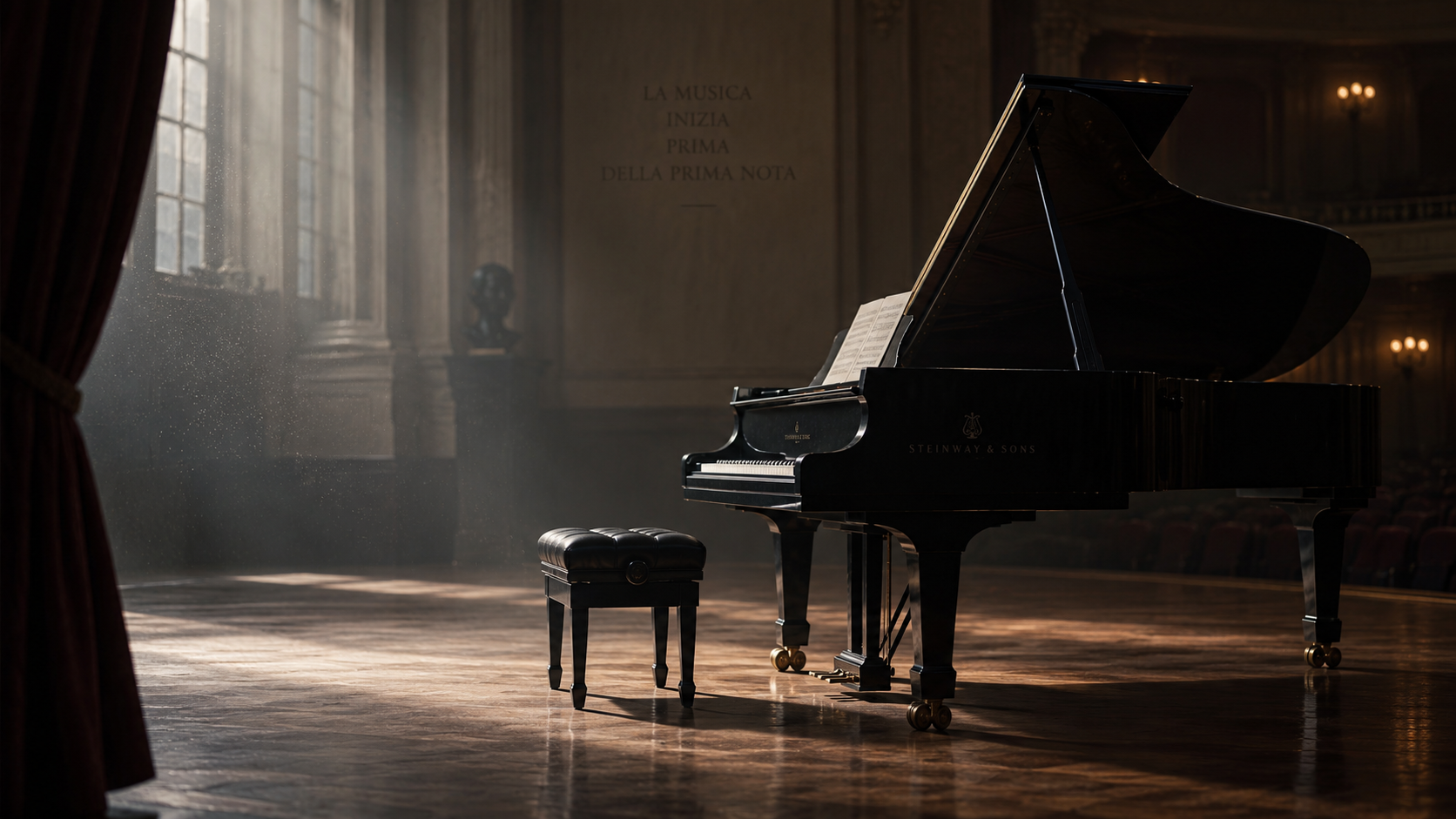
Tags: Marialuisaveneziano

  • The duel without guns

    Liszt, Thalberg and the night Paris fought with eighty keys.

    by Marialuisa Veneziano

    ************

    🎧 MUSIC FOR LETTURE – (Box 1)
    Sigismond Thalberg – Fantaisie sur des thèmes de Moïse, op. 33
    This time we don't listen to a simple soundtrack. We go directly into the duel.
    Start with Thalberg: search for that melody that seems to sing in the center of the keyboard while the other fingers build them on and under a whole sound world. It is the famous effect of "three hands".

    Click on the black arrow to make the listening appear

    Matthew received the weapon at 9 a.m.

    It was 15 centimetres long, it had the freshly tempered tip and it was red.

    — Don't miss it. — said Mr. Valmont.

    Matteo turned her in the fingers.

    — It's a pencil.

    — I see.

    — You said you'd have given me something important.

    The printer manager lifted his eyes.

    — With that, tonight, you're gonna kill a man.

    Matthew almost dropped the pencil.

    Valmont burst out laughing.

    — A name, you idiot. You'll kill a name.

    On the bench, between lead characters, dirty ink rags and still wet leaves, were spread two first pages.

    The first announced:

    The second one:

    Matteo read the first.

    Then the second.

    Then he returned to the first.

    — But the concert is tonight.

    — Good memory.

    — They haven't played yet.

    — Another impeccable observation.

    — And you already wrote who won?

    — I wrote both possibilities.

    Matteo scratched his forehead.

    — What if nobody wins?

    Valmont stopped smiling.

    He looked at it with that particular compassion that adults reserve to children when they say something reasonable.

    — You're 14, aren't you?

    — Yes.

    — He's heard.

    He pointed out the two pages.

    — Tonight you will go to the palace of Princess Belgiumjoso. You will listen to Liszt and Thalberg. When they're done, you'll take this pencil and make a cross on the loser's name.

    — And then?

    — Run here.

    — How strong?

    — If you want to keep the job, enough to get there before two.

    Matthew infiltrated the pencil in his pocket.

    — So I'll decide who won.

    Valmont laugh.

    — No, my boy. Paris has already decided.

    — So what do I serve?

    — To discover what to do He was right.

    That phrase remained in Matthew's head all day long.

    Not because he was particularly smart.

    Because, walking through the city, he realized that it was true.

    Paris had split.

    Not with barricades.

    Not yet.

    With something much more comfortable: opinions.

    Coffee was fighting.

    In the living rooms he fought with lower voice.

    He was fighting in the fights, interrupting the job.

    In the newspapers he fought with the ink, which had the advantage of making the nonsense permanent.

    — Liszt is a genius.

    — Liszt is an acrobat.

    — Thalberg sings the piano.

    — Thalberg always does the same trick.

    — Liszt is the future.

    — Thalberg tastes.

    — Liszt has fire.

    — Thalberg doesn't need it.

    Near Pont-Neuf, Matthew handed some drafts to a man who was arguing.

    — Thalberg is not worth half of Liszt!

    Matteo stopped.

    — Did you hear that?

    Man looked at him.

    — Who?

    — Thalberg.

    — No.

    — So how do you know Liszt is better?

    Man slowly took off his glasses.

    — Who are you for?

    — I don't know.

    Man trusted him with suspicion.

    — Then why are you talking?

    Matthew continued.

    Ten minutes later he heard two ladies.

    — Liszt will certainly be unbearable.

    — Have you ever listened to him?

    — Never.

    — So?

    The lady opened the fan.

    — My dear, certain things are understood.

    Matthew continued to walk.

    Around noon began to have the impression that the evening concert served everything except to listen to music. The palace of Princess Cristina Trivulzio of Belgiumjoso was already in ferment.

    The concert would have been beneficial. A part of the proceeds would be served to Italians in difficulty and exiles.

    When Matthew heard it, he straightened out.

    — I'm Italian and I'm in trouble.

    The butler who was giving him a pile of programs rode him.

    — I'll keep you in mind if they're advancing cans.

    Matthew decided that, for a Frenchman, he was a witty man.

    He spent the afternoon carrying chairs, bending sheets and trying not to break anything worth more than his mother, that is almost everything.

    That's when he heard the first piano.

    The door of a living room was open.

    Matthew peed.

    An elegant man sat on the keyboard.

    He didn't move much.

    He didn't need it.

    From the piano came out a clear melody, perfectly recognizable, as if someone was singing in the center of the instrument.

    But above that voice, they ran arabesques.

    And the bottom was moving.

    Matthew looked at his hands.

    Two.

    He listened.

    Three.

    He looked again.

    Two.

    He took a few steps.

    He leaned next to the piano.

    Music stopped.

    — Is there something interesting below?

    Matthew lifted his head.

    Man observed it.

    — I was looking for the third hand.

    Quiet.

    — What third hand?

    — The one playing the melody.

    Man was serious.

    Then laugh.

    — And you found it?

    — No.

    — Too bad. They've been looking for her for years.

    Matthew rose up.

    — You are Thalberg.

    — Depends.

    — From what?

    — If you come collect money, no.

    Matteo smiled.

    Sigismond Thalberg warned him to approach.

    — Look.

    He slowly recovered the passage.

    The melody was passing through the thumbs in the middle register. The other fingers built around a soundscape that gave the illusion of multiple overlapping planes.

    Matthew opened his eyes.

    — It's a trick.

    Thalberg looked at him.

    — You work in a typography?

    — Yes.

    — When you print the word seaIs the sheet wet?

    — No.

    — Then you do tricks, too.

    — It's not the same.

    — Of course. My cost a lot more.

    Matteo laugh.

    Then he remembered the pencil in his pocket.

    — Will you win tonight?

    Thalberg stopped playing.

    — Against who?

    — Liszt.

    — Ah.

    The name remained among them.

    — Everyone says it's gonna be a duel.

    — Human beings love the duels in which they are not likely to be affected.

    — But you want to win?

    Thalberg looked at him.

    Matthew expected a magnificent phrase on the superiority of art.

    Thalberg said:

    — Very much.

    Matthew was disappointed.

    — I thought you'd say that only music counts.

    Thalberg closes the keyboard slowly.

    — It's one of the things musicians say when they've already won.

    BOX MUSICOLOGICAL (Click on the black arrow to open the contents)

    The other piano was two rooms over there.

    Matthew heard the same sentence nine times.

    At the tenth he became angry.

    Franz Liszt sat alone.

    He played four jokes.

    He stopped.

    She was repeating.

    Again.

    Again.

    At the twelfth Matthew asked:

    — Can't you?

    Liszt turned.

    — What?

    — That piece.

    — Why?

    — Keep doing it again.

    Liszt studied it.

    — When you can't do something, how many times do you try?

    — Mr. Valmont usually arrives at the third and calls me incapable.

    Liszt laughed.

    Matthew entered.

    In bending to collect some programs, he dropped the two first pages.

    Liszt picked them up.

    Lesse:

    LISZT THALBERG.

    A smile.

    I'll turn the sheet.

    THALBERG DETRONIZZA LISZT.

    The smile remained, but the eyes changed.

    — Previously.

    — I need to get one back tonight.

    — Then you won't have any trouble.

    — What?

    Liszt pointed out the first.

    Matteo laugh.

    — Thalberg also wants to win.

    — What a surprising man.

    — I thought you might have said that only music counts.

    Liszt returned to the piano.

    — Did Thalberg tell you that?

    — No.

    — So, for once, we agree perfectly.

    He took the four jokes.

    Matthew observed it.

    Two very different men.

    They both wanted to win.

    For reasons Matthew didn't know yet, he liked it.

    It made them less statues.

    More dangerous.

    More human.

    And it's just when it feels important that you commit the best stupidities.

    Thalberg was in the hallway when Matthew came out.

    — Did you meet Liszt?

    — Yes.

    — And?

    Matthew could have said:

    He's trying.

    He could have said:

    He wants to win.

    He could have shut up.

    Instead, he heard Valmont's voice in his head.

    Nobody buys a newspaper if nothing happens.

    — He said he'd make you forget tonight.

    Thalberg stopped.

    — Did he say that?

    Matthew's heart had a little relief.

    — Sort of.

    It was fake.

    Not completely false, he said.

    Liszt wanted to win.

    One sentence, in the end, was worth the other.

    Thalberg looked at him for a moment.

    Then he entered the rehearsal room and closed the door.

    Soon after Matthew heard the piano.

    Not as calm as before.

    Faster.

    Harder.

    One sentence was repeated three times.

    Matthew felt cold.

    He did something.

    He didn't know how big.

    For the first time, I took out the red pencil.

    He looked at her.

    She didn't look so innocent anymore.

    At eight o'clock the building stopped being a house.

    It became a theatre.

    Then, slowly, an arena.

    Carrozze in front of the entrance.

    Jewelry.

    Uniform.

    Perfume.

    Silk.

    Ventagli.

    Voices.

    Matthew recognized Liszt's supporters and Thalberg's supporters without anyone carrying a uniform.

    Just listen to them.

    — If Thalberg still does his central melody game, I'm leaving.

    — Really?

    — Of course.

    — Did you ever hear that?

    — No.

    Further:

    — Liszt sounds too loud.

    — He hasn't started yet.

    — It doesn't matter.

    Matteo strinse the programs.

    He spent the afternoon with the two men.

    Neither of them looked like the version they gave them.

    As he walked through the salon, someone slipped his sheets out of his pocket.

    Matteo turned scared.

    Princess Belgiumjoso was reading them.

    One.

    Then the other.

    — Very practical.

    — Height...

    — Don't worry. I'm not gonna report your paper for excess imagination.

    He returned the papers.

    — What will you use?

    — The one.

    — What if they're both wrong?

    Matthew hesitated.

    — My director says it's impossible.

    The princess observed it.

    — He must be a very lucky man.

    — Why?

    — I spent most of my life seeing things that very safe men had just defined impossible.

    Then he directed the hall.

    — Listen well.

    — That's what I have to do.

    — No.

    Cristina just smiled.

    — You have to choose. It's different.

    He left.

    Matthew stayed there.

    For the first time, those two things seemed really different.

    When Thalberg approached the piano, the room fell into silence.

    A silence far from innocent.

    Hundreds of people were waiting.

    Some music.

    A lot of the verdict.

    Thalberg put his hands on the keyboard.

    Fantasia started on Moses by Rossini.

    Matthew knew him enough to see what the public could not see.

    At first Thalberg was tense.

    He knew it from his back.

    First breathing.

    From that tiny gesture he'd arranged his cuff.

    Maybe he was thinking about the phrase that Matthew had attributed to Liszt.

    It'll make you forget.

    Matthew felt the shame coming up.

    Then Thalberg really started playing.

    And he forgot everything.

    The melody appeared in the middle of the keyboard.

    She was singing.

    He had no other verb.

    She was singing.

    Around it, the notes ran like water around a stone.

    Up.

    Under.

    Three sound planes with two hands.

    Matthew looked.

    He no longer looked for the third.

    Close your eyes.

    And he saw his mother.

    Not in the present.

    Two years earlier.

    On the way to Paris.

    A room for one night.

    Few coins.

    The rain.

    He asked if the next day they would eat.

    His mother didn't answer.

    Then, in the dark, an Italian song.

    Sing slowly.

    With a voice he wanted to sound safe and he wasn't.

    Matteo, then, had understood.

    But he pretended not.

    Thalberg continued.

    The melody stood still in the middle while everything changed.

    Just like that voice.

    His mother was scared.

    And he sang the same.

    Matthew opened his eyes.

    For a few seconds he didn't see the princess's living room.

    He saw home.

    A house that no longer existed.

    The last note is lost.

    There was a very short silence.

    Then the applause.

    Huge.

    Matthew infiltrated his hand in his pocket.

    I'll take out the page:

    THALBERG DETRONIZZA LISZT.

    He took the red pencil.

    He spotted the tip to the card.

    One inch.

    Half.

    He stopped.

    Liszt hadn't played yet.

    He filled the sheet.

    *******

    🎧 – (Box 2)
    Franz Liszt – Great fantaisie sur des motifs de Niobe, S.419
    You listened to Thalberg while Matthew found something of his past.
    Liszt's coming in now.
    Do not look for the same kind of beauty: the duel really begins because the piano changes face.

    Click on the black arrow to make the listening appear.

    Thalberg passed near him.

    — So?

    Matthew suffered.

    — What?

    — The third hand.

    The boy smiled.

    — I didn't find it.

    — Good.

    — Good?

    Thalberg lowered his voice.

    — When you stop looking for makeup, sometimes you start listening to music.

    And he left.

    Matthew remained still.

    The phrase hurt him even more.

    Because he did exactly the opposite that afternoon.

    He looked for makeup in two men.

    And he invented one.

    When Liszt entered, a part of the audience applauded before it even touched the keyboard.

    Matthew realized he was bothering him.

    Then he recalled that it also happened with Thalberg.

    Adults, he thought, often managed to be unjust in a perfectly balanced way.

    Liszt sat down.

    He didn't look at Thalberg.

    Or maybe he did.

    Matteo couldn't tell.

    He started.

    The Niobe entered the hall completely differently.

    Matthew sought at first what he had found in Thalberg.

    The middle voice.

    The continuity.

    That song.

    There was no.

    He almost felt betrayed.

    Then Liszt changed perspective.

    An explosive passage.

    Another retreated suddenly.

    The piano seemed too tight for what the pianist claimed from him.

    Sometimes orchestra.

    You have one voice.

    At times matter.

    Sometimes dizziness.

    Matteo stopped thinking about his mother.

    He began to think of himself.

    The typography.

    To the shoes too big he brought because they were of his cousin.

    To the room he shared with his mother.

    To the letters of lead that he composed every day to tell the lives of others.

    He always thought he'd have a typography one day.

    Not because he wanted it.

    Because it was the only future he knew.

    Then Liszt played a phrase that seemed to open up something.

    Matthew had a thought.

    What if it wasn't decided?

    That's it.

    A tiny thought.

    But some thoughts need very little space to suddenly make the room where you lived until that moment small.

    What if it wasn't decided what he would do?

    Where would he live?

    Who would become?

    Liszt finished.

    The room exploded.

    Matthew did not applaud immediately.

    He needed his hands to hold something he couldn't appoint.

    Thalberg had returned him a place from which he came.

    Liszt made him suspect there could be one to go.

    Matteo took the two pages.

    He put them next to each other.

    He looked at the red pencil.

    And he realized he was in trouble.

    The music ended.

    The race began.

    — Liszt!

    — Thalberg!

    — Thalberg!

    — Liszt!

    Names bounced into the hall.

    Somebody laugh.

    Someone whistled.

    The princess raised a hand.

    The noise fell.

    Not entirely.

    Never entirely.

    — Apparently — he said, — Paris came here with a question.

    — Who won! — shouted someone.

    Laugh.

    Matteo looked at the pianists.

    Liszt looked like a man who pretended very well not to be interested.

    Thalberg is a man who pretended even better.

    The princess looked at them.

    Then he looked at Matthew.

    And he saw the two sheets.

    — Come here.

    Blood left the boy's face.

    He pretended he didn't understand.

    — You.

    Nothing to do.

    He crossed the hall.

    Every step seemed noisy.

    The princess pointed out the sheets.

    — Your newspaper wants a name.

    — Yes.

    — Good. Give it to him.

    Matteo swallowed.

    Someone said:

    — Let's judge the boy!

    A laugh went through the salon.

    — So? — asked a man. — Who was better?

    Matthew looked at Thalberg.

    Then Liszt.

    The answer didn't come.

    — I don't know.

    Laugh.

    — He doesn't know!

    — What a judge!

    — But you have to choose!

    Matthew infiltrated his hand in his pocket.

    It was the pencil.

    He watched Thalberg.

    — When he played...

    The living room slowly blew.

    — ...I forgot that monsieur Liszt existed.

    Someone will be biting approval.

    Matteo turned to Liszt.

    — And when he played, I forgot that monsieur Thalberg existed.

    The Mormon changed.

    The man of coffee, what he had already decided in the morning, drank.

    — What does that prove?

    Matteo lowered his eyes on the two first pages.

    The answer came from there.

    — That to decide who was better I should have remembered the other while listening.

    No one laughs.

    — But then I would have heard worse.

    Quiet.

    Matthew continued, now too scared to stop.

    — Monsieur Thalberg made me remember home.

    He looked at Liszt.

    — Monsieur Liszt asked me where I could go.

    Then he looked at the hall.

    — I don't know which one is better.

    Break.

    — And I don't want to lose one just so I can say I chose well.

    That phrase didn't make applause.

    Matteo was almost happy.

    The applauses would have ruined everything.

    He produced something more rare.

    People who didn't know what to say immediately.

    He could have stopped.

    The princess would have found an elegant sentence.

    The audience would have discussed.

    Valmont would have screamed.

    Life would continue.

    But Matthew saw Thalberg.

    And he saw that door closed again in the afternoon.

    The most nervous music.

    The invented phrase.

    He raised his hand.

    — There is another thing.

    The princess sighed.

    — Of course.

    A few laughs.

    Matthew looked at Thalberg.

    — I lied to you.

    Thalberg attacked the forehead.

    — When?

    — Today.

    Liszt looked up.

    — I told you that Monsieur Liszt promised to make you forget.

    The hall was built.

    Thalberg turned to Liszt.

    Liszt simply said:

    — I didn’t say that.

    Matthew felt his face burn.

    — I know.

    — Why? — Thalberg asked.

    He wasn't angry.

    It would have been easier if it was.

    Matthew looked at the leaves.

    — Because that sounds like a better story.

    Nobody moves.

    — I thought if you guys hated yourself a little more, people would want to know even more who would win.

    Thalberg kept looking at him.

    — What now?

    Matteo inspired.

    — Now I think the music was more interesting than the story I invented.

    Liszt lowered his eyes.

    Thalberg did the same.

    For a moment the two men did not seem rivals or virtuous.

    They seemed like two people who had just discovered how easily others could tell them where they felt.

    The princess observed Matthew.

    — You learned quickly.

    — What?

    — The journalist's job.

    The room rise.

    Matthew became red.

    Then Cristina added:

    — Fortunately you are also learning the remedy.

    The chronicler next to the piano raised his voice.

    — All very nice, Your Highness. But in the morning readers will still ask who won.

    The tension came back.

    — The boy has two titles — He continued. — One of them will be true.

    Matthew looked at the leaves.

    LISZT THALBERG.

    THALBERG DETRONIZZA LISZT.

    The red tip waited.

    That was the easiest thing.

    A cross.

    A loser.

    A winner.

    A clean story.

    Matteo thought of Valmont.

    At work.

    To his mother.

    To the coins he brought home.

    Then he drew a line.

    On the first title.

    Mormon.

    He moved the pencil.

    He drew a line on the second.

    — Boy! — cried the chronicler.

    Matthew put the pencil back.

    — They're wrong.

    — Both of you?

    — Yes.

    — And what should we write?

    Matthew lifted his back.

    — What happened.

    — That's what we were doing!

    Matthew looked at the two deleted phrases.

    — No.

    Then, very slowly:

    — You were writing what you wanted to happen.

    Liszt laughed first.

    A short laugh.

    Thalberg looked at him.

    Then he laughed.

    Not a hug.

    Not a fairytale reconciliation.

    Neither of them had suddenly stopped wanting victory.

    But for a moment they seemed to see from the outside the cage in which Paris had put them.

    And that was enough.

    When almost everyone came out, Matthew returned to the salon.

    He had to recover the abandoned programs.

    There were glasses on the tables, consumed candles, an overturned chair.

    The piano was still open.

    Liszt was about to leave.

    Thalberg was near the door.

    They met in the middle of the room.

    Matthew hid instinctively behind a tent.

    He didn't want to eavesdrop.

    He just wanted to see if they were gonna kill each other.

    Liszt looked at Thalberg.

    — The boy lied wrong.

    — Very.

    — He could have invented something more offensive.

    — I told you.

    A silence.

    Then Liszt directed the piano.

    — That melody in the middle registry.

    Thalberg looked at him.

    — What?

    — Let me see it.

    Thalberg remained still for a second.

    Then he returned to the keyboard.

    He slowly waved the passage.

    Liszt observed.

    He tried.

    Thalberg shook his head.

    — No.

    Liszt repeated.

    — Like that?

    — Worse.

    Liszt looked at him.

    — You know you have an unbearable character?

    — The public finds me elegant.

    — The audience doesn't know you.

    For the first time Matthew understood something that titles could never tell.

    Two rivals could study.

    Rub an idea.

    Admiring countervoke.

    Desiring to overcome and, precisely for this reason, to force itself to become better.

    Competition was not necessarily evil.

    Evil began when someone claimed that, to exist one, the other should be erased.

    Matthew came out of the tent.

    Liszt saw him.

    — You.

    Matteo stopped.

    — I'm still sorry.

    Thalberg made a gesture with his hand.

    — We know.

    Liszt directed the piano.

    — Can you play?

    — No.

    — Perfect. Come on.

    Matthew approached.

    Liszt pointed a button.

    — Press.

    Matthew did.

    A note.

    Thalberg bowed his head.

    — Too heavy.

    Liszt said:

    — Don't listen to him. It's envious.

    Thalberg presses the same button.

    — Here.

    Liszt made a damp.

    — Too elegant.

    Matthew looked at them.

    — Who played it better?

    The two Teachian pianists.

    Liszt pointed the door.

    — Out.

    That time Matteo laughed before he obeyed.

    When he arrived in typography, the two of them passed.

    Valmont was standing.

    He said nothing.

    It was worse.

    Matteo put his sheets.

    The director saw the first title erased.

    Then the second.

    He looked slowly.

    — Explain.

    — They didn't work.

    — They're titles. They don't have to work.

    — They were wrong.

    — Who won?

    — I don't know.

    — Matteo.

    — Really.

    — I sent you to find one thing.

    — I know.

    — And come back without knowing it.

    Matthew lowered his head.

    — Yes.

    Valmont inspired.

    — Do you even know why?

    Matteo thought about it.

    — Because when they played, I couldn't compare them.

    — That's exactly the opposite of what you had to do.

    — I think so.

    — You failed.

    Matthew looked at the red pencil.

    Then he said,

    — Maybe.

    Valmont became paonazzo.

    — Maybe?

    — But I listened to everything.

    Quiet.

    The printers stopped working.

    Valmont looked at the two sheets.

    Then Matthew.

    Finally he threw them on the counter.

    — Disassemble.

    A man began to remove the characters from the composer.

    SHOW.

    One letter at a time.

    S.

    C.

    H.

    I.

    A.

    C.

    C.

    I.

    A.

    The verb disappears.

    Then:

    DETRONZATION.

    D.

    E.

    T.

    R.

    Or.

    No.

    I.

    Z.

    Z.

    A.

    Matthew observed.

    In the morning those words seemed made to him.

    Now they came back to be what they had always been:

    lead pieces chosen by someone.

    Valmont took an empty composite.

    — Good.

    He looked at Matthew.

    — Since you destroyed two first pages, help me with the third.

    — Me?

    — Don't make me repeat it.

    Matthew thought.

    — "Liszt and Thalberg play beautifully."

    Valmont looked at him with disgust.

    — I want to sell newspapers, not sleeping pills.

    Matteo still reflects.

    He thought about the salon.

    To the public.

    To the pencil.

    To the two hands of Thalberg that seemed three.

    The four jokes Liszt had tried 12 times.

    To his mother.

    To the future.

    Then he said,

    — Write...

    Valmont waited.

    — And then?

    Matteo smiled.

    The MUSIC didn't choose one.

    Valmont fixed it.

    — It's long.

    Matthew lowered his eyes.

    The director took a lead character.

    — But you can work.

    It was the greatest compliment Matthew had ever received from him.

    ******

    Paris woke up exactly how she slept.

    Divisa.

    Those who supported Liszt continued to support Liszt.

    Those who loved Thalberg continued to prefer Thalberg.

    Someone swore that Liszt had triumphed.

    Someone else Thalberg gave him a lesson.

    Matteo was almost happy with it.

    History didn't change the world.

    The best stories rarely do it in one night.

    He was delivering the papers when he saw a copy of the Journal des Débats.

    He opened it.

    He was looking for the evening report.

    He read Jules Janin's judgment.

    The critic had not delivered the absolute winner in Paris.

    The sense was simple:

    Two winners. No wins.

    Matthew stood still on the sidewalk.

    Then laugh.

    The coffee man of the previous day was there.

    — What are you laughing at?

    — Nothing.

    — Who finally won?

    Matthew looked at him.

    — Who were you for?

    — Liszt.

    — Did you listen to Thalberg?

    — Of course.

    Matteo smiled.

    — No.

    Man attacked his forehead.

    — What's "no"?

    But Matteo had already gone.

    He had a typography to reach.

    Valmont would have deducted from his pay the cost of the pencil he had broken running.

    Because that morning, without thinking, Matthew had put his hand in his pocket, he had found it and had broken it in two.

    Then he repented.

    A good pencil had no fault.

    He collected both half.

    And he kept them.

    To remember one thing: it is not the tool that deletes names.

    It is the hand that decides to use it to do so.


    We were not born to become the best copy of someone else.

    There is always someone faster, safer, more applauded. But constantly confronting us can make us forget a more important question:

    Am I really becoming the person I want to be?

    Liszt and Thalberg were different because they were looking for different roads. Neither of them needed to erase the other to value.

    Even in life is like this: growing does not mean coming before others, but understanding what is its direction. Because the real failure is not to be seconds. It's time to run a race that doesn't belong to us.

    Leave a comment

  • When a locomotive becomes a legend

    Listening today: Francesco Guccini – The locomotive

    by Marialuisa Veneziano


    Before you start music

    Also this Sunday the door of the column opens thanks to one of you.

    Our reader offers us Francesco Guccini and The locomotive.

    And this time let's prepare: we will not simply enter a song.

    We'll get on a train.

    At first it will proceed almost with narrative step. Then it will acquire weight, tools, tension, speed. And when we think we're still in front of a songwriter with a guitar, we'll realize that Guccini has already dragged us into a nineteenth-century tale of workshops, steam, injustice, anger and myth.

    It lasts more than eight minutes.

    Today, in the time when after twenty seconds someone fears that the content "does not hold", it may seem a subversive act already this.

    Yet listen to her.

    After a while we will not wait for it to end.

    It will be the locomotive not to let us go.


    🎧 Open listening. Then he keeps reading

    This page is designed to be read with music next door.

    – THE COMMUNITY

    (click on the black arrow to make the listening appear).

    Start the song.

    For the moment, do not focus on political significance.

    Listen to something much easier first:

    as the song walks.

    Then see what happens at your step.

    Inside the score

    The locomotive appears in RadiusGuccini's fourth album, recorded in the spring of 1972. The arrangements were curated by Pier Farri, Guccini and Vince Tempera; around the voice and guitar we find bass, drums, keyboards, electric guitar, flute, banjo and even mellotron. It is a record in which folk cantautorale opens up to a wider sound palette, with some echoes of the progressive sensitivity of those years.

    Tu The locomotive has a fascinating paradox.

    Its harmony is relatively simple. His dramaturgy is not.

    Vince Tempera told that precisely that long succession of stanzas posed a problem of arrangement. The solution was to gradually increase tension through changes in shades and addition of instruments.

    It is a lesson of narrative composition.

    If the harmonic material does not change radically, it must change the energy with which we perceive it.

    And so music does exactly what a locomotive does.

    First it sets the mechanism in motion.

    Then it takes speed.

    Then it becomes difficult to imagine being able to stop her.

    🚂 THE MOTOR OF THE CANZONE

    Try to imagine four listening stations:

    RACCONTO → MOVIMENT → ACCUMULATION → COURSE

    At first Guccini is almost a narrator.

    The voice must show us a man we don't know.

    Then the rhythm acquires insistence.

    New colors come in.

    The stanzas happen and the arrangement gradually stops being simple background: begin to push the story from behind.

    We do not need the realistic noise of pistons and wheels.

    The train is already in the musical form.

    This is the thing to listen to.

    The locomotive is not imitated. It is built over time.

    But who was that man?

    And here we are at the most interesting point.

    Why The locomotive born of a real fact.

    The historical protagonist was Pietro Rigosi, twenty-year-old and railway fireman. According to the reconstruction of Treccani, on 20 July 1893 he took a locomotive released by a freight convoy and departed in the direction of Bologna, reaching a speed of about 50 km hours, remarkable for the time. The machine was deviated and ended up against stationary cargo tanks; Rigosi survived.

    But here comes the essential point:

    the song is not the news of the event.

    Guccini transforms Rigosi.

    He delivers a symbolic opponent.

    It builds around him the image of the clash between those who own little and those who possess much, between fatigue and privilege, between industrial machine and rebellion.

    The famous luxury train towards which in the song seems to direct the locomotive belongs to the poetic construction: in the historical story there was not that clash between two trains.

    And that doesn't "slow" the song.

    On the contrary.

    Show us as a myth arises.

    When history becomes danced

    Here Guccini has done something that the singers have done for centuries.

    He's got a thing.

    It changes.

    It enlarges it.

    It assigns a form that can be remembered.

    He doesn't write a railway record.

    He writes an epoeia.

    And the same language says it: Guccini consciously adopted an emphatic and rhetorical tone that recalled the tradition of the anarchist song between the nineteenth and twentieth centuries. The same singer-songwriter would have remembered that the song was born as an anarchist and romantic story, becoming only later a sort of collective flag.

    It's an ancient phenomenon.

    Achilles does not coincide with a war bulletin.

    Rolando doesn't coincide with Roncisvalle's record.

    And Pietro Rigosi, once entering the song, does not coincide completely with Pietro Rigosi.

    Become a the character a community can sing.

    🎧 Listen to this.

    Now go back to Guccini's voice.

    Note as stories before singing.

    The phrasing must contain a huge amount of words without breaking narrative tension.

    It is a fundamental feature of the great song: melody cannot become a cage for the text.

    You have to bring him.

    Sometimes anticipate it.

    Sometimes leave him room.

    And here is also a beautiful provocation for those who consider "music" only what has an immediately seductive melody.

    In The locomotive the word produces rhythm.

    The story produces form.

    Repeat generates wait.

    And the listener progressively begins to know the path to the point to want its return.

    That's how a song becomes ritual.

    Speed is not only speed

    For years Guccini has placed The locomotive at the end of their concerts. It had become practically inevitable: the public waited for it as you expect a conclusion that you already know and that, precisely for this, you want even more. The official site recalls it as a constant presence in the final of the concerts; in live performances it was made even more incalciating.

    And it's interesting.

    Because at that point The locomotive no longer belongs to the author.

    Everyone knows her.

    The public anticipates.

    She recognizes.

    Join.

    The concert stops for a few minutes being:

    a song → others listen

    and becomes:

    Everyone knows where we're going.

    It is perhaps one of the oldest forms of collective musical experience.

    More than custom streaming.

    Nobody asked the algorithm what you want to listen to later.

    The next track is already decided by a few thousand people.

    And good luck to those who try to change the ladder.

    The note remains

    Sometimes music does not tell the story as it happened.
    Tell her why we needed to remember her.

    This distinction is fundamental.

    The historical Pietro Rigosi deserves to be known in his reality.

    The Pietro Rigosi of Guccini belongs instead to poetry.

    Confuse the two would be bad story.

    Pretend they should be identical would be bad art.

    The song transforms an individual fact into a universal question:

    how much can a man accumulate before he decides to break the order of things?

    We must not approve the gesture to understand the question.

    And this is where listening becomes interesting today.

    Because locomotives change, factories change, jobs change.

    But the relationship between dignity, frustration, inequality and desire to be seen does not belong exclusively to the nineteenth century.

    The great political songs survive when they manage to overcome contingent politics and reach something more difficult:

    the human condition that generates conflict.

    🔎 One thing to know

    Guccini said he had written The locomotive with an exceptional speed.

    He had met the story of Rigosi in the memories of the Bolognese working world and said he had employed about half an hour to write the song, taking notes for later stanzas while composing the previous one.

    The amazing part?

    The beginning was last written.

    It's almost perfect.

    A song on a locomotive race was written practically on the run.

    Evidently, for once, even the white page had the common sense of getting rid of the tracks.

    Little curiosity by musicians

    Vince Tempera also remembers the presence of Moog in the arrangement of Radius, confessing with a certain autoironia that then did not even know how to use it.

    Seventies, gentlemen.

    You bought a synthesizer and then you saw what happened.

    Today we do the same with some software updates, so we avoid generational superiority.


    Take him with you

    When the eight minutes have passed, stop before listening.

    Not because The locomotive He's necessarily right.

    The best works of art do not serve to give us reason.

    We need to be more difficult to remain indifferent.

    We met a really existed man and a character who never existed exactly like that.

    A true locomotive and a symbolic locomotive.

    A chronicle and a legend.

    A failed gesture and a song that, instead, continues to run for more than half a century.

    Maybe this is the best paradox.

    Pietro Rigosi's locomotive was stopped.

    Guccini's not.

    He crossed different records, squares, concerts, generations and political ideas.

    It came from who in 1972 was twenty years old to whom today meets for the first time on a screen.

    And he keeps asking a question.

    Not necessarily:

    Where are you?

    Maybe a bigger one:

    What makes a human being willing to risk everything to oppose what he considers unjust?

    The answer is not simple.

    Luckily.

    Otherwise we wouldn't need history or music.

    That's enough.

    Guccini, on the other hand, leaves us a train running.

    And after more than fifty years, we are still here to listen to him passing through.


    An answer to "When a locomotive becomes legend"

    1. Avatar
      Anonymous

      BRAVA, transversal and 360° skills. Great reading of this famous Guccini song. Congratulations! !

    Leave a comment

  • Turandot, a hundred years later: the masterpiece that Puccini left without reply

    Turandot, a hundred years later: the masterpiece that Puccini left without reply

    Torre del Lago, in the 72nd edition celebrates the hundred years of Turandot. But behind the gongs, puzzles and triumph the wound of Puccini’s last work remains open: how do you write musically the moment when fear becomes love?

    by Marialuisa Veneziano


    19 September 2026

    There are works that end with the last note. And works that, just when the orchestra is silent, begin to ask us the most difficult questions.

    Turandot belongs to the second.

    In the summer of 2026, on the shores of Lake Massaciuccoli, the ice princess returned to live in the most intimately linked place to the memory of Giacomo Puccini. The 72° Puccini Festival dedicated her the inaugural evening of 17 July, in the centenary of the first representation of the Scala, entrusting the main roles to Anna Pirozzi, Roberto Alagna and Aleksandra Kurzak, with Marco Armiliato on the podium.

    An important celebration, of course. But above all the opportunity to return to a work that, after a hundred years, continues to resist any definitive interpretation.

    Because behind Beijing imaginary, gongs, puzzles and monumentality of his theatrical apparatus, Puccini hid a terribly close affair.

    A woman who learned not to trust. A man who confuses the strength of his desire with the certainty of being able to be reciprocated. Another woman who loves without getting anything in return.

    Three human beings who don't speak the same sentimental language.

    And a composer who, after giving them a voice, stops at the point where those three languages should have met.

    The real puzzle of Turandot has never been solved the three questions of the princess.

    It is to understand how you return able to love after having built your whole life not to have to do it.

    The woman who made fear a law

    Turandot is not incapable of loving. She is a woman who has learned to consider love a threat.

    The story of the ancestor Lou-Ling, kidnapped and killed by a foreigner, is not a simple fairy tale. It is the story through which the princess built her own identity: wanting a woman means wanting to conquer her; being desired means risking becoming property of someone.

    Turandot has not experienced that violence, but has transformed it into his own inner law.

    I won't be conquered. I won't be possessed. I won't be next.

    To prevent it, he built a monstrous defense: every suitor must face three puzzles and, if he fails, he is beheaded.

    Fear has become power. And power, exercised long enough, ended up looking like a form of security.

    The puzzles no longer serve to find the right man.

    They serve to make the meeting impossible.

    Until Calaf arrives. And the system, for the first time, doesn't work.

    Puccini had understood how difficult it was to make the princess's transformation credible. During the long gestation of the work, begun in 1920 with the librettists Giuseppe Adami and Renato Simoni, he returned several times on the concluding duet. It was not enough to announce that Turandot had fallen in love: it was necessary to find the music capable of making that change necessary.

    Because in music you can write a crescendo, transform a theme, modular towards a bright shade.

    But how does trust make up?

    How does the moment when a person, accustomed to protecting himself, decides to become vulnerable?

    Puccini knew how to build a final.

    This time he had to be able to deserve it.

    Torre del Lago: ice, voice, wound

    In the inaugural evening of the Festival, the conflict has rediscovered its spectacular dimension through the recovery of the 2008 exhibition, originally conceived by Maurizio Scaparro, with the scenes of Ezio Frigerio and the costumes of Franca Squarciapino. The production, restored for the centenary, was resumed by Pier Francesco Maestrini, with the choreography of Michele Cosentino and the lights of Valerio Alfieri.

    The monumental architectures, the richness of fabrics and the palace make up a declaredly imaginary China. It is a theatre that favours the splendour of the fairy tale and the visual impact, entrusting above all to the voices the task of restoring psychological complexity to the characters.

    A choice that makes comparison with the score even more interesting.

    Because Turandot is not Puccini's fold on his own way. His writing absorbs harmonic asperities, pentatonisms, esatonal sound, tonal overlaps and a completely nineteenth-century percussive wealth. Musical China, also built through authentic melodies known by the composer, becomes the subject of a very personal language.

    The orchestra can be transformed into a metal and percussion building, except to suddenly retreat before the fragility of a single voice.

    It is in this ability to move from the mass to the individual who resides an essential part of the puccinian greatness.

    Marco Armiliato has favoured the theatrical energy, the relief of the timbre impacts and the sharpness of dynamic contrasts. The concertation, according to the critical chronicles, has not always found the same compactness in the most relaxed moments, but has reached in the third act a more organic dramatic continuity.

    In a work like this, the balance is decisive: it is not enough to make the orchestra shine. You need to know when to remove it.

    Anna Pirozzi found in the relationship between power and nuance the center of his Turandot. The firmness of the issue, the homogeneity of the projection and the care of the phrasing allowed her to face the imperative weaving without turning the princess into a simple show of strength. In this palace, Lou-Ling’s painful memory progressively gave way to the aggressiveness of the proclamation; in the puzzles the character’s alternation emerged, while in Liù’s interrogation there was an ever more recognizable restlessness.

    This is the decisive question: Turandot must not only sing like an ice woman. It must make us feel how much it costs to continue to be.

    Pirozzi sought the woman under the symbol, finding especially in the dynamic modulations of the concluding duet the possibility to suggest a transformation that the musical writing continues to make problematic.

    Roberto Alagna offered a Calaf of strong heroic temperament, light vocality and generous emission, sometimes pushed to tension. The scene of the puzzles has recorded some inaccuracies and difficulties of coordination with the podium; No domain has constituted a moment of considerable communicative strength, although with some critical reserve on the concluding estate. The final duet benefited from the theatrical understanding with Pirozzi.

    This reading also reveals something of the character.

    Calaf sings as someone who imagines that the world can be convinced by the strength of their own will. His desire tends to expansion, conquest, affirmation of a destiny that does not easily contemplate defeat.

    But wanting someone doesn't necessarily mean meeting him.

    And winning a challenge does not mean being loved.

    Then Liù comes. And the monumentality of the work suddenly changes meaning.

    Aleksandra Kurzak faced the part with a technically supervised singing line and a careful dynamic modulation. If Lord, listen! He has aroused some reserve on the plane of emotional immediacy, in You that of gels you are citing the formal precision has combined with a more incisive dramatic participation, making Liù's death one of the most engaging moments of representation.

    The distinction between the two women is first and foremost musical.

    Princess Puccini entrusts a vowel called to emerge from a compact orchestra. In Liù he gives another kind of courage: that of a phrase that does not need to impose itself to be heard.

    The tied, the control of the breath, the very plane becomes instruments of psychological characterization. Liù must not win a sound battle: it must preserve the meaning of its word while sound seems to be consumed.

    Alongside the Kurzak, Andrea Vittorio De Campo returned with vocal solidity and intensity the farewell of Timur. Facing the trio of the ministers, formed by Simone Del Savio, Enrico Casari and Tiziano Barontini; the Choir prepared by Marco Faelli found greater effectiveness in the large pages of the whole, while the interventions of the white voices directed by Sonia Franzese were clearly revealed. At the end, warm consents welcomed the interpreters, with particular tributes to the three protagonists.

    But, beyond the applause, the evening of the centenary reproposed the conflict that crosses the entire work.

    Turandot defends himself from love.

    Calaf claims to reach him.

    Liù gives it without being able to hold it.

    Three different ways to inhabit the feeling, which the music leads to the collision.

    And when Liù dies, something happens that no scenography can represent instead of voice.

    The princess discovers a power that cannot govern.

    You can order the slave to be tortured. You can decide about your life. But he cannot force her to betray the man he loves.

    Liù possesses, in its apparent impotence, a freedom that Turandot does not know.

    His sacrifice must not be idealized: death is not a moral solution, nor should love require it. But in the dramatic puccinian construction it produces an irreversible fracture.

    Liù does not dissolve Turandot's ice. She reveals that ice is no longer enough to protect it from truth.

    And this is where the music performed by Puccini interrupts.

    The composer who could not write a birth

    There is something shocking about this coincidence.

    Puccini had been able to write death all his life.

    He had accompanied Mimì out of the world almost without letting us know. Tosca had dropped. He had transformed the last gesture of Butterfly into one of the most painful claims of dignity in the history of the work.

    Death knew her.

    Artistically, he could look her in the eye.

    In his last work, however, he remained to write a birth: the emotional one of Turandot.

    How can a woman who has built all her identity on the need not to surrender to love without her change seemingly a defeat?

    And how can the theater pass from the body of Liù to sentimental triumph without asking the public to forget what has just happened?

    Here the answer must be clear.

    Turandot should not love despite Liù. She should be able to love after understanding what Liù showed her.

    The slave destroyed the lie on which the princess had built her own existence: the idea that loving means necessarily being possessed.

    But even Calaf's kiss can be enough.

    Turandot doesn't need to be conquered. She needs a choice.

    The decisive moment should not consist in the fact that Calaf finally manages to reach her, but in what the princess decides to expose herself.

    It's not the kiss to make it human.

    It is the possibility of being wounded and not to escape.

    The true love passage should not be the defeat of the frost, but the discovery that the frost is no longer necessary.

    Perhaps this is one of the directions towards which he tended the search for Puccini. We cannot know the solution he would choose, but we know he continued to work on the final without completing it.

    In 1924 he left for Brussels to cure his throat tumor, bringing with him the sketches of the duet. He died on November 29, leaving the score to the Liù funeral scene and musical fragments for what should be followed.

    It is an image that preserves a difficult force to sustain.

    A seriously ill man starts to cure himself and brings with him the music that still fails to end.

    Like there's time.

    To come back. To get the job back. To finally find that woman's voice.

    The music needed to tell not a death, but a rebirth.

    The ending that another man had to write

    The task of completing Turandot was entrusted to Franco Alfano, called to transform the Puccinian sketches into an executable conclusion.

    An artistically ungrateful assignment.

    Too close to Puccini, he would have been an imitator.

    Too far away, a traitor.

    Alfano did not receive a score to finish, but fragmentary material that required authentic compositional decisions. Its first version was subjected to substantial cuts at the request of Toscanini; the shortened completion is what has been imposed in the executive custom.

    We should not consider it only the man who failed to be Puccini.

    His intervention poses a fundamental problem: to respect an author means to preserve what he wrote or to try to realize what he still wanted to write?

    They are two forms of fidelity.

    And they can come into conflict.

    On April 25, 1926, at La Scala, Toscanini transformed this difficulty into a theatrical gesture.

    The work proceeded until the death of Liù and the funeral procession. Then the director interrupted the execution: the Alfano final was not played that evening. The testimonies differ in the exact words spoken by the podium, but agree on the meaning of the interruption. There ended the music performed by Puccini.

    The curtain went down.

    Not on the triumph of love.

    On the absence of the composer.

    For one night, no one claimed to make that lack invisible.

    Since then others have tried to cross it. Luciano Berio proposed a different completion, more problematic in his sound landing than the traditional triumphal conclusion. Directors, directors and scholars continue to confront the final, without any solution having erased the original question.

    Perhaps because an unfinished work is not necessarily a faulty work.

    Sometimes incompleteness becomes an irreversible part of its history.

    We can study the sketches of Puccini, recognize its harmonic habits, reconstruct its motive processes, imagine a stylistically plausible conclusion.

    But plausible does not mean authentic.

    A composer is not the mechanical sum of his previous works. You can change your mind, surprise yourself, discover a solution that no analysis could have predicted.

    And no one can return a decision that Puccini had no time to make.

    Coda. The music that no one has ever heard

    Hundred years later, we continue to return to Turandot.

    Not because the scenery is magnificent.

    But because inside that huge theatrical machine there is a very small and universal question:

    how much courage it takes to let one love after having spent a life protecting oneself?

    Maybe the answer is simple.

    And terrible.

    Everything we have.

    Because loving really does not mean finding someone capable of melting our ice.

    It means deciding, one day, that ice saved us enough.

    And that now, to live, we have to take the risk of not needing it anymore.

    Every night Turandot arrives at the end.

    The orchestra plays the last chord.

    The voices rise.

    The public applauds.

    The princess finally pronounces the word that for the whole work had fought.

    Honey.

    Yet, between the body of Liù that disappears and that word, there is still a distance.

    A space Alfano filled.

    That others tried to reinvent.

    That directors and directors continue to question.

    But that Puccini never crossed permanently.

    That's where his last work continues to live.

    In that missing section.

    In that door locked.

    Behind it there is a music that no orchestra has ever played.

    Not because she was lost.

    Because it was never written.

    The music that he would tell how a woman returns to love.

    The music that Puccini was still looking for.

    And that, one hundred years later, we can only continue to imagine.

    photo credit Giorgio Andreuccetti

    Leave a comment

  • An impossible interview with Silence

    An impossible interview with Silence

    «You accuse me of being empty. Yet without me music would not breathe»

    by Marialuisa Veneziano


    15 September 2026

    He showed up in writing without knocking.

    Besides, it would have been inconsistent.

    He sat in front of me, and for a few seconds, he didn't say anything. I waited. He will. After a while I began to feel uncomfortable, as it often happens to humans when no one immediately fills the space with words, notifications, ambient music or at least a respectable background noise.

    «Is that your way of putting me in trouble?»

    Silence smiled.

    «No. It is your way of being afraid of me.»

    It started well.


    You have a bad reputation.

    «I know. I am associated with embarrassment, loneliness, empty rooms, phone calls that do not arrive. When a conversation is silent, say: "What a silence!" As if an unwanted guest appeared.»

    What about music?

    «In music, curiously, you treat me with more respect. You even invented signs to call me.»

    Semi-minimum, minimal, semi-breve. Multiple pauses. Cesure. Corone. Generalpause.

    Silence has a notation.

    It is therefore not absence of music. It is music to which it was forbidden, momentarily, to produce sound.

    And the difference is huge.

    A semi-minimum break is not equal to nothing. It has a precise duration. It takes time. It must be counted, thought, breathed.

    «It's funny.»Look. «Musicians spend years learning when they don't have to play. The others spend a life avoiding it.»

    Point for him.


    So a break is already music?

    «Of course. Try to remove them all.»

    The result would be terrifying.

    Music would become a pronounced speech without commas, without points, without inspirations. A person who tells you his whole life from elementary schools to retirement.

    Mozart, after a while, would also ask for help.

    The pause organizes the musical speech because it separates, articulates, prepares, surprises. It can be breath or abyss. It may conclude a sentence or deliberately prevent it from closing.

    In the language of baroque musical rhetoric there was even the Suspirate: the fragmentation of a line through small breaks that can evoke the sigh.

    Silence became a rhetorical figure.

    He did not interrupt the expression.

    It was the expression.


    But we think about music as a sound.

    «It's your first mistake.»

    He almost looks at me with compassion.

    «Confuse the material with the shape. Also a cathedral is made of stone, but no one would say that its size depends on the number of bricks.»

    In music the sound acquires meaning because there are separation, duration, distance.

    Think about the range.

    Two notes do not form a range only for what they are, but for the relationship between them.

    Even a melody needs something that is not materially present.

    Edmund Husserl, reflecting on the consciousness of time, had observed that we perceive a melody because the newly passed note continues to be held in memory as we wait for the next one.

    In other words, we listen to the present by bringing us behind what does not sound anymore and prolonging us to what does not sound yet.

    Silence seems to have fun.

    «See? It's always me.»


    Beethoven used it a lot.

    «Beethoven treated me very seriously. Sometimes even with brutality.»

    Just think about the attack of the Fifth Symphony.

    Even before the famous reason, Beethoven inserts a tiny rhythmic space. Then those four notes are blocked by a crown.

    The gesture seems elementary.

    It's not.

    Those interruptions transform a few heights into an event.

    Playing only the notes without understanding what happens around them means saying a question by eliminating the question mark.

    Beethoven understands very well that energy is not born only from sound.

    Born fromwaiting for sound.

    In his mature language, the cracks can become almost dramaturgy: a fracture, a suspension of thought, something that obliges the listener to complete interiorly what the orchestra has momentarily abandoned.

    «Beethoven», sigh my interlocutor, «He had at least the good education to let me work.»


    Haydn loved to play with her, too.

    «Oh, Haydn! A man who understood that the audience, to be surprised, must first feel safe.»

    Haydn's musical humor is often built precisely through manipulated expectations: prolonged expectations, false conclusions, caesures, unexpected returns.

    Silence can be comic.

    It's important to remember.

    It is not always death, metaphysics and fog on the abyss.

    Sometimes it's just timing.

    A comedian knows very well: a joke called half a second too soon can die; half a second break can blow it off.

    Music and comedy share something essential: both govern expectation.

    BOX IRONIC


    What about Debussy?

    Silence changes expression.

    «Finally someone who wasn't always trying to fill me.»

    In Debussy the space between the sounds often becomes part of the timbre matter. The agreement is not only valid during the attack: it applies in its resonance, in its decay, in the way it leaves the air modified after itself.

    The piano, above all, teaches an interesting truth.

    After the hammer hit the rope, the pianist can no longer "make" that note.

    Can only Listen to her die.

    This is one of the most severe lessons of interpretation.

    Control is not always about acting.

    Sometimes it is not to interfere.

    A good pianist must know when to let a deal continue without adding anything.

    «Surprisingly applicable concept also to conversations», observe the Silence.

    I can't blame him.


    And Mahler?

    «Mahler knew I could be frightened.»

    In Mahler's music, silence is almost never neutral. It can arrive after immense orchestral masses and, precisely by contrast, become louder than the orchestra.

    Particularly in the tarde pages, the rarefaction of the sound tissue assumes an almost existential meaning.

    The final of the Ninth Symphony seems to gradually subtract matter to sound.

    Dynamics lower.

    The phrases are fragmented.

    The orchestra seems to lose weight.

    The final gesture does not have the character of the theatrical conclusion.

    It's quite a progressive leave.

    And then something extraordinary happens: when the instruments stop playing, the listener does not immediately perceive the end.

    For a few seconds he continues to listen to something that is no longer there.

    «That's it.», says the Silence, «It's one of my best moments.»


    But at some point John Cage arrived and made her the protagonist.

    «Ah. Someone finally gave me the lead role.»

    In 1952 John Cage presents 4’33”.

    The pianist David Tudor sits on the instrument and, in the three movements of the opera, does not intentionally produce notes on the piano.

    Popular legend often says that 4’33” be "four minutes and thirty seconds of silence."

    But it's an imprecise definition.

    The point of the work is that absolute silence does not exist in the experience of listening.

    During the execution remain the cough blows, the movements of the public, the breath, the noise of the room, what happens outside.

    Cage therefore changes the boundary of the work.

    He does not ask us to listen to what the musician produces.

    He asks us to notice what was already playing around us.

    «Ammetta however»I tell him, «that you had an exceptional print office.»

    «Seventy years later, you are still talking about it.»

    Touché.


    But many people consider 4’33” a provocation.

    «Why would it be a problem? The history of art is full of very useful provocations.»

    In fact Cage does not force us to love 4’33”.

    He forces us to ask a question.

    Where does the noise end and the music begins?

    The answer is not purely acoustic.

    It depends on the attention.

    A clacson heard as a disturbance remains noise.

    The same clacson consciously inserted into a composition becomes musical material.

    The sound physically has not changed.

    It has changed our way of organizing it mentally.

    And that means listening is not a passive gesture.

    It's a creative act.


    So the real theme is not silence. It’s listening.

    «We finally get there.»

    Contemporary society has a curious relationship with silence.

    We're constantly trying to eliminate him.

    We enter a store: music.

    Let's get in the car: music.

    Let's run: headphones.

    Let's study: playlist.

    We cook: podcast.

    We wait five minutes: phone.

    Even the elevator, poor man, had to equip itself with a soundtrack to prevent two humans spending twelve seconds together without a diversion.

    It's not necessarily bad.

    Democratization of listening is a huge achievement.

    But there is a less reassuring question:

    What are we trying not to hear?

    Henri Bergson distinguished the measurable time of watches from the lived duration of consciousness.

    Silence gives us that duration.

    Without external events that segment it, we suddenly feel the time.

    And hearing time also means listening to ourselves in time.

    Maybe that's what bothers us.


    In the end pop music also uses a lot of silence.

    «Sure. I've never signed an exclusive contract with classical music.»

    A break before the chorus can make it immensely more effective.

    One stop Suddenly the accompaniment brings the voice to the foreground.

    In the funk the relationship between attack and space is essential.

    In jazz a musician can create tension just avoiding filling each line.

    In rock, a suspension before the sound explosion prepares the listener’s body.

    In electronic music, break prepares the drop also through subtraction and rarefaction.

    Even in the rap silence can have metric weight: a word isolated from a break can acquire more strength than a burst of syllables.

    The principle is always the same.

    The ear desires what is temporarily denied to him.

    Silence smiles.

    «I don't want to brag, but I have a decent transversal career.»


    What does the interpreter represent?

    This is serious.

    «Responsibility.»

    A written pause does not allow the musician to stop playing.

    On the contrary.

    During silence the musical tension must continue.

    It's one of the hardest things to teach.

    The beginner student thinks:

    note = music;
    pause = nothing.

    The mature musician includes:

    note = gesture;
    break = other gesture.

    A crown doesn't mean "let's stop for a while."

    It means deciding how much time can expand without losing shape.

    A crack is not a hole.

    It's a threshold.

    And in the ensemble the break is even a social act.

    You have to breathe together.

    Feeling when the others are coming in.

    Stay in time even when no sound is produced.

    It is almost a philosophy of cohabitation.


    I mean?

    «Being present without occupying space.»

    Shut up.

    He looks at me.

    I figured out the lesson for once.

    Perhaps we have confused too often the presence with production.

    If we don't talk, we believe we don't contribute.

    If we don't intervene, we're afraid to disappear.

    If we don't publish, we don't comment, we don't answer, we don't fill, it almost seems that we cease to exist.

    Music offers a different possibility.

    A voice can silent for many jokes and stay perfectly inside the composition.

    His momentary absence is not equivalent to irrelevantness.

    In fact, he can make his return decisive.

    Let's also think about relationships.

    Listening to someone does not mean to wait politely for it to end up being able to finally tell something more interesting about us.

    It means, at least for a few moments, give up our solo.

    It's not very small.


    So the silence between two people can also be musical?

    «Depends.»

    There are different silences as there are different agreements.

    There is silence of intimacy.

    The one where nothing needs to be filled.

    There is silence of embarrassment.

    The punishment.

    Who doesn't find words.

    Who would have too many.

    There is silence after a serious news, when any phrase would sound insignificant.

    And there is the very rare of those who can stay next to a pain without immediately trying to correct it.

    In music not all tensions require instant resolution.

    Some need to stay.

    Maybe people should learn the same principle.

    We have an almost harmonic smania to solve others:

    "You must react.”

    "It will pass. "

    "Positive thought. "

    They're all toned too soon.

    Sometimes the only musically correct answer is a suspension.


    So you are not always peaceful.

    «Absolutely not.»

    Silence can be violent.

    We think of the silence imposed, censorship, omerity, indifference.

    Not everything silent is deep.

    Sometimes he just shuts up because he didn't have the courage to talk.

    It is important not to romanticize it.

    The music itself shows it.

    A break only works if there is a context that gives it meaning.

    Otherwise it's not a break.

    It is lack of structure.

    «See? Even I need grammar.»


    What is the most difficult silence for a musician?

    Think about it.

    «The one after the last note.»

    She's right.

    The interpreter arrives at the end of a track and has to face a very delicate moment.

    Technically the execution is finished.

    Musically, often, no.

    A great performer does not immediately abandon the keyboard, arch or gesture.

    Let the resonance die.

    Store for a few seconds the shape in space.

    The public perceives it.

    There are endings after which an immediate applause seems almost a violation.

    Not because there is an aristocratic code of the concert.

    But because the body understands intuitively that something is still happening.

    Music has ceased.

    Listening is not.

    And this is perhaps the point where silence reaches its maximum intensity.


    If he should give advice to music listeners?

    «One.»

    I'm waiting.

    Of course.

    «Sometimes you don't do anything while you listen.»

    Nothing.

    Don't drive.

    No images.

    Don't answer the messages.

    Don't order your shopping.

    Do not use Bach to increase productivity, Chopin to fall asleep or Mozart to convince your brain to get results that Mozart himself had never promised.

    Put a song.

    Sit down.

    And leave him the scandalous right to be the only thing that is happening.

    Perhaps we will find that listening to music is one of the most radical forms of attention that have remained there.


    Last question. What then is Silence?

    For the first time it seems to hesitate.

    Then he answers.

    «They are the place where the sound includes not being eternal.»

    And suddenly the whole music story seems to be in that sentence.

    A note has value because it ends.

    A phrase can move us because it doesn't last forever.

    A whole symphony is only possible because each sound accepts to leave room for the next.

    Perhaps this is the reason why music speaks so deeply about life.

    We are also temporal creatures.

    Let's go in.

    We stay for a few jokes.

    Let's change shades.

    We meet other voices.

    Sometimes we find harmony.

    Sometimes a dissonance.

    Then, inevitably, we have to shut up.

    But music gives us a less naive consolation of eternity.

    He teaches us end doesn't necessarily mean you haven't been.

    The last note of a symphony disappears.

    Yet the symphony happened.

    One voice shut.

    Yet he can continue to resonate in the memory of those who listened to it.

    Maybe that's what Silence keeps.

    Not nothing.

    The trace of what has passed.

    I get up to take him to the door.

    «Can I ask you at least how you prefer to be quoted?»

    Look at me.

    He's not answering.

    And for once, the answer is perfect.

    Leave a comment

  • When a song becomes home

    Listening today: Noa – No potho reposing

    by Marialuisa Veneziano


    Before you start music

    This Sunday the music comes once again from one of you.

    A reader has proposed No potho reposing and chose, in particular, the live interpretation of No..

    And maybe he couldn't choose a version more suited to the spirit of this column.

    Because there are songs that belong to an author.

    Then there are others who, at some point in their history, seem to stop belonging only to those who wrote them. They pass by mouth, from generation to generation, enter into marriages, departures, returns, memorials. Someone sings them and someone else, without knowing well why, feels like he's home.

    No potho reposing It's one of these.

    It is not officially the hymn of Sardinia — since 2018 it is Procurade and moderate — but it was even among the songs taken into consideration for that recognition. More than an institutional anthem, it has become something perhaps even more difficult to decree by law: a place of collective memory.


    🎧 Open listening. Then he keeps reading

    This page is designed to be read with music next door.

    (click on the black arrow to make the listening appear).

    The recording that accompanies our listening dates back to Christmas concert of 9 December 2006. Noa dedicated her to Andrea Parodi and Sardinia. The video is now published on the official channel of the artist.

    Let her go.

    And for a few minutes don't worry about understanding every word.

    First he listens to what the voice does when words belong to something bigger than her.


    Inside the score

    The title with which today we know the song comes from poetry To Diosa, written in 1915 by Salvatore "Badore" Sini, lawyer and poet of Sarule. In 1920, Joseph Rachel made his famous musical appearance; from the following year the composition appeared in the repertoire of the Philharmonic Musical Body of Nuoro directed by Rachel himself.

    And it's important to point out something.

    No potho reposing was not born as an ancient anonymous song mysteriously emerged between the Sardinian mountains.

    He has authors. He's got a date. He's got a story.

    Yet time has turned on it a fascinating transformation: a song has been gradually absorbed by tradition until it is perceived as a common heritage. Cori, popular singers, classical musicians, jazz musicians and rock artists crossed it into dozens of different interpretations.

    This, for a musicologist, is already a wonderful story.

    Folklore is not always what is born without author.

    Sometimes it's also what a community decides not to let go.


    A melody that can't stand still

    The meaning of the title is simple and terrible:

    "I can't rest. "

    He who speaks does not find peace because thought continually returns to the loved one.

    Today probably someone would recommend distraction, exit, do sports, silence notifications and possibly not control the last access.

    Salvatore Sini did something less practical.

    He wrote a poem.

    Lucky for us.

    Rachel's music has a wide, cantabile performance, supported by a ternary pulsation that gives it something of the cradle and something of the incessant movement.

    And here's the little paradox.

    The music waves gently.

    The text, however, says there is no peace.

    The musical body seems to cradle what the heart cannot placate.

    It does not need a great harmonic complexity to achieve this effect. Strength lies in the continuity of the line, in the melodic opening and in the return of phrases: love is not represented as a momentary explosion, but as a thought that insists.

    Come back.

    And he's still coming back.

    As some names do within us.


    🎧 Listen to this.

    Now try to stop following the translation.

    Listen the direction of phrases.

    You will feel the melody continuously upwards and then falls, as if it tries to reach something that remains a little further.

    Listen to the repetitions.

    In a bad song, repetition may be a lack of ideas.

    This is the opposite.

    Repeating means not being able to stop thinking.

    And then listen to Noa.

    Do not try to determine whether its pronunciation belongs to Sardinia. That's not the point.

    This is a voice coming from elsewhere and entering a music received as a gift.

    And it is precisely this distance to make interpretation so meaningful.


    A handy song

    Here history becomes almost more beautiful than musicology.

    Noa says that Andrea Parodi invited her to Sardinia and taught her No potho reposing. In the description published on his official channel, he recalls his voice, his artistic audacity and the deep bond he had with the island. Shortly after that meeting Parodi died, at 51. When Noa participated in the 2006 Christmas concert, she chose this song and dedicated it to her memory and Sardinia.

    Let's think.

    A poet writes for a woman.

    A composer turns those words into song.

    An island adopts that song.

    Andrea Parodi takes him in his own voice to make one of the symbolic interpretations of his path.

    Then he teaches it to an Israeli singer.

    He is gone.

    She sings it.

    This is what music can do with time.

    Don't cancel it.

    He crosses it.

    Andrea Parodi had made No potho reposing a constant presence of its repertoire; the Foundation that bears its name also documents the collaboration with Noa in 2006.

    And then the performance we are listening to is not just a cover.

    IS a return.


    The note remains

    There are music that remind us when we no longer know how to do it.

    This is perhaps one of the reasons why No potho reposing has crossed the border of the simple love song.

    He speaks of a precise person, and yet everyone can live it.

    It's about distance, but it's become a member.

    He speaks of someone who cannot rest thinking of those who love, and over a century he was sung for loves present, distant, lost, for a land left and found, for people who continue to live in memory.

    Something happens here that belongs to music rather than words.

    A poem says:

    I love you.

    A song sung by thousands of people ends up saying:

    we know what it means.

    And it is in that passage from me to us that a song begins to become heritage.


    🔎 One thing to know

    No potho reposing is also known with the original title To Diosa.

    Salvatore Sini's poem dates back to 1915; Joseph Rachel put it in music in 1920. In the course of the 20th century the song passed through choirs, interpreters of tradition, cultured music, jazz and popular music, until it became one of the most recognizable sound symbols of Sardinia.

    And a curiosity says a lot about its identity value: in 2018 No potho reposing was among the alternatives discussed to become official anthem of the Sardinia Region. In the end it was chosen Procurade and moderate.

    Maybe that's okay.

    Some songs do not need a decree.

    They have already been elected from the heart.


    Take him with you

    When the last note is over, think for a moment about the journey that made this music.

    From Sarule to Nuoro.

    From paper to voice.

    From Sardinia to the world.

    From Andrea Parodi to Noa.

    And now from our reader to this page.

    That's exactly why we wanted to open it. Sunday listening to your proposals.

    A beloved music does not remain firm.

    It's delivery.

    Somebody let us know.

    We keep it for a while.

    Then we'll go to someone else.

    And perhaps this is the most beautiful form of immortality that music can grant: do not prevent things from ending, but allow them to continue in another voice.

    No potho reposing speaks of a love that does not let rest.

    But after more than a century he also tells something else.

    A land.

    A language.

    A man who gave a song to another voice.

    A singer who, when that man was gone, returned her singing.

    And a reader who today decided to pass it to us.

    The music, basically, does this.

    Don't keep it.

    Pass.

    And by the way, he can stay.


    Leave a comment

  • Falls of deception

    A musicological reading of ties, absences and what remains

    by Marialuisa Veneziano


    8 September 2026

    There are friendships ending with a banged door.

    They're almost lucky.

    They have a date, a cause, maybe even a guilty one. We can tell you: "this happened," "that said," "we haven't spoken since then."

    Then there are others.

    The ones that don't end at all.

    They decrease.

    First call every day. Then once a week. Then a distracted message, some birthdays, a promise to see itself formulated with the same conviction that certain governments announce epochal reforms.

    Finally silence.

    No fights.

    No death.

    And yet something is dead.

    Perhaps this is one of the most unique forms of adult pain: losing someone who quietly continues to exist.

    Music knows this kind of disappearance.

    Because in music not everything that is silent is over.


    Aristotle had already understood the problem

    Much before social networks, Aristotle had distinguished three fundamental forms of friendship: the one founded on utility, the one founded on pleasure and that, much more rare, based on mutual recognition of good.

    The first two last as long as it lasts.

    If the interest changes, the utility ends.

    If you change your pleasure, you end up dating.

    The third is more difficult because it does not use the other for something: see the other.

    Two thousand years later we have sophisticated tools to keep in touch and continue to have exactly the same problem.

    It's not hard to have relationships.

    It is difficult to meet someone in front of whom it is not necessary to be continually interesting, useful, efficient, cheerful.

    The contemporary society rewards the performance.

    Even in relationships.

    We must be available but not too needy, sensitive but not heavy, present but not intrusive, fragile but preferably in times compatible with the commitments of others.

    The pain, above all, has very little networking skills.

    When life begins to hit seriously — disease, loss, failure, separation, fear — We discover that some people were fond of our version in greater shades.

    At the first modulation towards the minor ask politely the account.

    And right here music begins to become interesting.


    The counterpoint of friendship

    A good friendship does not look like unison.

    The unison is reassuring: two voices follow the same note.

    But two human beings who always thought the same way would probably be unbearable after twenty minutes.

    True friendship rather resembles the counterpoint.

    In the counterpoint the voices remain autonomous.

    They don't have to coincide.

    They have different directions, profiles and rhythms, and yet they build together an intelligible form.

    This is one of the deepest insights that the history of music can offer to the philosophy of relationships.

    The second voice is not important because it repeats the first.

    Maybe because we don't always look for someone who eliminates pain.

    It's important because he answers them without cancelling.

    Bach knew that perfectly.

    In one escape the subject is pronounced by one voice and then delivered to another. While one speaks, others do not cease to exist. They continue, comment, support, contradict.

    No good escape works if all parties claim to be the soprano at the same time.

    Social life, too.

    It's just that the problem is called a meeting.

    Friendship requires this counterpoint ability: continue to be oneself while leaving room for the existence of the other.

    Not fusion.

    Report.


    Dissonance is not the opposite of harmony

    We have done a serious wrong to the word "harmony".

    We use it as a synonym for lack of conflict.

    A harmonious family.

    A harmonious couple.

    A harmonious friendship.

    As if musical harmony consisted of an endless succession of consonances.

    It would be unbearable.

    The history of Western music is a history of tension management.

    Sustainability.

    Ritardi.

    Passage notes.

    Prepared dissonances.

    Changed agreements.

    Chromatisms.

    Dominants who promise resolutions and then, with some perfidy, go elsewhere.

    Music does not eliminate tension.

    It gives you a sense.

    It's a huge difference.

    A seventh dominant is not beautiful despite its instability.

    It is beautiful also thanks to it.

    A delay acquires strength just because a voice remains momentarily where it should no longer be.

    Curious definition, if we think about it, even some people in our lives.

    The musical maturity consists in understanding that dissonance is not necessarily error.

    The emotional maturity should probably learn the same thing.

    A friend is not the one who never contradicts us.

    He is the one with whom even dissent keeps a relationship.


    And then the deception cadences arrive

    Who studies harmony knows well that small cruelty called cadence of deception.

    Everything seems to prepare the conclusion.

    The dominant tends clearly towards tonic.

    Our ear already knows where it's going.

    But not.

    The agreement deviates.

    Waiting resolution is denied and music takes another path.

    If there is a musical process that describes adult life well, here it is.

    We prepare for a conclusion.

    There's a deviation coming.

    We thought he was that person.

    That work, that house, that future, that friendship.

    Dominant.

    Then life puts another deal.

    We have no wrong theory.

    A deception cadence has simply arrived.

    The extraordinary thing is that in music a cadence of deceit does not necessarily destroy the composition.

    Prolong it.

    It compels the phrase to seek another solution.

    How many times does the same happen to us?

    The bat doesn't make life beautiful. It would be foolish to support him.

    But it can change the shape.


    Schubert and the art of changing light without changing room

    Few composers know the feeling of precariousness as Schubert.

    In his music something mysterious happens frequently: we have not yet come out of a sentence and already the harmonious landscape has changed.

    A modulation, a third relationship, an improvised far-off tonal region, and what until an instant seemed familiar acquires another light.

    It is a music that knows how little it is because what we know becomes foreign.

    People do that, too.

    Someone who knew our way of laughing, our fears, details that no one else could understand, one day speaks to us with the courtesy reserved to an acquaintance.

    And maybe that's what hurts.

    Not the distance.

    The transformation of intimacy into extraneity.

    An old friendship does not become painful because we have forgotten.

    It becomes painful because we remember very well.


    Music has memory

    Philosophy has discussed the relationship between time, identity and memory for centuries.

    Music offers a concrete demonstration.

    We cannot understand a melody by listening only to the present note.

    Each note acquires meaning because we remember the previous one and imagine the next one.

    Without memory there is no musical phrase.

    There are only later sounds.

    When Beethoven presents a theme and much later makes it back transformed, emotion also arises from recognition.

    We've heard it before.

    But it's not the same anymore.

    Just like us.

    Maybe that's why a song associated with a person possesses almost brutal power.

    It's not just autobiographical memory.

    The very structure of music forces us to live at the same time present and past.

    A photograph says:

    You were there.

    A music can say:

    For a few minutes, you're still there.

    And it's an almost metaphysical difference.


    Why do we listen to music when we're sick?

    Not necessarily because we want to be comforted.

    Sometimes we do something seemingly absurd.

    We are sad and choose sad music.

    We're alone and listen to Schubert.

    We have the cheerfully devastated heart and decide it is the ideal time for Mahler.

    From the point of view of emotional efficiency would seem a questionable strategy.

    And yet it works.

    Why?

    We're looking for something I know.

    Schopenhauer attributed the music a very unique position between the arts, because it felt that it reached the deep structure of our will, without passing through the representation of objects.

    We can discuss his metaphysics.

    But intuition remains very powerful.

    Music doesn't need to tell us:

    "I know you're sad."

    It can simply build a form in which sadness becomes habitable.

    This makes some great works.

    They don't eliminate pain.

    They give it walls.


    Music doesn't say: "You must react"

    Here it has a remarkable advantage over many human beings.

    A sonata doesn't ask us when we finally decide to move on.

    A quartet doesn't suggest that "time fixes everything."

    Mahler does not send very good motivational days.

    Music does not claim that our pain has a socially acceptable deadline.

    It stays.

    And perhaps his ability to remain explains why, in the most difficult times, we can perceive it almost as a presence.

    Be careful, though.

    Music does not replace friendship. You can't take us to the hospital. He can't help us. You can't tell us we're wrong. He cannot do that terrible and wonderful thing that makes a real friend: to contradict us when it would be much easier to indulge.

    But he can teach us something about the quality of the presence.


    The string quartet as a small political theory of friendship

    Let's get a quartet.

    Two violins, purple, cello.

    Four stamp identity.

    No one is self-sufficient.

    The first violin can lead, but without viola and cello would lose harmonic depth; without the second violin, much of the internal structure would become unthinkable.

    In the great quartetistic tradition — Haydn, Mozart, Beethoven, Schubert, Bartók — the four parts become interlocutors.

    Goethe defined the quartet as a conversation between four reasonable people: the image is famous because it catches something essential.

    In chamber music it is not enough to play your part well.

    You have to listen to what others do while playing your own.

    This could be one of the best definitions of friendship.

    Do not stop to exist to listen to each other.

    Do not stop listening to each other while we exist.


    Mozart and Haydn: the greatness of recognizing the greatness of others

    There is then a kind of friendship particularly rare in the artistic world: the one capable of surviving the talent of the other.

    Mozart dedicated six quartets to Haydn after a very long and severe compositional work.

    Haydn, listening to Mozart, openly recognized the extraordinary greatness of the young colleague.

    It's less trivial than it looks.

    Recognising the superiority or talent of the other without feeling diminished is one of the most mature forms of friendship.

    Envy says:

    If you shine, I disappear.

    Friendship says:

    I can see your light without losing mine.

    This is also polyphony.


    Schumann and Brahms: When believing in the other comes first of itself

    In 1853 Robert Schumann welcomed the young Brahms and dedicated him an article destined to change his career, presenting him as a new great voice of German music.

    Then life rushed.

    Schumann's psychic crisis, attempted suicide, shelter.

    Brahms remained close to Clara and the family.

    Here the history of music stops being a catalog of works and returns to be history of human beings.

    Behind the scores we find people who were afraid, who protected, betrayed, supported, admired.

    Genius does not immune from fragility.

    In fact, sometimes it amplifies it.


    Lennon and McCartney: friendship is not always consonance

    And we can get out of concert halls quietly.

    Lennon and McCartney show another kind of creative relationship.

    Collaboration.

    Competition.

    Compliance.

    Irritation.

    Move away.

    Their relationship shows that a fruitful bond must not necessarily be peaceful.

    Sometimes we need someone who doesn't say "brave."

    We need someone who can say:

    You can do better.

    The other becomes the limit against which we measure ourselves.

    This is also friendship.

    Not the most comfortable.

    Sometimes the most fertile.


    When does friendship end?

    Here music has an amazing answer.

    In a composition, a voice can disappear long before the last line and however have changed everything that comes after.

    It doesn't have to come to the conclusion to make sense.

    Perhaps we should give the same dignity to some relationships.

    Not all people encountered in life are destined to remain until the end.

    Some belong to a movement.

    A few more jokes.

    Some enter only to change shades.

    Pain arises when we confuse importance and duration.

    One short thing can be decisive.

    A very long thing can be irrelevant.

    Music always knows.


    The problem of contemporary loneliness

    Our age has an impressive amount of media and an amazing difficulty in the relationship.

    It is not necessarily a contradiction.

    Communication requires connection.

    Intimacy requires exposure.

    It's different.

    We can talk to dozens of people every day without being really known by anyone.

    We can continually produce a presentable version of ourselves.

    Then comes a bullshit of life.

    And that construction becomes too tiring to maintain.

    That's when we discover the difference between public and friendship.

    The public may want a good performance.

    The true friend can also witness the evidence.

    Breaks.

    The wrong jokes.

    The days when we don't even know which piece we're playing.

    Perhaps the true friend is this:

    someone in front of whom we can stop performing.


    Silence is part of music

    Don't forget it.

    A break is not lack of music.

    It has duration.

    Position.

    Function.

    It can prepare an attack, suspend a sentence, create wait, make huge what comes after.

    There are also different silences in friendship.

    The respectful one.

    The embarrassed one.

    The punitive one.

    The distance.

    The one where two people don't need to talk.

    The quality of a relationship is perhaps also measured in the quality of its silences.

    There are people with whom twenty seconds of silence seem a diplomatic catastrophe.

    With others we can cross an entire evening without feeling the need to fill anything.

    It's a rare privilege.

    Music would be called breathing.


    What music can teach us about friends

    Maybe we don't have to look for people who always play our same note.

    We have to look for those capable of entering our hue without claiming to possess it.

    People who know how to accompany without submerge.

    That they can take the theme when we have no more breath.

    That they can even leave us alone for a few jokes without leaving the piece.

    People with whom dissonance does not immediately mean breaking.

    And especially people who are not afraid of our minor hues.

    Because the true proof of friendship rarely arrives on bright days.

    It comes when we get less easy.

    Less fun.

    Less helpful.

    When we don't have a brilliant solution.

    When we can't return.

    When the only thing we can offer is our tired presence.

    That's where you find out who was listening to music and who only expected their turn to sing.


    Coda

    Life is not a well-built symphony.

    It does not necessarily have exposure, development and recapitulation.

    Sometimes it even forgets the main theme.

    He lets people in without explanation and lets them out without cadence.

    Promises resolutions and offers modulations.

    It suddenly gives us shades that we would not have chosen.

    And yet we continue.

    Perhaps because, as in music, the sense does not reside only in the final agreement.

    It resides in relations between what happened.

    Growing up we find that some friendships were only easy consonances.

    Others were necessary dissonances.

    Some people accompanied us.

    Others taught us to walk without accompaniment.

    Some have become silent.

    But silence, music taught us, does not always coincide with nothing.

    Sometimes that's what remains after a voice stopped singing.

    And perhaps true friendship does not consist in promising:

    "I'll always be here."

    The lives are too fragile for such absolute promises.

    Perhaps it consists of something more humble and much more difficult:

    "When I'm here, I'll really listen to you. "

    Because music doesn't teach us that all dissonances will solve.

    He does not teach us that every theme will return.

    It does not guarantee that what we love will arrive with us at the last line.

    He teaches us something more serious:

    that even a voice destined to silence may have changed harmony definitively.

    And that certain people, when they were really listened to and really loved, do not necessarily keep walking next to us.

    But they keep ringing.

    Leave a comment

  • Lightness is a serious thing

    Listening today: Jacques Ibert – Trois pièces brèves for breath quintet

    by Marialuisa Veneziano


    Before you start music

    This Sunday begins with a good news.

    The song we are about to hear we have proposed a reader.

    And that's exactly what we hoped would happen when she was born. Sunday listening: that, at some point, someone knocked at the door of the column with music in his hands and simply said:

    «You have to listen to this.»

    The proposal brings us to Jacques Ibert and his Trois pièces brèves for breath quintet.

    Flute.
    Oboe.
    Clarinet.
    Horn.
    Huge.

    Five instruments that, put together, seem almost a small civil society.

    No one has exactly the same voice as the other. Everyone has a pretty recognizable personality. Someone loves to talk. Someone else prefers to comment. The horn diplomatically attempts to hold the group together. When he wants, he seems to know the end of history and have fun not to tell us.

    I mean, more than a quintet, a particularly successful condo meeting.

    Yet Ibert manages to transform these differences into just over seven minutes of elegance, intelligence, theatre and humour.

    No monuments.

    No proclaims.

    No one seems to want to explain the ultimate meaning of existence before dinner.

    And maybe that's why it's worth listening.


    🎧 Open listening. Then he keeps reading

    This page is designed to be read with music next door.

    (click on the black arrow to make the listening appear).

    Let the music go.

    And for once do not seek "the main theme."

    Listen who takes the word, who passes it to another, who interrupts, who accompanies and who suddenly changes the color of the conversation.

    Because Ibert doesn't wear music.

    It is already part of thought.


    Inside the score

    The Trois pièces brèves born in 1930 from a stage music and preserve something of that theatrical origin.

    He's heard.

    Not because they tell a precise plot, but because the five instruments seem continually Enter and exit from an imaginary scene.

    The breath quintet is, from this point of view, a wonderfully imperfect training.

    In a violin, viola and cello string quartet belong to the same family: register and character change, of course, but share a timbre matrix.

    In the breath quintet, instead, put together flute, oboe, clarinet, horn and phagoct means bringing together five individuals who could hardly be mistaken for each other.

    The flute can be light.

    The oboe possesses that subtle and penetrating voice capable of appearing melancholy even when it is simply saying good morning.

    The clarinet is the great transformist: warm, agile, dark, brilliant.

    The horn carries something of space, distance, orchestra.

    The bassoon can be noble and, three jokes later, take the air of those who just told a joke that only he understood.

    Ibert does not attempt to erase these differences.

    He uses them.

    And here is the first small teaching of the page:

    harmony does not necessarily arise from the likeness.

    Sometimes it comes from being able to be together and being perfectly recognizable.

    It wouldn't be a bad idea even out of music.


    I. Allegro – The conversation begins

    The first piece almost leaves without presentations.

    Music snaps.

    It's fast, mobile, brilliant.

    Materials go from one tool to another with a naturalness that we risk forgetting how sophisticated the writing necessary to make everything seem so simple.

    And it is one of the great tricks of true elegance.

    When the technique is really high, it often stops showing up.

    The theme is not simply repeated: changes personality depending on the instrument you receive.

    A phrase on the flute has a different weight if it passes to the oboe.

    On the clarinet it acquires another flexibility.

    In the bassoon it may suddenly seem that someone introduced a small dose of irony in the conversation.

    It's almost a speechless theater.

    Five characters.

    No absolute protagonist.

    And a writing in which precision never becomes rigidity.


    🎧 Listen to this.

    In the first movement try not only to follow the notes.

    Follow colors.

    Ask yourself:

    Who's talking now?

    And right after that:

    Would the same phrase have the same meaning if it was entrusted to another instrument?

    It is a small exercise, but it completely changes listening.

    Why do we begin to understand that the orchestration — even in such a small organic — does not come after the musical idea.

    It is the musical idea.


    II. Andante – When music stops wanting to have fun

    Then the second piece comes.

    And something changes.

    After the movement, arguzia, rapid exchanges, music retreats.

    Flute and clarinet emerge in a much more intimate dialogue.

    It doesn't happen very much.

    That's the point.

    We live in a time when, if nothing happened within seven seconds, someone already fears that the content is not performing well.

    Ibert doesn't seem particularly concerned.

    Leave room.

    Breathe.

    It dialogues two instruments without requiring them to continually produce an event.

    And suddenly we discover another form of lightness.

    Not the brilliant one in the first piece.

    The one from the measure.

    Know what to say.

    And, above all, know when to stop.


    III. Assez lent – Allegro joking

    The third piece begins with a suspension.

    It's like music looks around before deciding what to do.

    Then the scene changes again.

    Here comes theAllegro joking.

    And it is already contained in that word: joking.

    Not superficially.

    Not distracted.

    I'm kidding.

    One of the most intelligent indications that the history of music has left us: to accurately perform something that must seem born lightly.

    The instruments follow.

    They answer.

    They're provoked.

    The movement increases.

    And what had begun almost at the tip of feet gradually regains energy.

    Ibert does not build a great rhetorical final.

    He does not go up on the podium of the universe to give us his spiritual will.

    He greets us with intelligence.

    That, sometimes, is even more difficult.


    The note remains

    Lightness is not absence of weight.
    It is the ability to carry it without making it weigh to others.

    We often have a curious aesthetic bias.

    We think the depth should be recognizable by the gravity with which it enters the room.

    The more a music is slow, painful, dark, tormented, the more we are willing to consider it "important".

    If he smiles, he must immediately prove that he is not frivolous.

    It's a kind of cultural customs.

    Mahler can come in.

    Ibert, please open the suitcase.

    Yet authentic lightness is a very serious conquest.

    To be clear you have to choose.

    To seem spontaneous, you must know perfectly the job.

    To leave space to five tools so different it is necessary to avoid someone continually occupying the center.

    In Trois pièces brèves Ibert reminds us of something that goes well beyond music:

    not all that is deep must be heavy.

    There are thoughts that come without knocking with your fist.

    People capable of intelligence without exhibiting it.

    Emotions that do not need to shout to be true.

    And music that can tell us something important while they just seem to have fun.


    🔎 One thing to know

    The Trois pièces brèves, composed of 1930, are intended for the classical formation of the breath quintet:

    flute, oboe, clarinet, horn and bassoon.

    The three movements — Allegro, Andante and Assez lent – Allegro joking — In a few minutes, many of the typical qualities of Ibert's writing are concentrated: clarity, rhythmic mobility, timbre taste, theatrical sense and rejection of every academic heaviness.

    A short music, then.

    Which is very different from a small music.


    Take him with you

    When these few minutes are over, try to ask you what's left.

    Maybe not a specific theme.

    Maybe a color.

    A ride.

    A phagot response.

    A flute line.

    A moment in which five instruments seemed to speak at the same time without stopping listening.

    And maybe this is the most beautiful image to take away.

    Being together doesn't mean becoming equal.

    A good conversation is not the one in which everyone pronounces the same phrase.

    A good orchestra is not the one in which everyone possesses the same stamp.

    Music is born because there are differences capable of finding a relationship.

    Ibert does it without predictions.

    He doesn't write us on a sociological treaty.

    Seven minutes, five instruments and away.

    Which, we must admit, is a communication efficiency that many conferences could study with profit.

    And then there is one last thing.

    This listening came from our reader.

    Someone chose this music and decided to give it to the column so that other people could meet it.

    That's how Sunday listening It really starts to become a small community.

    One proposes.

    Someone else listens.

    Another, perhaps, discovers something he didn't know.

    Music passes by.

    And keep going.

    This Sunday leaves us a small lesson:

    not all that is worth must weigh.
    Not all that is light passes.

    Some things, just because they know how to walk without making noise, they can accompany us further.


    Leave a comment

EnglishenEnglishEnglish