Tags: theatre

  • MACERATA OPERA FESTIVAL 2027 – Preview

    Three loves under the same sky

    From 17 July to 8 August 2027, the Sferisterio arrives Tosca, The Elixir of Love and the legendary Traviata of mirrors

    by Marialuisa Veneziano


    Macerata, 9 August 2027

    The curtain on the 2026 edition had not yet collected the latest stage dust when the Sferisterio decided to look further. Moreover, the theatre lives like this: while the audience applauds what ends, behind the scenes someone is already imagining what must begin.

    The Macerata Opera Festival announced the poster of its 63rd edition, in program at the Sferisterio Arena from 17 July to 8 August 2027. Three selected titles: Tosca by Giacomo Puccini, The Elixir of Love by Gaetano Donizetti and La traviata by Giuseppe Verdi, in the famous staging now delivered to history as the "Transport of mirrors".

    Three very popular works, of course. But popular does not mean simple and, above all, does not mean harmless. To unite it is love subjected to three different courts: power in Tosca, insecurity in The Elixir of Love, social morality in Traviata. The centuries, customs and conventions change; the ancient habit of humanity remains to complicate what the heart had understood very well.

    Tosca: the new exhibition opening the Festival

    To open the 2027 edition will be Tosca, opera in three acts by Giacomo Puccini on libretto by Giuseppe Giacosa and Luigi Illica. The title will be presented in a new equipment, made in coproduction by the Macerata Opera Festival and the Pergolesi Spontini Foundation.

    The direction is entrusted to Tomer Zvulun, general and artistic director of the Atlanta Opera and artist regularly present in major US theatres, including the New York Metropolitan. On the podium of FORM– Marchigiana Philharmonic Orchestra I'll go Ramón Tebar, after the debut at the Sferisterio with Carmine Burana and expected in September 2026 at the Metropolitan for The bohème.

    The return Tosca brings with it an important memory. The puccinian masterpiece first appeared at the Sferisterio in 1968, with Tito Gobbi — one of the most authoritative Discards in the history of operatic interpretation — and since then there has been represented fifty times. In 2027, however, it will not return as a relic to be polished, but as a matter to be questioned again.

    Why Tosca It is not only a melodrama of extreme passions. It is a work on how power invades intimacy, transforms faith into blackmail, art into suspicion and love into a place to guard. In an absurd space like the Sferisterio, the real challenge will be to make visible not only Rome, but the invisible cage that Scarpia builds around others.

    The Elixir of Love: the lightness that can tell the truth

    The second title will be The Elixir of Love, playful melodrama in two acts by Gaetano Donizetti on a libretto by Felice Romani. To return the acclaimed production signed in 2018 by Damiano Michieletto, born in co-production with the Palau de les Arts Reina Sofía in Valencia and the Real Theatre in Madrid and subsequently adapted also to the outdoor dimension of the Sferisterio.

    The musical direction will be entrusted to Corrado Rovaris, since 2005 musical director of Opera Philadelphia and habitual presence in the major international seasons.

    Colorful, summer and theatrical, this Elixir possesses all the qualities to dialogue with the Arena without being crushed by its proportions. But under the bright surface cleans a truth far from frivolous: Nemorino does not acquire a potion, acquires the hope of being worthy of love. Dulcamara sells a bottle; the company, for centuries, sells far more expensive versions of the same illusion.

    Donizetti laughs, but doesn't laugh. His music keeps for the characters a tenderness that prevents the comedy from turning into caricature. And this is precisely the most difficult measure: to make the public smile without subtracting humanity to whom, to be loved, he thinks he has to become someone else.

    The return of Traviata of mirrors

    The conclusion of the Festival will be entrusted to one of the shows symbol of the Sferisterio: the "Transport of mirrors", created in 1992 by the German director Henning Brockhaus with the scenes of the great Josef Svoboda.

    Since then the exhibition has crossed the world, overcoming the one hundred performances and the fifty reorganizations. His scenic device — a gigantic inclined mirror surface, able to reflect and deform actions, lights and public — does not constitute a simple glance. It is the very idea of the work: a society that looks at Violetta, judges her and in the meantime carefully avoids looking at herself.

    On the podium will rise the Chinese director Lü Jiaat the Macerata Opera Festival. Artistic director of the National Centre for the Performing Arts in Beijing and music director of the China NCPA Orchestra, will be called to confront a legendary staging, in which memory represents a resource and, inevitably, also a test.

    Bringing back to the scene a historical spectacle is in fact more delicate operation than it seems. The masterpiece should not be kept under glass: it must continue to breathe. Otherwise the mirror remains, but the image fades.

    A popular billboard: landing or starting point?

    The 2027 program chooses three titles among the most beloved of the repertoire. It is a highly attractive proposal and, together, prudent. The real question is not whether it is lawful to rely on the masterpieces that the public desires — of course it is — but what use they make of their popularity.

    If Tosca, Elixir and Traviata They will become opportunities to renew the languages of the scene, form new spectators and accompany them towards less frequented repertoires, then recognisability will be a door. If it only serves to avoid taking risks, it will become a very beautiful room from which, sooner or later, it will be necessary to leave.

    The happy 2026 edition, marked by many exhausted and an increase in spectators and recesses, has shown that the audience does not escape in front of the great music. The Festival now looks at 2027 claiming its role as cultural infrastructure of the territory: not only a summer calendar, therefore, but a place where entertainment, tourism, training and collective identity can still meet.

    It is also a possible dance proposal, but at the moment it has not been officially inserted in the billboard: the event will depend on the definition of the tour of the companies.

    The information already confirmed

    • Period: from 17 July to 8 August 2027
    • Location: Arena Sferisterio, Macerata
    • Edition: 63a
    • Opening: Tosca by Giacomo Puccini — new preparation in coproduction with Fondazione Pergolesi Spontini; directed by Tomer Zvulun; direction Ramón Tebar
    • Second title: The Elixir of Love by Gaetano Donizetti — direction Damiano Michieletto; direction Corrado Rovaris
    • Closure: La traviata by Giuseppe Verdi, "Traviata degli specchi" — direction Henning Brockhaus; scenes Josef Svoboda; direction Lü Jia
    • Ticket: planned opening in autumn 2026
    • Cast: will be announced by the end of 2026
    • Calendar of individual performances: not yet communicated
    • Dance: hypothesis to the study, not yet confirmed

    On 17 July 2027 the Sferisterio will resume breathing. You will start with the jump of Tosca, you will pass through the naive bottle of Nemorino and end up in front of the mirror of Violetta. Three ways of loving, three ways of being wounded, three ways with which the theatre continues to tell us the same thing: we can change clothes, epochs and sceneries, but in front of desire we remain stubbornly without proof.

    And maybe that's why we go back to work. Not to know the final — that, often, we already know — but to find out if, this time, we will be able to look at ourselves as it happens.


    Data updated on 9 August 2026 on the basis of official communications of the Macerata Opera Festival.

    Leave a comment

  • The world takes place in the audience

    The world takes place in the audience

    The condominium theatres of central Italy enter the UNESCO World Heritage Site. Eight of the ten recognized rooms are Marches: the "region of theatres" rises on the stage of history.

    by Marialuisa Veneziano


    History has the defect, or perhaps the courtesy, not to always warn when it comes in. Don't knock, I don't ask for lights to light up. Sometimes it comes with the sober language of a deliberation, through a few lines destined to the archives; and yet, behind those lines, an entire land discovers that its name has just become a little larger.

    It happened on 26 July 2026.

    While the summer stretched out on the hills of Marche with its quiet air, almost convinced that nothing was too fast, in Busan, South Korea, the 48th session of the UNESCO World Heritage Committee enrolled in the World Heritage List "The system of Italian condominium theatres of the 18th and 19th century in central Italy".

    A compound phrase, almost austere. But inside there is an applause over two centuries.

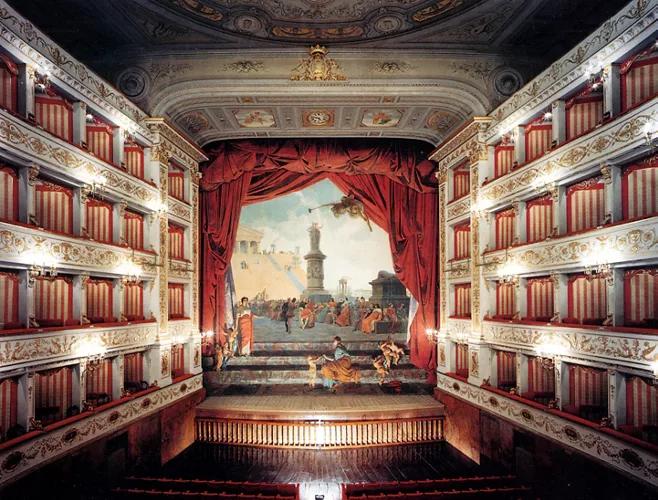
    The UNESCO-recognized serial site includes ten theatres distributed between Marche, Emilia-Romagna and Umbria. Eight are the Marches: the Teatro Gentile da Fabriano, the Pergolesi di Jesi, the Ventidio Basso di Ascoli Piceno, the Serpente Aureo di Offida, the Teatro dell’Aquila di Fermo, the Lauro Rossi di Macerata, the Feronia di San Severino Marche and the Bramante di Urbania. The Teatro Angelo Mariani of Sant’Agata Feltria and the New Gian Carlo Menotti of Spoleto join them.

    The inscription, deliberated according to the UNESCO III criterion, recognizes in these buildings an exceptional testimony of the transformation of the theatre from aristocratic space to cultural and civil institution. With this result rise to sixty-two Italian sites listed in the World Heritage List.

    For one evening, therefore, the proverbial sobriety of Marche can afford the luxury to applaud standing.

    That building where civilization was built

    The word condo, it must be admitted, it does not today enjoy a particularly lyric reputation. Evoca administrators, thousandths, grondaies in discussion and assemblies in which humanity sometimes offers less noble evidence than those contemplated by UNESCO.

    Yet, between the eighteenth and nineteenth centuries, that term could designate a much more ambitious pact.

    Municipalities and private citizens — nobles, professionals, traders, representatives of the emerging bourgeoisie — They participated together in the construction of the theatre, supported its costs, owned its stakes and shared its management. Thus the theatre was born not only by the will of a ruler or by the magnificence of a court, but through a collective investment of the community.

    It was not yet cultural democracy as we would like to see it today. The poles kept social distinctions, the hierarchies settled on different orders and, in addition to the show, everyone willingly contemplated himself. The story, moreover, never proceeds with the nectity of the manuals: it advances for compromises, contradictions and closed doors.

    But one of those doors really opened.

    The theatre came out of the exclusive aristocratic domain and became a city institution, a meeting place, a representation and even a formation of public opinion. UNESCO has recognized precisely this passage: not only the beauty of the rooms, but the social idea that had created them. The condominium model, founded on the collaboration between public institutions and citizens, made possible the diffusion of theatres even in small and medium cities, transforming them into centres of cultural, economic and political life.

    Those buildings, therefore, were not simply containers of shows. It was citizenship laboratories.

    On the stage there were passions, crimes, loves and revolutions; in the audience, in the meantime, a new society learned hard to look at, to recognize itself, sometimes even to discuss itself. And it is not a small thing that the public consciousness has found one of its first dwellings right there where men pretended to be others: often the theatre says the truth by using a mask, while daily life is very good at lying without even bothering to wear one.

    An architecture that can hear

    The Italian theatre is not a building in which, fortunately, music is produced. It is itself a musical instrument.

    The plant, the superimposed orders of the poles, the curvature of the room, the relationship between scene and plate, the reduced, the foyer and the ancient scenic apparatuses make up a true architecture of listening. Each element organizes vision, governs distance, collects and distributes sound. UNESCO emphasizes the attention reserved to acoustics and visibility, together with the presence of common architectural features, mainly linked to Neoclassicism, but still crossed by late Baroque influences.

    Before the orchestra agrees, the room has already chosen its stamp.

    The stakes placed vertically seem the voices of an agreement; the audience is the foundation; the stage opens the unstable area in which the order can turn into drama. The viewer looks at the scene, but also sees other spectators: he listens to music and, at the same time, takes part in a community gathered by listening.

    In these theatres opera found a capillary network through which to reach cities and villages. The crescendo of Rossinian, the long bellinian melody, the theatrical nerve of Donizetti, Verdi's word lit were able to circulate far beyond the great centers, penetrating the living fabric of the provinces. Before Italy became fully a political nation, the melodrama had already taught her a common vocabulary of passions, conflicts, sacrifices and freedom.

    The province, in this system, was not suburbs. It was blood circulation.

    Le Marche, a region built in the form of theatre

    Recognition would be important for any territory. For the Marches, however, has a particular force, almost the precision of an agreement finally resolved.

    This land is not organized around a single dominant city. It lives of large, small and very small centres; of villages lying on the heights; of communities that for centuries have defended their identity with tenacity. In this plural geography, the theatre became the place where each city could publicly pronounce its name.

    Alongside churches and civic palaces, ornate halls, stages, waiters, foyers rose. Not for decorative whims, but because a community that built a theater declared it wanted to be something more than a set of houses. He said he had a memory, imagination and a future.

    The Marches preserve a network of sixty-two historical theatres and a theatrical density, related to the population and the number of Municipalities, which has no equal in the Italian territory. Not all are formally part of the UNESCO serial site: the award covers ten theatres, eight of which are Marches. But the light that is now on those eight rooms inevitably illuminates the entire regional constellation.

    The Pergolesi, the Lower Wind, the Aureo snake, the Eagle, the Lauro Rossi, the Feronia, the Gentile and Bramante are not eight isolated monuments. They are the usual voices of a much larger choir.

    And this is perhaps the most beautiful victory: UNESCO has not rewarded the greatness of a capital, but the cultural tenacity of communities. He acknowledged that beauty can also become public in the centers away from the metropolis; that culture does not belong only to the places where power is concentrated, but also to those in which men decide to build together a space for listening.

    UNESCO is not a funeral crown

    It is at this point, just as the applause grows, that it is necessary to ask him to stop for the time of a breath.

    For every authentic feast bears with it a responsibility; and such a solemn recognition would risk taking a bitter irony if it celebrated as a living heritage what, in daily life, is left slowly to die.

    Alongside the large theatres with regular seasons, too many historic Marche theatres remain closed, inactive or entrusted to an occasional opening. Others are only on for a few appointments a year, devoid of continuous programming, stable staff, adequate resources and an artistic project able to really return them to the communities.

    We saved the stucco, but we risk losing our voice. We have restored the stakes, but we don't always let you back the public. We defended the facades from time, while silence, much more patient than moisture, continued to work inside.

    It must be said without celebratory attenuation: a restored theater is not necessarily a live theater. Open it once a year for a guided tour is not equivalent to living it; lighting the lights for a ceremony does not mean giving it back to the city; hosting some summer events does not replace a season thought, recognizable, capable of forming an audience.

    A theatre lives when the curtain rises regularly. When it offers work to artists and technicians. When he welcomes orchestras, companies, schools, conservatories, associations and young interpreters. When a child enters for the first time and understands, perhaps without knowing yet, that beauty is not a luxury reserved for adults or big cities.

    It is precisely the continuity of the theatrical function to constitute one of the essential elements recognized by UNESCO. The decision also recalls the need to involve local communities in the daily heritage management. This is not an accessory recommendation: these theatres were born through the participation of citizens and only through a new participation will survive.

    The recognition of 26 July must therefore become a reprimand for the institutions. It is not enough to finance the restorations: management, maintenance, personnel and especially programming must be supported. It is not enough to promote cinemas photographically: you have to fill them with shows. It is not enough to call them "cultural requirements" in the official speeches, if then, after the speeches, turn off the lights and close the door.

    The same regional cultural programming indicates among the objectives the support for fruition, integrated management, residential activities and the relationship between small theatres, conservatories and subjects of live show. This is where it is necessary to share: transforming the intent into calendars, projects into openings, resources into continuous cultural work.

    Municipalities must also be put in the conditions of collaborating, overcoming fragmentation and building a real regional network: shared productions, artists' circuiting, musical and theatrical residences, school projects, common ticketing, cultural itineraries. Sixty-two isolated theatres are likely to be sixty-two fragility; linked together they can become one of the most extraordinary cultural infrastructures in Europe.

    And a responsibility also belongs to the public. The theatres are not only saved by funding, but they cannot be abandoned by a few volunteers. They need citizens who frequent them, schools who know them, young people who feel their own. Culture is a right; but, like all the rights they want to remain alive, also ask for participation.

    UNESCO does not become a golden plate on a closed door. It is not the prestigious certification of a greatness spent, neither — worse — a funeral crown laid on beauty while it is still breathing.

    An extinguished theater is not a monument to rest. It's a betrayal promise.

    For this reason the recognition must mark the beginning of a new season: not only more visitors, but more shows; not only tourism, but cultural production; not only memory, but work, study, education and future.

    Otherwise we will have got the privilege of being admired from the world just as we stop listening to ourselves.

    An applause for the future

    On 26 July there was not simply an institutional path promoted by the Marche Region together with the Ministry of Culture, with the participation of Emilia-Romagna, Umbria and the Municipalities involved. It opened a new time.

    It's fair to celebrate. It is right to light the chandeliers, open the doors, tell this story to the boys, invite the audience to enter. It is right to thank those who have built the candidacy, scholars, administrators, restorers, technicians, artists and all the people who, often far from the spotlight, continued to believe that a provincial theatre was not a luxury of the past, but a necessity of the present.

    Above all, it is right to recognize the merits of the communities that have preserved these places over the centuries. The stones are not preserved by themselves. Velvets do not resist spontaneous devotion. Every heritage that has come to us is the result of someone who, at a time often difficult, decided not to abandon it.

    This time recognition not only celebrates what the Marches possess. It celebrates what the Marches are: a plural, laborious, discreet land; a region that has scattered theatres among hills, squares and villages because it has never considered beauty a privilege reserved to capital.

    But on July 26 it will really be a historical date only if, after the applause, someone will return to open all those doors.

    The world took place in the audience.

    He looked towards these small and great cities of central Italy and recognized in them a universal history: that of men and women who, putting together resources, ambitions and hopes, decided to build not only a building, but a space in which a community could imagine itself better.

    Now the lights go down. The caterpillar is silent.

    The curtain does not fall: it rises.

    And for the Marche region of the theatres, the story begins right from here.

    Leave a comment

EnglishenEnglishEnglish