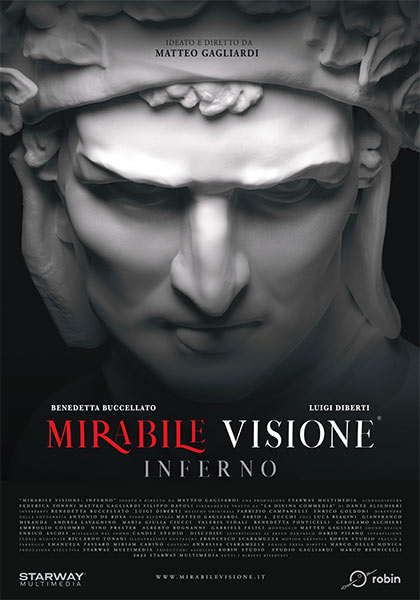
A cinematic reading of Hell that returns the philosophical depth and moral modernity of the Comedy.
by Marialuisa Veneziano
Ancona 25 March 2026, DanteDí
On March 25, the date that tradition recognizes as the beginning of the journey of Divine Comedy, Italy celebrates Dante, a national day dedicated to the Supreme Poet. It is not a purely commemorative occasion: it is rather an invitation to return to Dante as a source still alive of our thought and language. In this symbolic and cultural context, the vision of the film by Matteo Gagliardi is inserted with particular strength, a work that attempts — with awareness and respect — to return to the contemporary public the intellectual and poetic energy of Dante’s Hell.
Approaching Dante's Hell means measuring one of the most vertiginous moral and poetic architectures of Western civilization. It is not simply a poem, nor an allegorical narrative: Hell is a philosophical construction of human responsibility, a topography of the soul in which every penalty is the necessary consequence of a choice. Transposing this universe into cinematic language inevitably entails a risk: to reduce symbolic complexity to pure visual representation.
The film by Matteo Gagliardi shows a rare awareness of this challenge. His Dante is not treated as a monument to be illustrated, but as a living text to be questioned. The director seems to understand that Hell is not as much a place as a structure of thought: the place where Dante testes man’s freedom and his tragic ability to self-determinate in evil.
It is known that Dante’s Hell does not work as a simple catalog of sins. Each damned man represents a tension of the human brought to the extreme consequences. Francesca da Rimini is not only the adultererer transformed by passion: it is the tragedy of love that confuses its justification with fatality. Ulysses is not only the hero of knowledge: it is the symbol of intellectual hybris that claims to exceed the limits of the human condition. Ugolino is not only the figure of revenge: it is the terrible image of despair that devours itself.
In this sense, the greatness of Hell does not reside in punishment, but in the psychological clarity with which Dante looks at his characters. It does not reduce them to moral examples; it lets them speak. And while they speak, they reveal the drama of human freedom.
Gagliardi's film shows that he understands this deep dimension of the poem. He does not try to spectacularize Hell, but to return the character of universal human drama. The direction maintains a delicate balance: on the one hand the philological respect for the Dantesque word, on the other the awareness that cinema must translate that word into sensitive experience.
It emerges a Dante who preserves his original strength: that of a poet able to look at evil without stopping questioning man.
Moreover, the same structure of Hell reveals the modernity of Dante’s thought. The infernal circles are not only levels of punishment: they are a progressive descent into the deformation of reason. We start from the uncontrolled passion, we go through violence, we finally reach fraud and betrayal. The more human intelligence is used to deceive and dominate, the more guilt becomes serious. It is an ethical concept of extraordinary modernity, which focuses on the responsibility of the individual.
In this context, Dante's journey is not only an ultra-terrestrial itinerary. It's a cognitive path. Hell becomes the place where the poet learns to recognize the truth of human passions. Only through evil can one understand the need for salvation.
Gagliardi's film is able to return this pedagogical and philosophical dimension of the poem, showing how Dante continues to speak to contemporary sensibility. In an age that often perceives classics as distant objects, cinema can become a tool capable of reopening dialogue with that tradition.
This is where the cultural value of the work is grasped. It is not simply about telling Dante, but to return the urgency.
Because Dante, in the end, does not write only for his contemporaries. He writes for every age that he wants to question the fate of man. Hell is the place where humanity contemplates its possibility of falling, but also its ability to understand itself.
It is no coincidence that one of the highest moments of the poem is in the voice of Ulysses, when the desire for knowledge turns into a challenge to the human limit:
"You did not live like brutes,
but to follow virtute and canoscence. "
It is the verse that perhaps best summarizes the intellectual tension of the entire Commedia: the dignity of man lies in the search for knowledge, but that research must remain aware of its boundaries.
In this sense, the cinematographic Dante of Matteo Gagliardi succeeds in an uncomplicated task: to bring the viewer back into the great moral question that crosses the poem. Not so much what Hell is, but what man becomes when the sense of responsibility is lost.
And it is precisely this question to make Dante still necessary.
Because, as the poet writes at the beginning of his journey, every human existence knows sooner or later the moment of dismay:

"In the middle of the cammin of our lives
I found myself for a dark forest. "
The merit of works like that of Gagliardi lies in reminding us that the wild does not belong to the Middle Ages.
It still belongs to our conscience.


Leave a comment