From September 1st LaScalaTv opens its archive for free to the public. A revolution of access that poses a less simple question than it seems: if culture is not paid, it is worth less — or can it finally be worth for everyone?

by Marialuisa Veneziano
22 September 2026
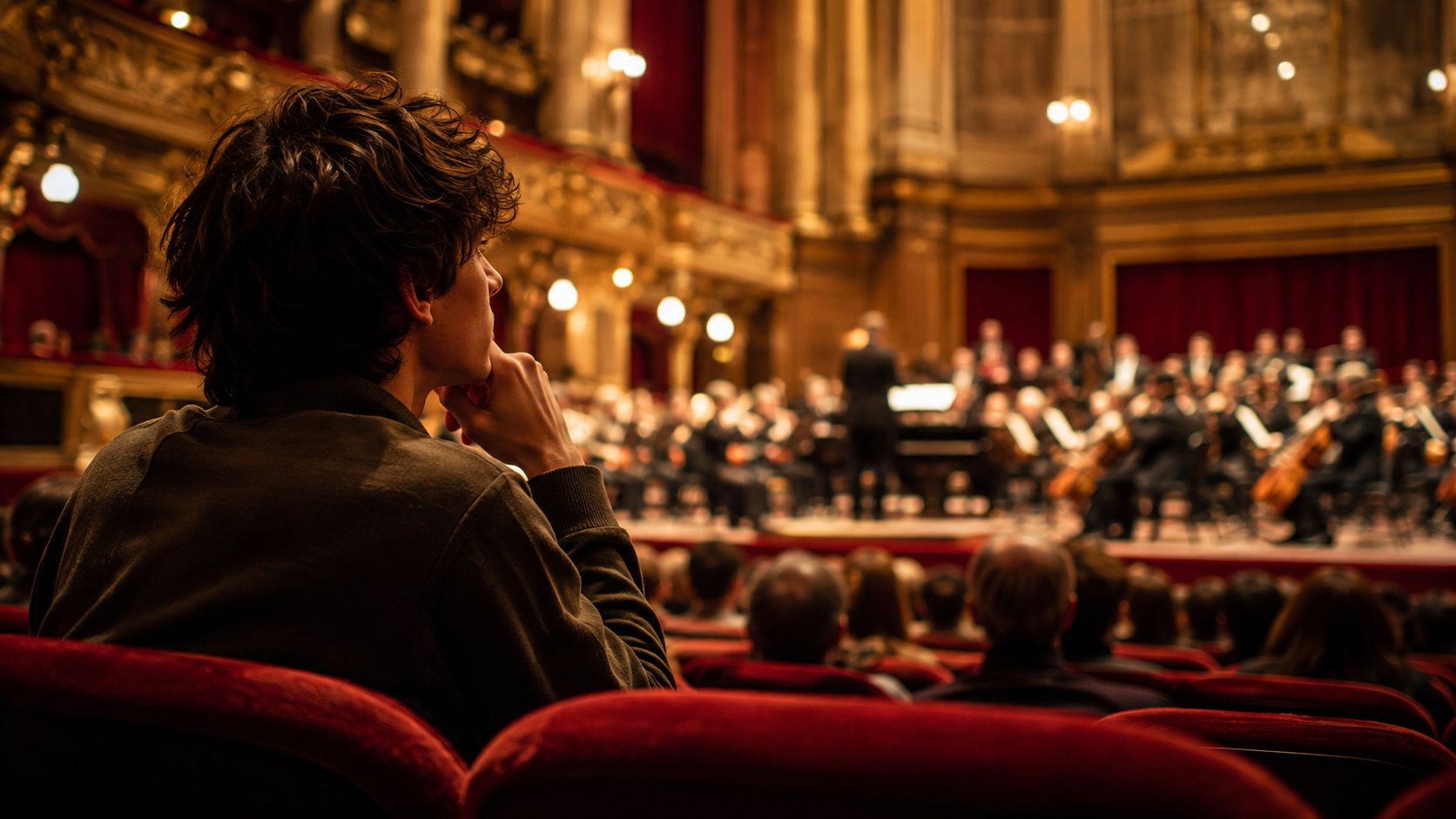
There is something slightly subversive in the idea of entering the Scala in slippers.
No red velvet. No foyer. No ladies who, after identifying their place, discovers with dismay that someone else has already sat there and starts that ancient Italian recitative that always begins with: «Excuse me, I think this is mine.».
No evening dress.
No Milan.
Not even a note.
From 1st September 2026, a free screen and registration is enough to enter LaScalaTv, the digital platform of the Teatro alla Scala. The service, born in 2023 and initially paid, has changed model: thanks to the support of Intesa Sanpaolo, the catalogue is now accessible free of charge after registration. No more purchase of the single content, no more compulsory subscription.
It's apparently simple news.
It actually contains a small cultural revolution.
Because when the most famous Italian opera house decides that a substantial part of its audiovisual memory can be reached without paying an entrance fee, it is not simply changing a list.
He is speaking on one of the most delicate words of contemporary culture: access.
And immediately another one appears. Value.
Because we're still oddly convinced that the two things are tied up.
If something is expensive, it must be important.
If it is free, somewhere in our brain begins to appear the suspicion worth less.
It is the same brain that considers a bottle of wine worth a hundred euros before even tasting it and looks with moderate skepticism a free conference on Kant.
The market has educated us well.
The music, fortunately, is a little more complicated.

The work has always been a question of doors
Since the melodrama exists, someone had to decide who could come.
At first they were short.
Then came public theatres for a fee: Venice, in the 17th century, transformed the aristocratic play into a theatrical work open to those who could buy access.
It was a revolution.
The work became public, market, subscription, success, fiasco, impresario, singers’ whim and composers’ concern.
In other words, he became very modern.
For centuries the opera house has been at the same time the place of art and place of social distinction. Going to the theatre didn't just mean listening to music.
It meant being seen.
Have a stage.
To belong to a city.
Participate in a rite.
The room itself told a society: audience, orders of poles, logging. Architecture and hierarchy looked at the show next to each other.
Then the record, the radio, the television.
And every time someone announced that the theater would die.
He has shown, so far, some stubbornness.

But seeing the Ladder on the screen means being at La Scala?
No.
And it's important to say it.
Otherwise, in an attempt to celebrate digital accessibility, we will end up devaluing just what we are trying to spread.
A recovery of Traviata It is not Traviata in the theatre.
IS another experience of Traviata.
In the room, the eye chooses.
We can watch Violetta or the director. We can lose for a few seconds the protagonist and observe a real appearance on the bottom. We can really feel the orchestra coming from the hole, perceiving sound pressure, space, breath of the room, cough of the neighbor at the least opportune moment.
The video shoot chooses for us.
It offers us the first floor.
He shows us his hand.
He leads us behind a scenic detail that we might have ignored from the audience.
Audiovisual assembly is not neutral.
It is already an interpretation.
The same goes for sound. In the hall the balance between voice and orchestra arises from the acoustics, the body of the singer, the position of the viewer. In streaming it passes through microphones, sound direction, compression and loudspeakers.
The theater is presence.
Streaming is mediation.
But "mediate" does not necessarily mean "lower".
It means different.

Walter Benjamin would probably open an account
When Walter Benjamin wrote about the work of art in the era of his technical reproducibility, he reflected on the loss ofaura: that uniqueness linked to the unrepeatable presence of the work in its own place and time.
The question comes back with a surprising precision.
What happens at the aura of La Scala when the Scala enters our computer?
A superficial answer would be: you lose.
But maybe something more interesting happens.
The aura does not necessarily disappear.
Move.
Streaming can even increase the desire for real presence.
Seeing from home the room of Piermarini, listening to a singer, knowing a work, understanding the plot can transform a perceived place as a stranger into something we finally want to cross.
A 2022 work on streaming work consumption found that certain values of digital experience — especially the cognitive one — can also be linked to the intention to attend the opera in the theatre. (Taylor & Francis Online)
It is not necessarily:
stream or theater.
Could be:
streaming before the theatre.
Streaming after the theatre.
Streaming because the theatre is far away.
Streaming because that title won't be back for years.
Streaming because we have thirteen years and no one, until yesterday, had ever shown us a work from the beginning to the end.

But be careful: "gratis" is a lying word
LaScalaTv is free to watch.
It doesn't mean that producing what we see is free.
This distinction is fundamental.
There are orchestras, choirs, singers, dancers, conductors, master collaborators, technicians, sarte, stage designers, lighting engineers, engineers, directors, audiovisual staff.
There are also nine fixed cameras installed in Piermarini, recovery systems, assembly, storage and digital management. The platform is economically supported by a sponsor.
Free culture is not expensive culture.

It is culture whose cost is sustained at another point in the chain.
Someone always pays.
The state.
A foundation.
A sponsor.
A patron.
A subscriber.
A taxpayer.
In the 17th century he paid the prince.
In 2026 you can also pay a bank.
History changes suit, but the account comes with remarkable punctuality.
And it's good that the audience knows.
Because making cultural content accessible for free does not mean that content has no economic value.
It means making a choice on who should bear the cost.
It's very different.
The most difficult question: just open the door?
Here we get to the most interesting sociological problem.
If we make the free work online, will new publics arrive automatically?
Not necessarily.
And it's a very important point.
A research presented in 2026 on the use of the OperaVision platform, based on 3.125 responses, has found a high added value of streaming especially for the already regular and faithful audience of the work; for users less interested or occasional, the simple digital availability is not always enough to change associations and attitudes existing towards the genre.
Translated:
opening a door doesn't necessarily mean you want to cross it.

If a person thinks that the work is incomprehensible, old, elitist and as long as a particularly complex income statement, being able to see it for free does not solve the problem alone. Cultural mediation is needed. We need to tell. Explain without childishness. Create curiosity. Give listening keys.
To make it clear that Verdi was not born to intimidate students and that Mozart did not spend his life knowing that one day he would appear in school programs under the threatening heading "Classicism".
Economic accessibility is a condition.
Cultural accessibility is a job. And maybe it's even the hardest job.
The work must not become easier. It must become less foreign
It's two very different things.
Every time we talk about new publics, the temptation to "simplify" appears.
Come in.
Let's modernize.
Let's make everything faster.
Let's put some contemporary light.
Maybe we add a projection in doubt.
But not always the problem is the work.
Sometimes it’s the way we presented it.
No one scandalizes if to understand a football game you have to know the out game.
No one claims to understand chess by randomly observing three minutes of a game.
With cultured music, instead, we have developed a strange claim: either immediately excites or failed.
It's not like that.
Some beauties require apprenticeship.
And there is nothing helitar in saying it, provided that apprenticeship is offered to all.
Streaming can be terrific right here.
I can stop.
Listen up.
Read.
Compare two productions.
Listen Götterdämmerung in more evenings without having to explain to my family that Wagner needs some logistic adaptation.
I can slowly build familiarity.
And familiarity is the opposite of the elite.
The screen can even teach us to see
There is also a musicologically interesting effect.
The audiovisual revival makes visible details that the traditional theatre distributes in space.
A first floor can show us how a singer prepares a breath.
How to change the articulation.
As a word is physically produced.
We can observe the director's gesture.
The relationship between hole and stage.
The attack of an orchestral section.
The expression of a character from the gallery would just be perceptible.
This produces a different form of spectators' competence.
It does not replace the acoustics of the room.
But he can train his eye.
The Metropolitan Opera has been working for twenty years on this transformation of operatic spectacle through Live in HD: in the 2026-27 season his film productions reach thousands of venues in about sixty countries.
The opera house is not simply going online.
He's learning a according to language.
And the sacredness of the theatre?
Someone could object to losing the rite.
Part of it is true.
Watching O on the sofa is not equivalent to entering the Scala.
Especially when God, you could have thrown me away. Someone interrupts to ask if we want a herbal tea.
But be careful not to turn the rite into fetish.
The theatre must be special.
It doesn't have to be intimidating.
There is a huge difference between protecting solemnity and safeguarding exclusion.
The work does not become less important because it can reach someone who lives far from Milan, who cannot afford a trip, who has motor difficulties, who is very young or who simply wants to understand if this world does for him before buying a ticket.
On the contrary.
Cultural heritage acquires strength when it can be known without being banalized.

It is not the gratuitousness to devalue art
The devaluation begins elsewhere.
Start when we consider music a background noise.
When we stop giving her attention.
When we imagine that, as we can easily reach it, it does not require work.
A public library does not devalue Dante because it lends free Comedy.
The public school does not devalue Pythagoras because it does not issue an invoice after the theorem.
A free museum makes no less important Caravaggio.
Access and value are not synonymous.
Sometimes they are even inversely proportional: making something valuable accessible is one of the highest forms with which a society recognizes its collective value.
This, however, involves a responsibility for those who receive it.
The gratuitousness should eliminate the price.
Not attention.
La Scala without Milan
There is finally something symbolically beautiful in this operation.
La Scala is one of the most popular places in Western musical culture.
Milan.
Piazza della Scala.
Piermarini.
The stakes.
The story.
Toscanini.
Down.
Move.
Callas.
Memorys that seem to belong indissolubly to those walls.
Yet now a part of that heritage can cross them.
Recent productions and historical materials live in the catalogue; the project also continues with new publications and direct streaming. Among the events already announced, the concert of 25 September directed by Daniele Rustioni, with Brahms and Schumann's Second Symphony, will be broadcast free of charge and will remain available on demand for a few days.
La Scala remains in Milan.
But it is no longer necessary to be in Milan because a part of La Scala arrives to us.
It's a huge cultural difference.
The real luxury
Maybe, then, we misformed the question.
We should not ask ourselves:
"If the work is free, will it lose value? "
We should ask ourselves:
"What will we do with the privilege of listening to her? "
Because for centuries millions of people had no chance to hear a great orchestra, see an important production, compare interpretations, access the archives of the great theatres.
Today we can do it from a screen.
It's not the theater.
He doesn't want to be.
It is another door.
And perhaps the real risk is that the work, becoming accessible, loses its aura.
The risk is much more contemporary:
finally have the door open and no longer find the time to enter.
Having access to Mozart, Verdi, Wagner, Puccini, ballet, symphony, archives, great directors and great interpreters — and continue to distract the screen because something shorter has just sent us a notification.
Technology can lower the price.
It can abolish the distance.
He can take La Scala to a house he could never afford to get to La Scala.
But one thing can't give us yet.
Attention.
We have to put that on.
And perhaps, in the age of infinite abundance, it is precisely the focus of becoming the most expensive ticket.
LaScalaTv is free today.
The music, fortunately, keeps asking us a price.
Not in euro.
In time.
In curiosity.
In readiness to let us be surprised by something we do not yet know.
And this is perhaps the most beautiful way of understanding a truly public culture:
not a culture that is worth little because it costs nothing,
but a culture that is precious enough to decide no one should be excluded before even having had the opportunity to meet her.



Leave a comment