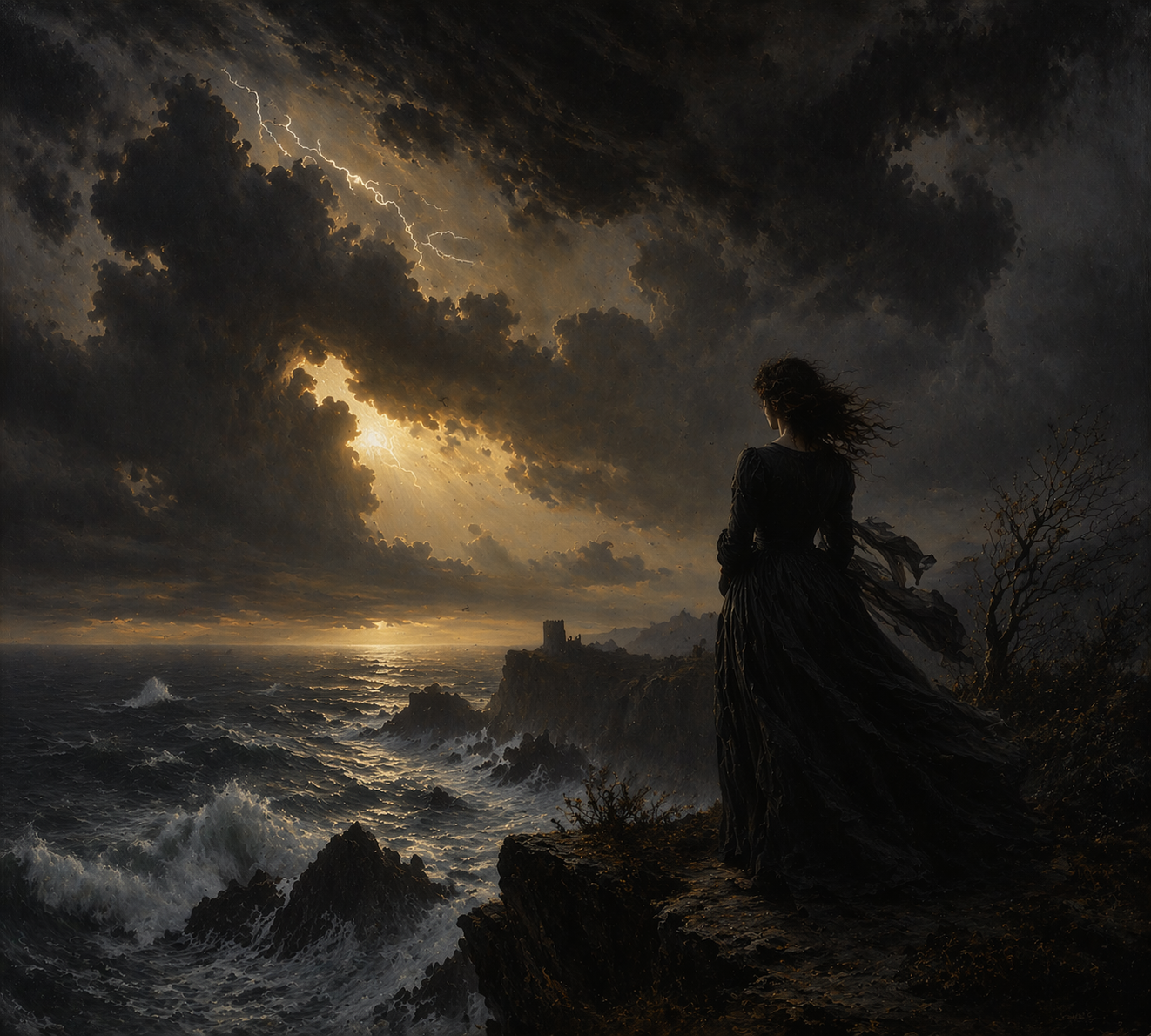
A recollection of the soul between sound and silence, where fear unfolds and death is revealed in its composed truth.
by Marialuisa Veneziano
Ancona 15 April 2026
I remember almost embarrassing clarity — as it happens for those moments who do not ask to be remembered and just for this they do not forget — the evening in which, without any particular disposition, I found myself listening to the Requiem of Fauré. There was neither in me nor the fervour of the scholar, nor the devoted expectation of those who approach a sacred work with the intention of being built of it; indeed, if I must be honest, I carried with me that elegant distraction and a little guilty of those who believe they can cross the beauty without being touched.
And yet, few jokes were enough — few, but of such a unique quality to escape any frantic description — because my safety, so well-disposed and so unfounded, was intrigued with a discretion that, if it had not been so deep, could have exchanged for kindness.
There is nothing that would be expected of a Requiem. No harsh gravity, no sense of imminent catastrophe, none of those solemnities that, more than rising, sometimes seem to please their own weight. But there was a sort of measure — and give me the term, though imperfect — that did not humiliate the pain, but did not even exhibit it; a composure that did not deny death, but it deprived it of all theatricality.
It was then that I understood, not without some inner resistance, that Gabriel Fauré did not intend to persuade me of anything. He did not want to teach, nor to move in the most immediate sense of the term; and his renunciation — so unusual, so little accommodating — It produced a more radical effect than any statement: it left me alone, but not abandoned; exposed, but not threatened.
It is as unique as, in the history of music, the most daring works are recognized not so much for what they say, as for what they dare omit. In the case of the Requiem of Fauré, this omission assumes an almost philosophical character: he renounces terror. There where others — and just evoke the names of Wolfgang Amadeus Mozart and Giuseppe Verdi — they had questioned death through tremor or challenge, Fauré chooses a way that, at first sight, may appear less intense, but that, at a more careful glance, it turns out to be an almost disconcerting audacity: he removes his apparatus from death.
And what remains, when the end of his most feared images is deprived?
It remains, to say it with a frankness that does not exclude grace, the simple fact of not being able to continue. A limit, and nothing more.
Now, if there is something that the human soul endures with difficulty, it is not so much the presence of evil, as the absence of a form that makes it intelligible. Judgment, punishment, even punishment — all these figures, however terrible, have the advantage of offering a narrative. But Fauré, with a discretion that shatters irony, withdraws this narrative, and leaves the listener in front of a more naked truth, and therefore more demanding: that of an existence that does not need to be justified or punished, but only understood in its end.
This understanding, however, does not give itself as a concept, but as an experience — and, as far as I am concerned, it was revealed with unexpected clarity in the "Sanctus".
There is, at that time, an appearance that escapes any ordinary description. The harp — and here every word risks being either too poor or too stressed — does not accompany, does not say: inaugurates. Its sound stretches out with a naturalness that makes it forget its origin, as if it were not produced, but simply given.
Then I had the singular impression — that I could not defend with arguments, but that I cannot deny — to find me suspended. Not raised, not elevated in the rhetorical sense of the term, but freed from the very weight of being placed. It was like planar, yes, but without wind, without direction: above an infinite sea, immovable, whose extension did not arouse dizziness, but an unexpected quiet.
The ropes of the harp drew, so to speak, the surface of this sea; and when the choir entered, he did not do it to dominate it, but to live it. The voices rested on that sound as light on water, without ripple. There was nothing solemn in the common sense: no affirmation, no will to rise. And yet, precisely in this renunciation, something was manifested higher than any elevation: a presence that did not ask to be recognized, because it could not be denied.
If the "Sanctus" was, so to speak, a revelation of space, the "Pie Jesu" was a revelation of the limit.
Here the music is portrayed again, as a person of great education who, having said the essential, does not insist. The single voice arises, and its simplicity is such as to disarm every attempt of interpretation. There is no supplication in the dramatic sense of the term; there is no urgency, nor fear. There is, rather, a form of abandonment that has nothing passive, but that comes from such a complete understanding that you no longer need to resist.
I remember having felt, at that moment, a feeling that I could describe — with some fear of being misunderstood — like a loss. Not loss of something dear, but loss of a tension. As if a part of me, always vigilant and always ready to oppose, had suddenly been found without function.
And it was then that death, a word that until then I had dealt with that prudence that is proper to things not understood, ceased to appear to me as a violent interruption. She became a friend — would be an expression too easy — but stopped being enemy.
In this transformation of the gaze, which happens without declaring itself, is perhaps the highest lesson of the Requiem of Fauré. There is no consolation, because consolation implies a promise; and Fauré, with a coherence that shatters the severity, refuses to promise. There is not even despair, because despair requires conflict, and here the conflict has already been overcome.
There is, however, a sort of balance — fragile, of course, and yet sufficient — that comes from the renunciation of images that, while making death more bearable, make it even less true.
When, finally, the "In Paradisum" unfolds, it is not the impression of reaching a conclusion, but of witnessing a progressive subtraction. The voices are made to read, the harmonics are rarefied, as if the sound itself, reached the limit of its need, retreated with an almost moral discretion.
There is no triumph, there is no landing. There is, rather, the lack of that need — so deeply human — to reach.
And perhaps, if I am given a conclusive thought, it is precisely here that the work reaches its highest truth: in suggesting, without ever affirming it, that the end is not an event to understand, but a condition to welcome; and that such acceptance, far from being a surrender, can constitute — for short and precarious — a form of peace.


Leave a comment