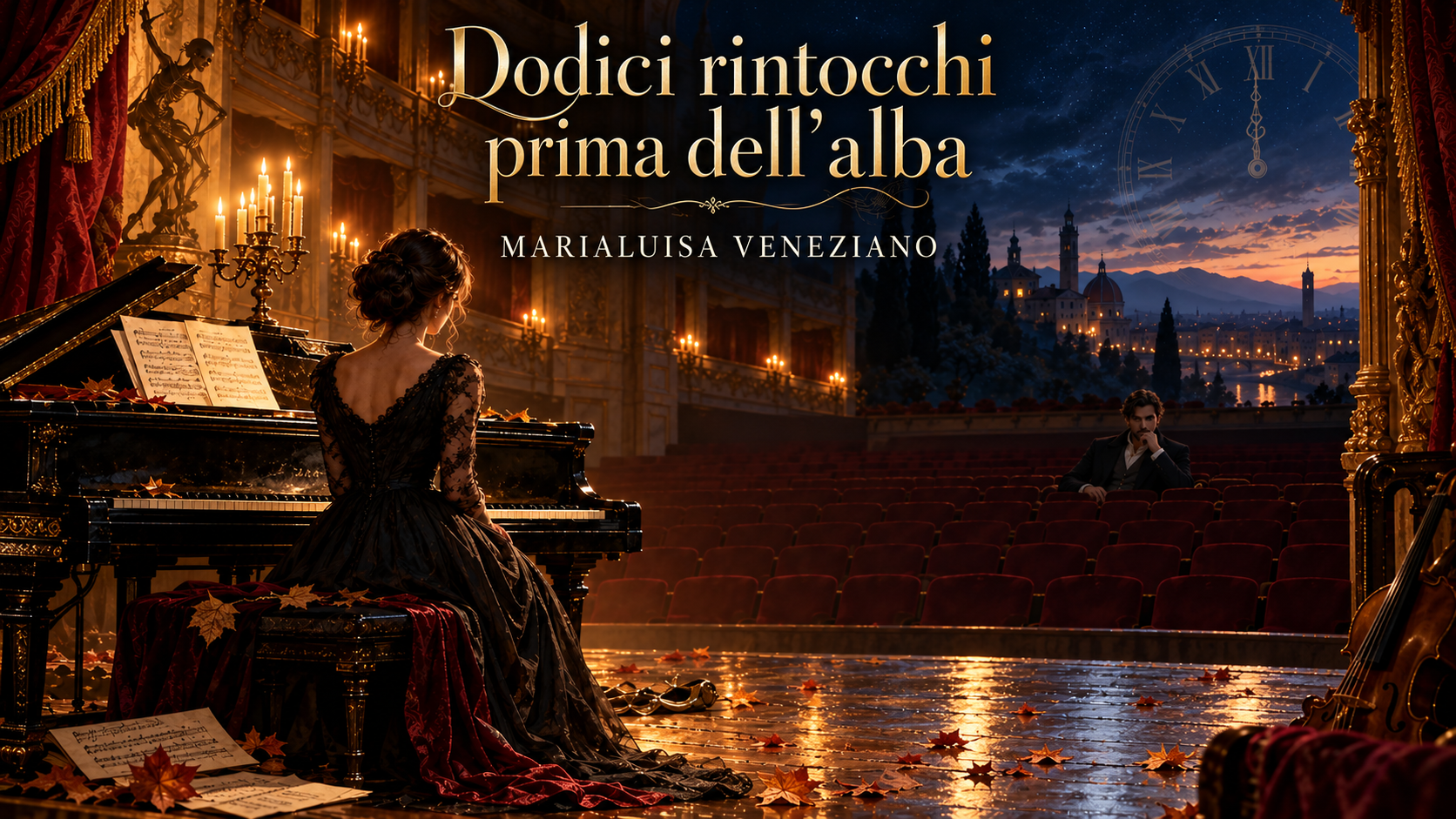
A story about what ends, what remains and what continues to resonate.
by Marialuisa Veneziano
***********
🎧 MUSIC FOR LETTURE – I (Click on the black arrow to make the listening appear)
To accompany reading Twelve touches before dawn, we recommend a musical path that does not act as a simple background, but follows the emotional breath of the novella.
It starts with Camille Saint-Saëns, Danse macabre, op. 40
This music not only accompanies reading:
opens a threshold.
First night dance.
Then the pain takes voice.
And finally there's that mysterious resonance that death can't completely shut down.
Listen to her by reading.
And when the dawn comes, perhaps you will understand that not all that disappears really stops resounding.
There are people who leave our lives with such discretion that, for some time, we continue to leave them a place.
Not necessarily at the table, because domestic habits, unlike the heart, have an enviable layout to practicality and learn early enough to count the dishes. It is elsewhere that that place remains: in a phrase that comes to us to tell them precisely; in the sudden reflection of a face that is not theirs; in a street where the step slows down without which we commanded it; in an object that we would not have any reason to preserve and that nevertheless survives to move, clean, angry and good intentions.
Sometimes he stays in music.
A certain sequence of notes, an agreement, the way a violin enters after a silence: and here is that a person who is not in the room returns you with a precision that no photo would have obtained.
Men call all this I remember.
It's a comfortable word.
And above all ordered.
Put the living on one side, what is no longer on the other; fix the past in a decorative shelf and let the present freedom to take care of their own affairs.
But the heart, it must be said, has never shown a particular inclination for the archives.
He keeps what he wants.
He loses what he should keep.
Reopen rooms that we thought were walled.
And there are nights in which even time, which is usually quite scrupulous official, seems distracted.
The night of October thirty-one was one of those.
Elena came to the theater shortly after eight.
It rained for hours, but without conviction: one of those thin and stubborn autumn rains that do not make noise and, however, when they are finished, they impregnated everything.
The square was shiny.
The lights were doubled on the stones.
The facades of the buildings seemed darker than usual and the windows lit, seen from outside, had something remote, almost as if they were lives observed from another time.
Elena crossed the road by tightening the folder against her chest.
The theatre welcomed her with the usual disorder.
There was someone looking for a pencil.
Who was looking for the person looking for the pencil.
A technician shouted that there were five minutes missing asking at the same time silence.
A door opened.
Another closed.
A man with a tag crossed three times the corridor in opposite directions and with the same urgent air, evidence not negligible that much of the human face is to convince yourself to know where you are going.
Elena knew that agitation.
She almost liked it.
Before a concert a theatre is not yet the place of art: it is a nervous organism that desperately tries to look elegant before the spectators enter.
On the stage, however, everything was still.
The piano was waiting.
Black.
Open.
The polished surface collected the lights from above and the deformed restitutions.
On the leggio there was the score.
Camille Saint-Saëns. Danse macabre.
Below, Liszt's name.
Elena just smiled.
He always found the ambition with which Liszt treated the orchestras: Saint-Saëns had laid strings, wood, harp, percussion, solo violin and even a discreet number of skeletons; Liszt, who arrived later, decided that all this could be easily entered into a piano.
The modesty, however, was never the main defect of certain genes.
Elena put her fingers on the paper.
He's known that music for years.
He had studied it.
Analized.
Explained.
He had shown other students those twelve initial shots, the entrance of the violin, the scoring, the triton, the xylophagus, the Dies irae, the rooster song.
He knew about engineering.
Yet there are compositions that, even when we know how they are made, continue to escape.
The Danse macabre It was one of those.
The legend was almost childish in its simplicity.
At midnight Death comes out.
Accord the violin.
The dead rise.
They dance.
At dawn the rooster sings.
The graves take them back.
That's it.
But Saint-Saëns had understood something that perhaps belongs more to the philosophy than to music: death becomes really creepy not when she cries, but when she laughs.
He didn't write a funeral march.
He wrote a dance.
The bones didn't moan.
They grew up.
The dead weren't begging.
They danced.
Death itself did not come with a serious and solemn step, but with a violin.
A violin, however, deliberately altered.
The sharpest rope lowered.
Bemolle against La.
A triton.
That sound suspended, unresolved, which doesn't seem to know where to fall.
Elena thought it was one of the most beautiful insights of all composition.
Death entered the world of the living with an instrument that everyone knew, but no longer accorded as it should.
Almost to say: the world is the same. Only a range has changed. Yet from that moment nothing sounds the same.
He realized he had delayed.
He raised his eyes.
The hall doors were open.
The audience came in.
Dark coats.
Closed umbrellas.
Folded programs.
Say hi.
People looking for their place with that slightly comical seriousness that humans reserve to the numbers printed on an armchair.
Elena distracted the files.
First.
Second.
Third.
Then back.
And he saw it.
He didn't think his name right away.
The body came first.
The hand holding the score stopped.
The breath broke.
The heart did something strange: it accelerated and together seemed to miss a blow.
Then the name came.
Lorenzo.
He was sitting in the last row.
Almost downtown.
Dark coat.
Hands braided in front of him.
He looked at her.
Elena stayed still.
How long have you seen him?
The answer existed.
He could have even counted it.
Months.
Days.
Hours.
But at that time measured time had no meaning.
When an important person suddenly comes back in front of our eyes, the past does not appear with a calendar.
Everything's coming together.
A gesture.
A voice.
A sentence.
An absence.
One question was suspended.
Anger.
The tenderness.
And that particular form of amazement that arises only when we see someone we have now learned to meet only in thoughts.
Lorenzo didn't smile.
Neither do you.
They stayed like this for a few seconds.
Among them were dozens of armchairs, people who spoke, lights, a piano, years of things said and especially of things not said.
And yet to Elena it seemed there was nothing.
He stepped towards the edge of the stage.
— Teacher.
A voice behind him.
Elena turned abruptly.
— Yes?
— Five minutes.
— Yeah.
When he returned to look at the bottom, Lorenzo was still there.
This time he just bowed the boss.
Nothing more.
Such a small gesture that anyone else would have seen nothing.
She does.
He knew him.
Go.
Because people who have long lived within us end up leaving a vocabulary that has no words.
A eyebrow.
One hand.
The way they tilt the head.
The breath before a sentence.
Elena inspired slowly.
Then he sat at the piano.
The caterpillar ceased.
The hall was built.
She didn't start right away.
She liked to talk about music before she played it.
Not to explain.
Music doesn't need a lawyer interpreter.
But because sometimes it is enough to point out to someone a detail so that when that detail arrives, listening suddenly becomes conscious.
— Before starting — he said, — I'd like to ask you to listen to something very simple.
He looked up.
— The beginning.
A break.
— Saint-Saëns does not show us the cemetery. He doesn't describe us at night. He doesn't need to. He's only 12 hits on the same note.
He made a light gesture towards the score.
— Midnight.
His words crossed the hall.
Elena looked instinctively towards the bottom.
Lorenzo was there.
Very real.
— Then Death comes.
Someone smiled.
— And here Saint-Saëns makes a wonderful choice. It does not entrust it to the orchestra’s most severe instrument. He doesn't let her in with a dark, heavy sound. He gives her a violin.
A child in the front row moves into the chair.
— And it changes the tuning. The sharpest rope is lowered from Mi to Mi bemolle. In this way, against La, a triton arises.
Elena left for a second.
— A disturbing sound. Unsteady. A range that over the centuries has earned even a suggestive name: diabolus in music.
The girl in the first row opened her eyes.
Elena smiled.
— Then you will feel the bones. In the orchestra is the xylophone to evoke them. Not with a terrifying sound: with a dry, almost playful noise.
He looked at the score.
— Further the Dies irae. The ancient medieval song of the day of judgment. But Saint-Saëns takes him and drags him into the dance, almost to deform him.
He took a longer break.
Then he said,
— And finally the dawn comes.
This time he looked directly at Lorenzo.
— The oboe imitates the chant of the rooster. And when the rooster sings, the dead must return to the graves.
Lorenzo lowered his eyes.
Elena heard something.
He couldn't have said what.
A thick little girl.
Almost an omen.
I'll ignore him.
— The night is over.
He put his hands on the keyboard.
And it started.
The twelve hits fell into the hall.
Net.
Equal.
One.
Two.
Three.
Elena knew them so well that she didn't have to count them anymore.
But that night, as he played them, he had the crazy feeling that someone else was counting on her.
Four.
Five.
Six.
Every note seemed to open a door.
Seven.
Eight.
Nine.
When she arrived at the last, she just held her breath.
Twelve.
Then the triton.
La.
Bemolles.
Two sounds.
Nothing else.
Yet the whole room changed.
Elena always loved that moment.
Saint-Saëns did not need to say: «Here is Death».
It was enough to alter his familiarity.
The music seemed the same.
But he wasn't.
Elena's hands entered the dance.
The piano became orchestra.
Or at least he tried, as every transcript of Liszt forces a pianist to do with a certain lack of piety.
Your fingers were running.
The agreements overlapped.
The lines chased.
She was looking for the lightness of the violin, harp, bows, dry noise of the bones.
When the imaginary xylophagus came, he thought how brilliant that effect was.
Tac.
Tac-tac.
Tac.
Don't worry.
Not pain.
Bones dancing.
The private death of his tragic dignity and forced to become rhythm.
Because, in the end, this is also a form of equality.
In front of macabre dance there is no noble, poor, wise, foolish, lucky or unhappy.
The bones make the same noise.
The audience was breathing together.
Elena played.
And he knew where Lorenzo was.
He didn't look at him.
He didn't need it.
The last row seemed to have a weight.
A precise point in the room was a presence on her.
Then came the Dies irae.
The theme emerged in the music fabric.
Ancient.
Recognizable.
But deformed.
Almost irony.
And then something happened that Elena couldn't explain.
From the piano it seemed to meet a note that had not played.
Not a mistake.
Not an acoustic bounce.
Something further.
As if, under the music, there was another.
An echo.
He heard it.
And she didn't feel it right now.
The fingers continued.
The dance became more and more hectic.
The skeletons of Saint-Saëns were spinning.
They laughed.
They chased.
Until, almost suddenly, the night began to yield.
In the orchestral version, the oboe would sing the rooster.
That evening there was only the piano.
And yet Elena heard it.
Not with the ear.
Somewhere more internal.
A simple voice.
A call.
Something he said:
Stop.
The dance broke.
The last note is lost.
For a moment no one applauded.
Elena always loved that short space.
The second in which the music is no longer there and men have not yet returned entirely.
Then the room exploded.
Applause.
She got up.
He jumped.
I looked at the last row.
The place was empty.
******
🎧 MUSIC FOR LETTURE – II (Click on the black arrow to make the listening appear) Camille Saint-Saëns – Requiem, op. 54
From this point, let the dance slowly give way to another voice of Saint-Saëns.
The night continues, but the music changes: what first belonged to the mystery of the Macabre Danse becomes more intimate, serious, human.
While Lorenzo and Elena finally begin to talk about what time had left suspended, the Requiem accompanies the story towards its deepest meaning.
Don't interrupt reading. Just let the music change.
******
It seemed such a rapid disappointment that almost irritated her.
«Of course.», thought.
It was typical.
Comparison.
Move something.
And then take off.
He ended his greetings.
He talked to someone.
He received compliments he forgot while still listening.
A lady told her that the xylophagus was magnificent.
Elena thanked her without pointing out that there was no one.
Human beings, when they listened with sincerity, sometimes deserve to retain what they imagined.
He picked things up.
Use it.
Lorenzo was under the porch.
Approached to a column.
The rain had ceased.
On the stones remained a wet light.
Elena stopped.
He smiled.
— You really came.
— I said I'd listen to you sometime.
She broke her forehead.
— I don't remember you ever promised.
Lorenzo made a little gesture.
— Then I must have thought it very hard.
That answer.
Exactly that way of taking a sentence, just move it and return it without having responded.
Elena felt something that she knew well.
Irritation.
And, much more embarrassing to admit, she did well.
Because there are people who have missed us so much that, when I reappear, even the defect that used to exasperate us acquires the tenderness of the things found.
— You could have warned me.
— And lose your face when you saw me?
— It wasn't a good face.
— She was very informative.
She tried to keep her smile.
He couldn't.
They stayed a few seconds without talking.
They had a lot to say.
And, as it happens almost always when two people have a lot to say, no one knew where to start.
Lorenzo looked at the square.
— Shall we walk?
Elena should have said no.
It was late.
It was cold.
He just played.
She was hungry.
He had a normal life to take.
And above all, he had spent a lot of time convincing himself that if Lorenzo had ever returned, he would have known exactly what to do.
He said:
— Yes.
They crossed the square.
The last people came out of the theater.
A lady explained to a friend how much she liked «that noise of the xylophone».
Elena laughed.
— What? — asked Lorenzo.
— Nothing.
— When you say "nothing" there is always something.
— That lady is praising the xylophone.
Lorenzo looked in the direction indicated.
— Maybe he has an exceptional hearing.
— Or much imagination.
— Don't underestimate her.
— The imagination?
— He filled more concert halls of music.
Elena looked at him.
— That's good.
— You can use it.
They walked.
She watched him side by side.
There was something different.
Not in the face, maybe.
Or not just.
The light of the lamps fell on him in a strange way, but the night light is a great falsifier and Elena did not trust.
— Where have you been?
Lorenzo looked ahead.
— Around.
— Extraordinary answer.
— I worked on it.
— You had time.
— A lot.
Elena stopped.
He did one more step.
Then he turned.
— What?
— Don't do that.
— Like what?
— Like it's been a long time.
Lorenzo lowered his eyes.
— I didn't say that.
— No. It's worse. You act like nothing happened.
Quiet.
Elena felt anger up.
Not violent anger.
The oldest.
Tired.
— You're gone.
Lorenzo said nothing.
— And you know the worst part?
He looked at her.
— No.
— That there was not even a precise moment in which I could say: behold, it is over.
Her voice went down.
— If someone bangs a door, at least you have a door to hate. If he says, "I don't want to see you anymore," you can hate those words. You can remember them. You can argue against yourself if you want to waste time.
She smiled bitterly.
— But when someone just stops...
He couldn't finish.
Lorenzo did.
— There.
She raised her eyes.
— Yes.
It was a simple word.
Yet among them he became something huge.
Being.
Such a small verb.
The whole world that can contain us.
I'll walk again.
A little later there was a small bar still open.
They came in.
Behind the counter, a man was stacking glasses with the expression of those who considered customers an administrative abuse.
Elena sat down.
Lorenzo in front.
— Two coffees — He said.
The bartender nodded.
He returned shortly after.
One cup.
Elena called him back.
— Sorry. I asked two.
Man looked at her.
— Two?
— Yes.
Lorenzo intervened.
— Forget it.
Elena turned to him.
— What?
— I don't want any.
— You could have said that before.
— I didn't thirst.
She fixed it.
— Coffee doesn't drink for thirst.
Lorenzo smiled.
— This is one of the things I never understood of the living.
Elena stopped raising the cup.
— The living?
One second.
He smiled more openly.
— Italians.
— Ah.
Elena drinks.
The sentence stayed somewhere.
Not close enough to consciousness to become a thought.
The things that warn us, moreover, have this defect: they almost always become clear only when they no longer serve.
They went out.
The city was almost empty.
After midnight the streets lose their job.
Shops don't sell anything anymore.
The bars close.
The windows turn off.
Walls, stones, bells, corners remain.
The bones of the city.
Lorenzo put his hands in his pockets.
— You know what always struck me about Danse macabre?
Elena looked at him.
— Let’s see if you pass the question.
— It seems late to study.
— So?
— That the dead have one night.
— It's the legend of departure.
— Don't play musicologist.
— It's hard.
— For once.
She laughed.
— All right. One night for what?
Lorenzo continued to walk.
— To come back.
— They don't really come back.
— I know.
— It's symbolic. Macabre dance comes from an iconographic and literary tradition in which death...
Lorenzo sighed.
— You are.
— What?
— The musicologist.
Elena smiled.
— I told you it was difficult.
— Try again.
She made a gesture.
— All right. So, the dead have one night.
— Yes.
— Does that sound good to you?
— Generous.
Elena turned.
— Generous?
— Very.
— A story where skeletons come out of graves?
— He gives them one night.
— To do what?
Lorenzo stayed a few seconds quietly.
Then he said,
— To remember being alive.
Elena didn't answer.
He felt something tightening her chest.
Not pain.
Not yet.
Something subtler.
Almost a note out of harmony.
At that time the bells began to beat.
Lorenzo raised his head immediately.
One.
Two.
Elena smiled.
— Really?
Three.
— Are you counting?
Four.
Lorenzo did not answer.
Five.
Six.
— Lorenzo.
Seven.
Eight.
Nine.
He continued.
Ten.
Eleven.
Twelve.
Quiet.
Lorenzo slowly lowered his hand.
— All in order.
Elena fixed it.
— You were afraid the 13th would come?
— Don't worry.
— And what?
— Curiosity.
— Have you become superstitious?
— No.
A half smile.
— Just more attentive to what ends.
Elena looked at him.
He started walking again.
She followed him.
They passed in front of an old building.
Elena slowed down.
Lorenzo noticed.
— Remember that?
She looked at him.
— You do?
— It rained.
— It was often raining.
— You had that umbrella.
Elena laughed.
— It was a great umbrella.
— Water fell on you.
— He had a personality.
— It was broken.
— It was conceptually an umbrella.
Lorenzo laugh.
And that laugh came to Elena with unexpected violence.
Because it was the same.
Not like that.
Equal.
A sound that time did not change.
For a moment, she felt nothing had happened.
That's enough for that laugh to erase everything.
Lorenzo indicated the gate.
— You got mad at me here.
— I was right.
— Of course not.
— What were we fighting about?
He shut up.
Elena looked at him triumphant.
— See?
Lorenzo laugh.
— I don't remember.
— So what do you need to remember so well?
He looked at her.
The smile just disappeared.
— When you can no longer add anything to a story, you become very good at remembering what is already there.
Elena heard the phrase in.
Slowly.
— What does that mean?
Lorenzo distracted his gaze.
— It means you had a terrible umbrella.
— Lorenzo.
He didn't answer.
And right then, from a window opened later, music came.
A harp.
Then the violin.
Elena stopped.
— I don't believe it.
The Danse macabre.
The orchestral version.
Go away.
Someone in a house was listening.
Lorenzo lifted a hand towards her.
— Let's dance.
Elena looked at him.
— No.
— Why?
— Because we're in the middle of the road.
— I don't see the problem.
— I do.
— It's Halloween.
— So what?
— Saint-Saëns is dancing the dead in a cemetery and you fear the judgment of the condominiums.
Elena shook her head.
— You're ridiculous.
— I know.
— What if someone passes?
— He'll think we're alive.
The sentence passed.
Elena didn't hold her.
He looked at his hand.
Then Lorenzo.
He took it.
They danced.

Bad.
Which saved the scene from all sentimentalism.
Lorenzo tried to lead her.
Elena ran his rhythm.
— You're anticipating.
— We're dancing, not doing an exam.
— Time is time.
— Here.
— What?
— You want to run when you dance.
— I'm a musician.
— Is it bad?
— Chronic.
He made her turn.
Elena stumbled and burst out laughing.
He really did.
With the face just backwards.
With that kind of laugh that hadn't been through for a long time no thought.
For a few seconds the night had no weight.
Music grew.
The bones of the xylophagus began to beat.
Tac.
Tac-tac.
Tac.
Elena thought of the finding of Saint-Saëns.
Death reduced to noise.
The body, after all claims, ambitions, dresses, titles, fears, transformed into percussion.
The narrator of medieval macabre dances would have found it a reasonable idea: kings and beggars, once reduced to the essential, keep the same pace gradually.
He looked at Lorenzo.
He saw him different for a moment.
younger.
Not in the face.
The way he was in the night.
In the smile.
The way he looked at her.
A Lorenzo who belonged to before.
Before hesitation.
Before the distance.
Before each learned to protect himself.
She stopped laughing.
— What is it? — He asked.
— Nothing.
— Again?
— I reminded you differently.
Lorenzo slowed down.
The music continued.
— We all remember the other different.
— Why?
He thought about it.
— Because memory doesn't keep people.
— And what do you keep?
Lorenzo looked at her.
— The way we were when we were with them.
This time the sentence hurt.
Not now.
Things that really hurt often need a few seconds to find the right place.
Elena lowered her eyes.
I'll walk again.
From the house away Dies irae began to emerge.
She recognized him immediately.
— There he is.
Lorenzo listened.
— Judgment.
Elena looked at him surprised.
— Day of wrath.
— Not "death song."
— I see you studied.
— I listened to you.
— Not always.
Lorenzo just smiled.
— More than I thought.
The ancient melody passed deformed through the orchestra.
— You know what I find weird? — He said.
— What?
— Let the judgment come to the end.
Elena attacked her forehead.
— It would be hard to do it first.
— Not so much.
— Explain.
Lorenzo continued to look ahead.
— Maybe the judgement comes when you can't fix anything anymore.
Elena felt cold.
Not the cold of the night.
Another.
— Why are you talking like that?
— Like what?
— Like I know.
Lorenzo died.
Then:
— We all know.
— That's not true.
— Yes.
He looked at her.
— Just, as long as we can, we pretend we have more time.
Elena stopped.
He didn't want metaphors anymore.
He didn't want Saint-Saëns.
She didn't want the night.
He wanted the question.
The one who waited too long.
— Why did you leave?
Lorenzo closed his eyes for a moment.
— It's not easy.
— I don't want it to be.
— Elena...
— No. Don't.
He looked at her.
— What?
— Don't protect yourself with complications.
Lorenzo remained still.
She continued:
— Why did you leave?
He spent a few seconds.
Then he said,
— I was scared.
Elena didn't expect that word.
She was prepared for almost everything.
Not that.
— About what?
Lorenzo looked at the road.
— What would have happened if I chose.
— Then you chose not to choose.
— Yes.
— Comfortable.
He looked at her immediately.
— No.
It was the first really hard answer of the night.
— Not comfortable.
Elena squeezed her lips.
— I thought silence was less cruel.
— For who?
Lorenzo lowered his boss.
— For everyone.
— And it was?
He made a short smile.
Tired.
— No.
Then he added:
— The silence chooses anyway.
Elena said nothing.
— Just let others know what you chose.
That sentence struck her.
Because it was true.
And the truths said too late have a particular cruelty: they can no longer change anything, but they can still change the way we remember everything.
Elena lowered her eyes.
How many times he had imagined that conversation.
How many times he had spoken mentally impeccable speeches.
Final phrases.
Questions that would force Lorenzo not to escape.
In fantasy, of course, the other always silent at the exact point where he must feel guilty. It is one of the few luxury that the imagination grants.
Now that Lorenzo was there, all those words seemed old to her.
— You had to explain.
— Yes.
— I waited for her.
— I know.
She sharply lifted her face.
— How do you know?
Lorenzo looked at her.
— Because I would have done the same.
— That's not enough.
— No.
— Nothing you say is enough.
— I know that, too.
Elena squeezed into the coat.
Lorenzo was silent for a little while.
Then:
— But there is something you need to know.
— What?
— That at some point what someone owes us cannot become what we owe ourselves.
She attacked her forehead.
— Explain.
— I had an answer.
— Yes.
— But you couldn’t stay forever where I didn’t give it to you.
Elena shook her head.
— I didn't stay.
— I know.
— I lived.
— I know.
— I worked.
— I know.
— I did things.
— I know.
— So what are you saying?
Lorenzo looked at her with a tenderness that made her angry more than any defense.
— That living does not necessarily mean to stop waiting.
Elena couldn't answer.
I'll walk again.
They passed in front of a window.
She saw her reflection.
Dark coat.
Moisturized hair.
I'm tired.
Next, nothing.
He stopped.
He went back half a step.
Lorenzo was there.
— What are you doing?
Elena looked at the glass.
A light crossed the road.
Two figures appeared for a moment.
Then one.
Then only the lights.

— Nothing.
Lorenzo just smiled.
— This word works too hard tonight.
— The light confused me.
— It happens.
She started walking.
After a few feet he turned.
The window was dark.
He didn't see anyone.
The night was moving.
It wasn't too late.
It seemed rather that time had given up, for a few hours, the claim to be measured.
They talked again.
And this time not important.
Perhaps because the important things, when they were finally touched, need silence around.
They talked about a concert.
A person they both knew.
A call.
Summer.
Of a phrase you remembered perfectly and that Lorenzo denied you ever said.
— You said it.
— Never.
— Word by word.
— Impossible.
— I remember you better than you remember.
Lorenzo smiled.
— That's possible.
The more they spoke, the more Elena felt something foolish.
Not Lorenzo.
The night.
As when in an agreement a note is just lower than necessary: it does not always identify it, but everything changes color.
At one point he asked:
— Where do you live now?
Lorenzo looked at her.
— Hard question.
— Not so much. A city.
— I don't think that's enough.
— Why?
He died.
— Lorenzo.
— Yes?
Elena hesitated.
Then:
— Will you come back?
This time he didn't smile.
She looked so long that she felt afraid.
— I'm here.
— That's not what I asked you.
— I know.
The sky in the east was becoming less black.
Not yet clear.
Simply less certain than your own darkness.
Lorenzo saw him.
— How long till dawn?
Elena fixed it.
— Why?
— Curiosity.
— First you count the touches.
— Precision.
— Then you talk about dead all night.
— Saint-Saëns.
— Now you want to know when the sun comes.
— Meteorology.
She laughed.
— You're unbearable.
Lorenzo smiled.
— This should reassure you.
The phrase took her smile.
— Why?
He didn't answer.
The theatre was not far away.
When they arrived, the side door was already open.
A janitor was bringing out some boxes.
Vide Elena.
— Master?
— Good morning.
Man looked at the clock.
— Is he still here?
— I took a walk.
Elena made a gesture towards Lorenzo.
— We talked and...
The keeper followed the movement of his hand.
Then he looked at her.
Then again the point indicated.
His face changed.
Not much.
But enough.
— Who?
Elena felt something tight.
— With Lorenzo.
Man remained silent.
— Lorenzo?
He gave his last name.
She announced.
The keeper lowered his eyes.
— Master...
There are phrases that should get prepared.
With a chair.
A glass of water.
One hand.
A warning.
And the most terrible phrases often have the simplest form.
— But Lorenzo is dead.
The world did not change.
This was the first thing Elena didn't forgive the world.
No light is lost.
No thunder.
The road continued.
A window opened upstairs.
A woman dragged a chair.
A man started a scooter.
The keeper continued to speak.
A date.
A few months earlier.
Something's up.
Someone who maybe thought you knew.
Elena didn't listen anymore.
He turned.
Lorenzo was on the other side of the square.
He looked at her.
Present.
Whole.
I live.
No.
I don't live.
That word now existed.
He crossed the road almost running.
He stopped in front of him.
— You're dead.
Not a question.
Lorenzo lowered his eyes.
— Yes.
Elena hit him on his chest.
Or he tried to.
He saw his coat.
Or maybe he remembered how he should hear it.
He never knew.
— No.
— Elena.
— No.
— Listen to me.
— No!
The eyes filled them.
— Why didn't you tell me?
Lorenzo looked at her.
Almost tender.
Almost with pain.
— Because you'd spend all night talking to a dead man.
Elena fixed it.
— What about?
He just smiled.
— You talked to me.
It was then that everything returned.
Not in order.
All together.
The cup.
«I never understood certain things of the living.»
Glass.
His way of remembering.
«When you can't add anything to a story...»
People who didn't say goodbye.
Evasive answers.
The question about dawn.
The cock.
Music.
Every detail of the night, which until then had preserved its own innocence, changed its meaning.
— I knew it.
Lorenzo shook the boss.
— No.
— Yes.
— No.
Elena was breathing badly.
— Something knew.
Lorenzo announced.
— Maybe.
— I don't.
— No.
She cried.
Not as you cry when you receive news.
Worse.
As we cries when it turns out that news had already entered within us and had spent hours knocking from rooms we didn't want to open.
— Why are you here?
Lorenzo looked at the theatre.
— Tonight you played Danse macabre.
Elena made an exasperated gesture.
— Don't joke.
— I'm not joking.
— You came back because I played Saint-Saëns?
Joseph smiled.
— It would be a remarkable vanity even for a French composer.
Elena gave a broken laugh.
Almost a hiccup.
He continued:
— I don't know why I'm here.
— What's that?
— I don't know.
— You're dead.
— We have established this.
— And you don't know why you're here?
— They don't give much explanation on my side.
Elena looked at him in tears.
— What part?
Lorenzo made a little gesture.
— That one.
They came back for a moment.
Almost normally.
Almost.
— Perhaps some nights have doors that others do not have — He said.
— I don't believe that.
— I didn't believe it either.
— What now?
Lorenzo looked at his hands.
— I have a few extra items.
Elena would have wanted to laugh again.
He couldn't.
The sky was clearing.
Lorenzo saw him.
And his face changed.
This time she understood.
— No.
He said nothing.
— No.
— Elena.
— The cock.
Lorenzo lowered his eyes.
— Yes.
— No.
— It's got to get here.
— Nothing has to come.
— It's not up to us.
— Music can start over.
Lorenzo looked at her.
— Not the same way.
— I don't care.
Elena took his hand.
This time he heard it.
Or he wanted to hear it.
It didn't matter.
— Stay.
— I can't.
— I don't care.
— I know.
— You can't go back like this and then go again.
The voice broke on the last word.
Lorenzo squeezed his hand.
— I didn't come back to leave.
Elena raised her eyes.
— Then why?
He looked at her.
Long.
Like he wanted to remember his face.
Or like he's already remembering it.
— Because you knew I never left completely.
Elena shook the boss.
— But you're dead.
— Yes.
— It's enough to leave.
Lorenzo smiled.
Not with joy.
With that terrible sweetness of things that cannot be changed.
She took her hand to her chest.
— From the world, maybe.
He took a break.
— Not from everything.
***************
In some yard he sang a rooster.
A small sound.
Almost ridiculous.
An unsuspecting animal.
Elena closed her eyes.
It seemed unbearable that such a simple thing could have the power to divide time.
But maybe dawn always won like that.
He doesn't convince the night.
She doesn't console her.
He doesn't fight it.
Here we go.
Lorenzo looked at the sky.
— It's time.
— Wait.
— It's not up to me.
— Who then?
He smiled.
— If you find out, let me know.
Elena fixed it.
The pain of the sentence came a moment later.
Lorenzo saw her.
— You don't have to.
— What?
— Sorry for asking.
She lowered her eyes.
They remained real.
The world around began to wake up.
And there, in the middle of a square that slowly returned to its own businesses, deliveries, scooters, keys in the locks, two people were exhausting the time they had not been able to use when they had more.
This is perhaps one of the greatest cruelties of life: it not only gives us a limited time, but it looks good to tell us which part of that time will be the last.
— Can I ask you something? — said Elena.
— One?
— One.
Lorenzo announced.
She had imagined different questions for years.
Did you love me?
Why didn't you choose?
Why didn't you come back?
You think about me?
Did you miss me?
Questions that seemed necessary at other times.
No one was enough now.
She was looking at him.
Then he asked:
— Did I stay with you?
Lorenzo didn't hesitate.
He didn't look down.
No better words.
He only said:
— Until the end.
Four words.
Elena closed her eyes.
He felt the pain open, but together something different.
Not consolation.
Consolation is often too ambitious.
Quite a truth.
Terrible.
Beautiful.
She was left.
Even in silence.
Even in absence.
Even without knowing.
Cries.
He didn't try to hide.
Lorenzo waited.
As he had waited several times.
Then he said,
— It's my turn now.
Elena looked at him.
— You said a question.
— One each.
— We didn't set the rules.
— It's the advantage of the dead.
She laughed through tears.
— Barates?
— Very.
Lorenzo became serious.
— When you think about me...
He stopped.
Elena waited.
— What?
— Don't think I'm dead.
The sentence hurt her.
— How can I?
— I don't know.
— You're dead.
— I know.
— So how am I supposed to think about you?
Lorenzo looked at her.
— As you thought before you knew.
Elena was speechless.
That was perhaps the most impossible request.
That's exactly why it's the best.
He did not want to be reduced to the last news.
He didn't want death to rewrite everything that had been retroactively.
The square began to fill.
A bicycle.
A van.
A woman with a dog.
A metal hanger came up with an atrocious noise.
Life had little elegance to return.
Lorenzo stepped back.
Elena followed him.
— No.
He raised a hand.
— This part of the road is not yours yet.
She stopped.
— I don't want you to go.
Lorenzo slowly shook his boss.
— Don't confuse not seeing me with not being there.
A person passed between them.
Elena lost Lorenzo for a moment.
When the man moved, Lorenzo was farther.
— Lorenzo!
He turned.
And smiled.
Then he did that gesture.
Same as the previous night.
The head just tilted.
Go.
Elena included.
The voice came out almost without sound.
— Sounds?
Lorenzo smiled.
— Play.
A bus crossed the square.
For a few seconds he hid his body.
Elena waited.
When it passed, the road was empty.
There was no fade.
There was no light.
There was nothing supernatural.
Lorenzo simply wasn’t there.
And maybe this was the most terrible thing.
And the most true.
Elena stayed still.
People kept going.
For some of them that morning started well.
For someone else wrong.
Someone was in a hurry.
Someone thought about work.
No one knew that, a few moments before, in that square a dead man had greeted a woman.
And the world, with the ancient indifference that men often exchange for cruelty, continued.
Elena returned to the theatre.
The room was empty.
It really empties.
On stage the piano was waiting for her.
The score of the Danse macabre was still open.
Elena went up.
Sit down.
He did nothing for a few minutes.
Then he looked at the first page.
Twelve hits.
Midnight.
The violin.
Sliding.
The triton.
The bones.
The Dies irae.
The cock.
He knew everything.
He explained everything.
And suddenly he realized that he didn't understand the most important thing.
Saint-Saëns had written a music in which, for one night, alive and dead shared the same time.
Then the dawn came.
The border reappeared.
The dead went back to the graves.
But the dance had happened.
That was the point.
The rooster could interrupt.
He couldn't erase it.
Elena put her hands on the keyboard.
The first King.
Then the second.
Third.
Count.
One.
Two.
Three.
Four.
Five.
Six.
Seven.
Eight.
Nine.
Ten.
Eleven.
Twelve.
He stopped.
The silence answered her.
He didn't go on with the triton.
He stayed still.
He thought about Lorenzo.
Not the dead Lorenzo.
That word now existed, but she refused to grant her the right to devour everything else.
He thought of laughter.
To the umbrella.
To the answers that made her angry.
The way he counted the riots.
To the hand stretched in the road.
At the ball under the lights.
To the phrase said too late.
The silence chooses anyway.
He thought of the four words.
Until the end.
And you know.
Death can do a lot.
More than men like to admit.
You can stop a voice.
He can take a face off our gaze.
It can make a call impossible.
You can leave an answerless question.
You can stop a hand before you touch ours.
He can take away the future.
This is especially the case.
The future is perhaps the greatest theft of death: not what has been, but all that can no longer be.
Another meeting.
Another discussion.
A reconciliation.
Any day.
A phrase that's better.
A useless afternoon.
The time we thought we had.
But there is one thing death cannot do.
He can't take it back.
He can't go back and cancel.
It can never make what happened.
You can't take a laugh already.
He can't cancel a person from the way we became us.
He can't stop anyone from changing us.
He can't give us back to what we were before we met him.
And maybe this is the greatest limit of death.
Here we go.
Takes.
Divide.
But it always comes after.
Elena raised her eyes.
I looked at the last row.
Lorenzo's place was empty.
And yet she didn't seem empty.
Not because he thought he was seeing him.
Not because he wanted to deny what he knew.
Not because the pain needed ghosts.
It was something different.
An empty place can belong to someone.
As a break belongs to music.
As a silence written in score is not absence of music, but part of the sentence.
That last line, by now, contained Lorenzo just because he was not there.
Elena lowered her eyes.
He started playing.
I don't. Danse macabre.
Another thing.
Something he couldn't have named.
He didn't play to say goodbye.
This word, at that time, seemed almost false.
He didn't play to hold him.
Not to get rid of it.
Not to accept.
It sounded because music was the only language able to contain two truths together that words would want to keep separate.
Lorenzo was dead.
E:
Lorenzo was still in his life.
Not as an imaginary presence.
Not like illusion.
Not as a rejection of death.
But as it happens with the things they really counted: once they enter our history, they cease to be completely external to us.
They become a way of looking.
An intonation.
A memory.
A pain.
A choice.
That's a sentence.
A vulnerable point.
A form of tenderness.
Even a silence.
The sun entered the high windows.
The light slowly crossed the hall.
He got the first files.
Then the others.
Finally the last.
Elena saw the armchair empty illuminating.
He didn't stop playing.
He thought maybe he misunderstood for years part of the Danse macabre.
He believed that dawn was the victory of the living.
That the rooster would restore order.
The dead here.
You live there.
Maybe not.
Perhaps dawn simply remembered that each encounter has a different form.
That what in the night can have a body, in the morning must find another way to stay.
The rooster sang.
The night was over.
Lorenzo was dead.
All three things were true.
No one could have changed.
Yet another thing was true.
Harder.
More stubborn.
Perhaps even more scandalous than the dance of Saint-Saëns.
They were still tied up.
Not like before.
Not like two people who still have a tomorrow to decide.
Not in the form Elena wanted.
Not in what Joseph had desired and could not choose.
But in the way a music, after the last note, remains suspended in the hall.
Nobody's playing it anymore.
The instrument shuts down.
The physical vibration itself turns out.
Yet whoever listened to it does not immediately return what was before.
Something's left.
Sometimes for a few seconds.
Sometimes for the whole life.
Elena continued to play.
Tears went down without her drying.
And only then understood to the bottom what the music of the previous night seemed to have prepared them.
Saint-Saëns had returned the dead to the graves.
He interrupted the dance.
He silenced the Death Violin.
He called dawn.

But in the score there was no sign that ordered the memory to silence.
No indication that forced love to end.
No joke in which it was written that, along with the dead, what they had left in the living should die.
Elena's hands slowed down.
The last note was raised from the piano.
He remained in the air for a little while.
Then he didn't feel any more.
Elena doesn't move.
He listened to what was left later.
And for the first time he realized that silence can also be filled with someone.
Death can take away a presence.
You can take away the future we would have wanted to live with someone.
But it can't make what that person left inside us non-existent.
There are bonds that do not survive because we refuse to say goodbye.
They survive because, after crossing us, they have forever changed the way we feel the world.
As a finished music: the last note silent, but the listener no longer returns exactly what was before.


Leave a comment