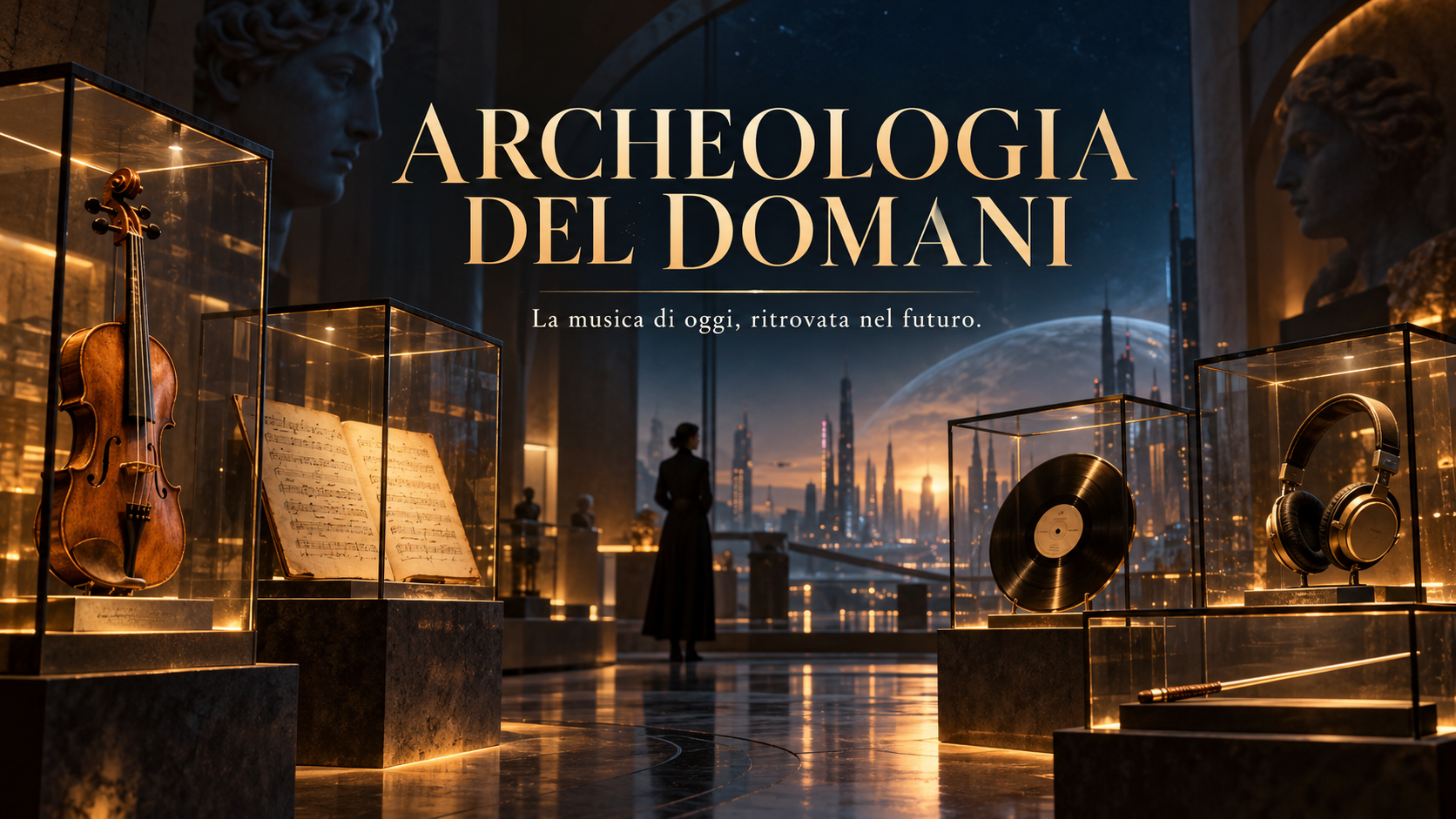
Our newspaper opens the doors of an imaginary museum in the year 2126, where today’s music becomes memory, every reperto keeps a story and the future invites us to rediscover the wonder of the present. First entrance: 28 October 2026!
by Marialuisa Veneziano
Today's music, found in the future
A new fifteen-year column is born: a journey between musicology, history, philosophy and imagination, to discover what our time will leave in legacy to the future.
Imagine waking up a morning and discovering that a hundred years have passed.
It's 2126.
The world around you has changed. Cities have taken unknown forms, technologies have changed habits that once seemed unchangeable and many of the things you considered indispensable now belong to history books.
Someone invites you to visit a museum.
Cross an immense atrium, walk through silent corridors, past salt illuminated by a discreet light. Wherever objects from a distant age are kept behind large crystal skulls.
A violin. A vinyl record. A score in pencil. A pair of headphones. A wand as conductor.
Stop curious.
A conservative approaches and begins to tell. It is about men and women who gathered in large buildings to listen to other human beings to produce music with wood, metal and string instruments. It describes a civilization that had learned to imprison sound within material objects, to transport it through immense distances, to preserve it for entire generations. It tells of people who entrusted their memories to a melody, their hopes, even what they never found the courage to say.
Listen fascinated.
Then, suddenly, you understand.
That civilization is us.
That world that the conservative describes with the wonder of an archaeologist is our present. The objects kept behind the crystal belong to our everyday life. The habits that scholars of the future seek to decipher are gestures that we do without thinking.
And this is where our journey begins.
Born Archaeology of tomorrow, a new 15-year-old column that invites readers to perform such an unusual and fascinating experiment: observing the music of our time as if it belonged to a civilization now far away.
We won't be studying the past.
It will be the future to study us.
Every fifteen days we will ideally cross the threshold of an imaginary museum, located in the year 2126, and let us accompany among its rooms to discover a new reperto.
It could be an object, a document, a sound testimony, a social custom or a musical practice that we consider absolutely normal today.
But nothing in this museum will be very ordinary.
Because what seems familiar to us can become extraordinary when we learn to observe it from the right distance. And sometimes it is enough to change perspective to discover that behind the simplest gesture there are centuries of history, revolutions of thought, transformations of sensitivity and questions concerning the very nature of the human being.
Ours will be a paradoxical archaeology: We're going to search for traces of a world that hasn't disappeared yet.
Where imagination meets knowledge
It would be easy to consider Archaeology of tomorrow a simple literary game. Actually, the ambition of the column is much bigger.
The museum of 2126 will be imaginary, but all that will hold will become an opportunity for an authentic and rigorous investigation.
Musicology will dialogue with philosophy, history with literature, anthropology with aesthetics. We will meet the great issues of musical interpretation, the transformations of listening, the inventions that have modified our relationship with the sound and contradictions of a civilization that, while living immersed in music, does not always find the time to really listen to it.
We will not just tell how objects worked or when certain habits were born.
We will try to understand why men felt the need.
Why have we invented new tools to produce sounds? Why do we want to preserve something that, by its nature, exists only when it happens? What mysterious relationship unites a melody to memory? What reveals the music we choose to listen to, what we betray and what we let disappear?
Every reperto will become a question. Every question will open a story. And every story will bring us, on an unexpected path, to our experience of human beings.
With a small privilege that reality does not grant us: We can observe the present with the depth that we usually hold only to the past.
A conservative, many rooms and a mystery to discover
To accompany us on this route there will be a figure destined to become familiar: the conservator of the museum.
We will meet him among archives, corridors and illuminated skulls, intent to reconstruct the musical uses and customs of that curious civilization lived a hundred years earlier.
He will be an intelligent observer, sometimes ironic, sometimes moved, able to look at our habits with the wonder of those who discover an unknown form of beauty.
Through his stories we will know our time as we have never known him.
And maybe, visiting, we'll end up discovering something about her world.
Because 2126 will not only be a narrative background. It will be a mysterious horizon, of which we will slowly glimpse the contours, one room after the other.
We do not know what musical instruments will exist in a century, what technologies will become indispensable or what new forms of art will have transformed the sensitivity of future generations.
We don't expect that.
We prefer to imagine that future to ask deeper questions about the present.
The doors are about to open
Please note this date: Wednesday 28 October 2026.
It will be the day of our first entrance to the museum. A curious date, to think about it well: we will start from 2026 to find ourselves, in the space of a reading, one hundred years later. No time machine, no technological wonder. Just cross the threshold of imagination.
And when the doors open, the conservative will already be there waiting for us.
Somewhere, in the still silent rooms of the museum, a theca awaits to be illuminated. Inside is the List No 001.
We will not reveal its identity yet.
Know only that what it holds also belongs to your life. You have probably met him many times, never to suspect how much history, how much humanity and how many questions could hide behind his apparent simplicity.
It will be the first of many appointments.
Every fifteen days, a new one. Every fifteen days, a journey of one hundred years. Every fifteen days, a different way of listening to the world.
But there is a reflection that we would like to entrust to readers before even starting.
We are accustomed to recognizing the value of things when time has made them far away. We preserve with veneration yellow manuscripts, we remain ancient instruments, we patiently reconstruct the musical habits of the past ages. We are thrilled by what has survived and often forget that our present is also destined to become a testimony.
History is not only found in museums.
It's happening now.
In concert halls, in our houses, in music that accompany the days, in objects that we use distractably, in the sounds that enter our memory without asking permission.
And perhaps the greatest privilege of this imaginary journey will be to remind us of a very simple truth: it is not necessary to wait for something to disappear to understand its beauty.
Because every age leaves behind traces. But only a few people have the chance to recognize, while they are still living them, those that one day will become wonders.
Archaeology of tomorrow That's why it was born.
To return astonishment to family things. To question music through the mirror of time. To discover that the future, sometimes, can teach us to understand the present better than the past.
On 28 October 2026 the museum will open its doors for the first time.
The entrance is free. The journey lasts a century. And the most extraordinary repertoire, perhaps, is us.
Welcome to Archaeology tomorrow.
The future begins by remembering us.


Leave a comment