Chronicles of the Apeiron


  • From the night of conscience to the light of mercy. Verdi's Requiem in the sign of Dante and Manzoni

    From the night of conscience to the light of mercy. Verdi's Requiem in the sign of Dante and Manzoni

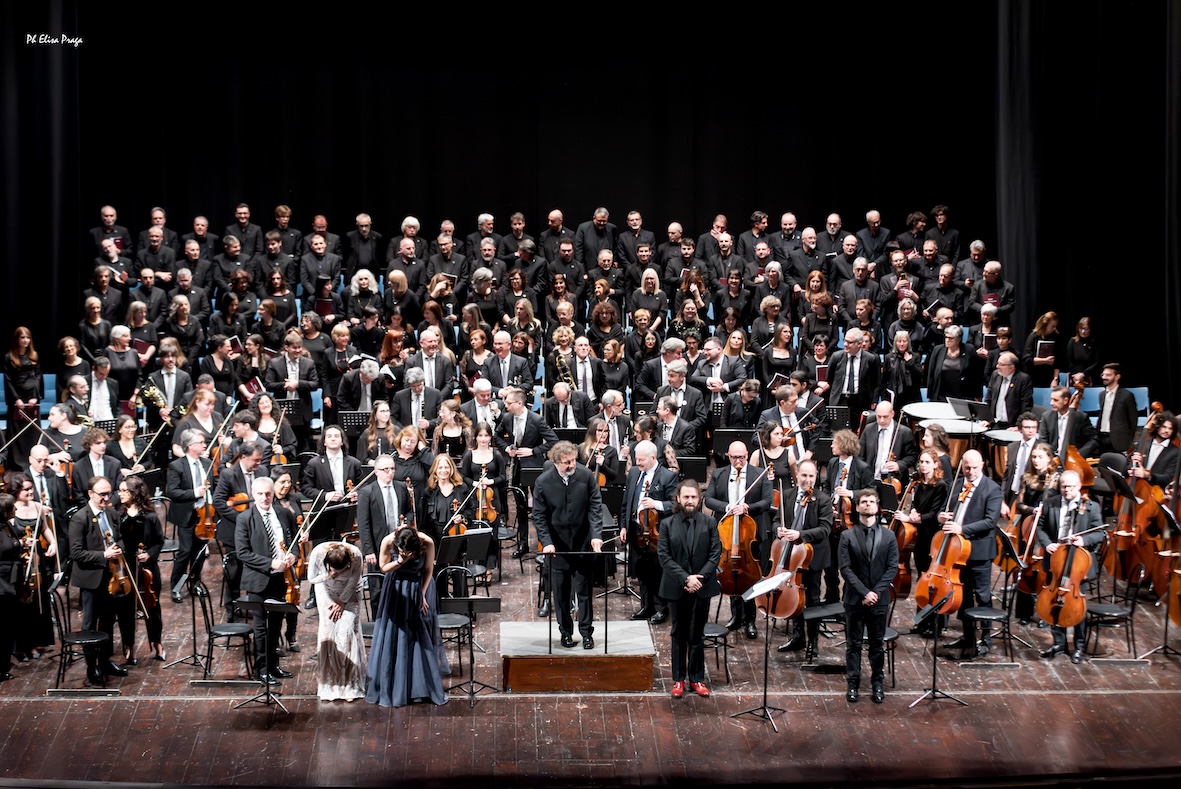
    Saturday 28 March 2026, 2 hours1 – In the historical hall of the Teatro dell’Aquila di Fermo, the FORM – Orchestra Filarmonica Marchigiana, together with the Regional Choir ARCOM and the young musicians of the "Rossini" Conservatories of Pesaro and "G.B. Pergolesi" of Fermo, retrace under the direction of Manlio Benzi the great path of the soul that Verdi entrusted to his Requiem.

    by Marialuisa Veneziano


    «God never troubles the joy of his children except to prepare them for a more certain and greater.»
    — Alessandro Manzoni

    If the human soul was a land to be crossed, there would not be only bright plains and gentle slopes, but also sudden ravines, shadow valleys and cliffs from which the gaze struggles to detach. And it is perhaps from one of these inner cliffs that seems to be born Mass by Requiem by Giuseppe Verdi. Not as a peaceful music, not as a liturgy that goes down already consoled from above, but as a cry that rises from the depth of man, crosses the terror of judgment and slowly, almost with hesitation, seeks the way of mercy. Those who have had the opportunity to listen to her live know well that unique impression it produces: it is not only about attending a concert, but to take part in an experience that resembles a moral journey. So it was also in the performance of Saturday 28 March 2026 at the Teatro dell’Aquila di Fermo, where the FORM – Orchestra Filarmonica Marchigiana, enriched by students of the Conservatories "Gioachino Rossini" of Pesaro and "Giovanni Battista Pergolesi" of Fermo, together with the Regional Choir ARCOM and the quartet of the soloists Yulia Tkachenko, Mariangela Marini, Davide Giusti and Alessandro Abis, under the direction of Manlio Benzi, gave rise to an intense reading of this score that, at a distance of one hundred and fifty years, continues to question man more than comfort.

    The Requiem was born in 1874 to commemorate Alessandro Manzoni. Greens, who was not prone to literary idolatry, nourished for the Lombard writer a veneration that aroused devotion. When he heard about his death, he wrote to the editor Remember words that reveal a seldom confessed emotion: «With him disappears one of the purest splendours of our glory». Now, those who are familiar with Verdi's temperament know how alien the composer was from all rhetorical sentimentalism; and yet that loss struck him as one gets hit when a figure disappears, which, despite not belonging to his own daily intimacy, represents a kind of collective moral consciousness. Manzoni had been, for many Italians of the nineteenth century, something like this: not only an author, but an ethical point of reference. It is not surprising that Verdi’s tribute was not just a musical commemoration, but a work of extraordinary spiritual complexity.

    And here, if you look carefully, a consonance emerges that is not only literary but almost philosophical. The history of human consciousness — they knew well thinkers like Blaise Pascal or Søren Kierkegaard — is always suspended between two abyss: that of despair and that of faith. The man, writes Pascal, is «a thinking rod»: fragile in his matter, immense in his consciousness. The Requiem Verdiano seems to be born from this condition. We do not find a faith proclaimed with theological security, but a conscience that is questioned. Not a dogma, but a drama. In this sense Verdi’s music is surprisingly approaching the Manzonian vision of human moral history. In Wedding promises, the conversion of the Unknown represents perhaps one of the most profound moments of European literature: a man who, coming on the edge of the abyss, suddenly discovers that mercy can exist. It is exactly the same spiritual movement that crosses the structure of the Requiem.

    This tension is already evident in the first lines of the Requiem aeternam. The entrance of the choir has nothing of the solemn proclamation: it is rather a breath, a prayer that is almost shy. The arches accompany with a suspended delicacy, as if the music itself feared to disturb the silence from which it emerges. Here Verdi demonstrates an extraordinary theatrical wisdom: faith does not appear as certainty, but as desire. The ARCOM Choir has returned this atmosphere, albeit with a pronounced shyness of female voices, keeping the sound suspended in an almost metaphysical dimension.

    But who believed that this calm represents the definitive face of the Requiem He would soon be denied. Just wait a few minutes for the entire musical building to be shaken by one of the most impressive pages in the history of music: Dies. Here Verdi seems to want to evoke not only the day of judgment, but the moral earthquake that it represents for human consciousness. The brass explode with almost apocalyptic violence, the choir enters as a compact mass and the orchestra turns into a feverish organism. Many scholars have observed how this page possesses something profoundly Dante, and the reference to Dante Alighieri does not appear at all arbitrary. In the sound turbine of Dies it seems to glimpse the storms of Dante’s Hell, those souls overwhelmed by forces that can no longer govern.

    But here there is also a deeper philosophical question. Judgment, in Christian tradition, is not only an eschatological event: it is also a metaphor for consciousness. Every man carries his own inner court. Immanuel Kant talked about «moral law within me and starry sky above me». Verdi, without any explicit philosophical claim, seems to transform this idea into music. The Dies It is not only the divine judgment: it is the moment when man is suddenly faced with his own truth.

    Incipit of Dies Irae, by Requiem

    The FORM has faced this moment with energy and compactness, supported by the enthusiasm of the students of the conservatives of Marche who have joined the teachers of the regional ensemble. But what was most striking was not only technical precision or sound power, but that rarer quality that could be called collective musical consciousness. The orchestrals of the FORM seemed to breathe together, as if each instrumental gesture was part of a greater thought than the individuality. In philosophy it would be said that here the individual is done in the community: not the sum of isolated musicians, but a living organism, able to transform the individual gesture into shared language. And this is one of the most silent miracles of orchestral art. The bows, compact and intense, possessed that timbre depth that allows green music to never become merely sound rhetoric; the brass, powerful but not brutal, sculpted the acoustic space with the almost liturgical dignity that this score requires; the woods, with their most intimate nuances, remembered that even in the heart of musical storms there is always a more fragile and more human inner voice.

    The direction of Manlio Benzi has favoured a vibrant and theatrical reading, highlighting the dramatic dimension of Verdi's writing. If you would like to make a critical remark — and criticism, when it is sincere, must always maintain its freedom — some times of Dies Perhaps they could have adhered even more deeply to the narrative monumentality of the mature Green, which tends to sculpt terror with an almost sculptural gravity.

    The choir, throughout the work, plays a role that goes far beyond that of simple sound mass. Verdi uses it as a sort of collective consciousness of humanity. In Quantus tremor est futurus writing assumes an almost declaiming character, as if the whole human species spoke with one voice in front of the unknown of the final judgment. The ARCOM Choir has shown here a compactness and clearness of remarkable joints.

    In the Confutatis maledictis the drama takes on an almost theatrical form. The bass Alessandro Abis authoritatively pronounces the condemnation of the wicked, while the orchestra responds with a restless plea. Verdi builds this passage on a clear contrast between the serious and the acute register, between the sentence and the prayer. It is one of those moments when his operatic experience emerges strongly: the composer knows perfectly how to transform a theological concept into a musical gesture of immediate effectiveness.

    Among the most moving pages emerge then the Lacrimo, where the invocation appears Save me, fons pietatis. Here music suddenly changes color. The melodic line of the soloists stretches with an almost disarming sweetness, as if the consciousness, after contemplating the abyss, finally found the strength to beg. But Verdi is not limited to this: it lets the choir enter over that melody, slowly, as a wave that wraps and exceeds the individual voice. The result is one of the most intense moments of the entire score. The solo quartet has found here a particularly successful balance: the soprano Yulia Tkachenko with a bright and penetrating line, the mezzo-soprano Mariangela Marini with a warm and deep timbre, the tenor Davide Giusti with a clear and well projected vocality and the bass Alessandro Abis with a strong timbre authoritativeness.

    And when, after so many storms, the Pie Jesu, music finally seems to breathe. It is a simple, almost childish supplication, which asks mercy more than justice. Here the parallel with Manzoni becomes almost inevitable: as the Unknown who, after the night of conscience, discovers the possibility of forgiveness, so the Requiem Verdiano seems to arrive at a dimension of hope.

    But Verdi does not give an easy conclusion. In Free me, Domine the solo soprano is back in front of the theme of Dies, returning as a shadow of memory. It is an extraordinary dramatic gesture. The composer does not erase the fear of judgment: he recalls it, reproposes it, almost to suggest that human consciousness can never get rid of it completely. Yet, through the final prayer, that fear seems to turn into something different: no more terror, but awareness.

    And at that moment — while the choir suspends its voice between imploration and silence and the orchestra seems to hold the last breath — something happens that no musicological analysis can really explain. One has the feeling that that prayer no longer belongs to the Latin text, neither to Verdi's score, nor to the performers on stage. It becomes a question addressed to each of us. Not a question cried, but almost whispered, as happens in the most intimate hours of consciousness: if indeed, beyond the tumult of life and our fears, there may be a mercy capable of accepting man as it is, fragile, imperfect, but irreparably human.

    When the last sound dissolved in the hall of the Teatro dell’Aquila, the audience remained for a few moments suspended in that silence that follows only the great musical experiences. Verdi, with his disarming irony, once said: «I don't know. Requiem be sacred or theatrical; I know only that it is true». And maybe this is the truth. — human before even religious — to make this work one of the leaders of Western music: a journey that, starting from the barter of conscience, stubbornly attempts to find the way to heaven.

    30 March 2026

    Photo © Elisa Prague
    7–11 minutes

    Leave a comment

  • Family concert in Senigallia (An): the FORM between magic, story and awareness

    Family concert in Senigallia (An): the FORM between magic, story and awareness

    From the enchanted chaos of "The Sorcerer Entrepreneur" to the narrative clarity of "Pierino and the Wolf": a Family Concert of FORM that transforms listening into experience and the boys into interlocutors of music.

    Senigallia, 22 March 2026


    by Marialuisa Veneziano

    Before the music begins, there is always a fragile and precious moment in which everything is still possible.

    The lights hesitate, the caterpillar gets thinned, the theater holds the breath without declaring it. It is a time suspended, almost imperceptible, yet decisive: there we measure the quality of what is about to happen.

    At the La Fenice Theatre in Senigallia, on Sunday, March 22, that moment had a particular density. It wasn't just waiting. It was helpful. Children prostheses towards the stage, children gathered in unexpected silence, families immersed in a quiet vigilant. Not a distracted audience, but an audience already listening before the sound was born.

    And that changes everything.

    Because when listening precedes music, music must not conquer: it can happen.

    Many of those guys didn't get empty. They brought with them traces, previous encounters, sedimented insights. And so, from the first moment, what has been created has not been a simple relationship between who performs and who receives, but a relationship. A silent dialogue, ready to sound.

    When the FORM – Orchestra Filarmonica Marchigiana – took place, led by the measured gesture of Jacopo Rivani, the concert — in a way — had already begun.

    And when the first note crossed the hall, he did not find spectators.

    He's got careful consciences.

    It was a Family Concert. But in this definition there was no reduction: there was an opening. An act of trust. The idea that music, even in its complexity, can be inhabited by all — if you only create the right space.

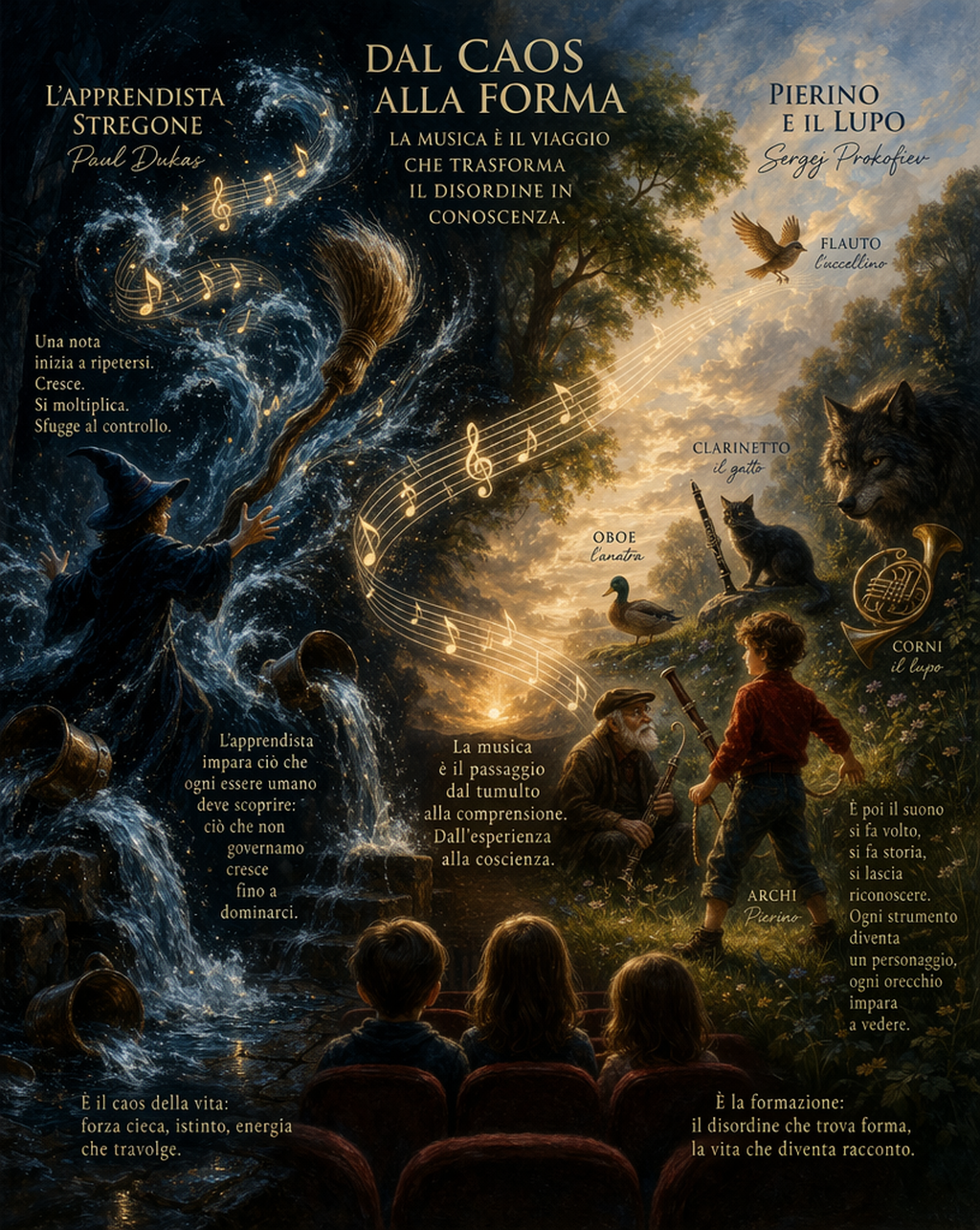
    The apprentice who loses control, Pierino who gives a face to the sound: the music between vertigo and conscience.

    Then the journey began.

    With "The sorcerer apprentice".

    And now the music has made itself a gesture.

    An apprentice who dares too much, a formula that escapes, a broom that comes to life. The water that rises, which grows, does not stop anymore. But what makes this story so powerful is not history — is the way it is thought.

    Paul Dukas builds the song as an organism that feeds itself. A minimal rhythm cell creeps into the orchestra and begins to proliferate. It repeats, expands, multiplies until it loses any possibility of control.

    The broom is not an object.

    It's a principle.

    A rhythm that becomes destiny.

    The bows put it in motion, the wood chases it, the brass amplify it until it becomes overwhelming. The orchestration does not describe the action: it generates it, pushes it, makes it inevitable.

    And in this process there is a truth that goes beyond music: what we do not know how to rule grows to dominate us.

    In this tension so alive, so proruptive, interpretation has chosen a more contained, more guarded way. The times, sometimes retained, have favoured clarity with respect to urgency, carefully returning what in Dukas' writing also lives and necessarily excess, almost feverish momentum.

    And yet, precisely in this choice, the orchestra has shown considerable solidity. The sound was compact, the sections dialogue accurately, the sound planes were legible. A less overwhelming reading, perhaps, but aware, able to make intelligible, despite everything, complexity.

    And the boys — exceptionally — They were inside all this.

    They followed. They recognized. They were guessing.

    They didn't get the music. They lived there.

    Then, when the flow reached its limit — when chaos showed itself in its fullest form — the story has turned.

    He didn't stop.

    It's clear.

    He went in "Pierino and the wolf."

    And suddenly, the music took face.

    With Sergei Prokofiev, every sound becomes identity. The flute flies light in the bird, the oboe waves in the duck, the clarinet moves furitive in the cat, the phagotto leans heavily in the grandfather, the horns open the shadow of the wolf.

    And Pierino — the arches — He's not just a character.

    It's a balance.

    Lucia Palozzi's acting voice fits with intelligence, as a discreet thread that binds without stringing. He didn't explain: he accompanied. He didn't translate: he let it emerge.

    And something rare happened.

    The boys smiled before the sound was done. They were anticipating. They connected.

    The cat is there.
    The wolf is coming.
    The bird is already flying.

    It was no longer a concert.

    It was a recognition.

    And in that recognition something profoundly educational was accomplished.

    Because culture is not what is explained.

    That's what you recognize when you meet him.

    And here then the bond, powerful, inevitable, between the two tracks.

    In the first, music is growing matter, energy growing, strength escaping.
    In the second, that same matter is organized, clarifies, lets itself be appointed.

    It is the passage from chaos to form.

    From experience to understanding.

    From vertigo to consciousness.

    And this — more than anything — is the heart of pedagogy.

    The Filarmonica Marchigiana supported this path with professionalism and coherence, building a sound that did not seek the effect, but the sense. And in this, also the direction of Rivani — in his choice of containment — has maintained the thread of the speech, favoring readability, structure, clarity.

    Then we understand.

    It wasn't just a concert.

    But an experience.

    Of those that do not consume when they happen, but continue to work inside.

    In the end, applause was not just a sign of enthusiasm.

    They were an act of awareness.

    As if the audience knew they had received something that didn't run out.

    A rhythm that continues to turn.
    A sound that remains.
    An image that does not dissolve.

    Because music, when he really meets the listener, doesn't end.

    Deposit.

    And from there — slowly slowly — It starts to turn.

    Leave a comment

  • When culture changes its voice: the day Montemarciano listened to his boys.

    A journey between sound, matter and history led by young people: culture as a daily exercise, not as a simple event, on the occasion of FAI Days, 21 and 22 March 2026.

    By Marialuisa Veneziano


    Montemarciano, 21 March 2026

    There are afternoons that do not happen: they turn out.

    They do not come as events, but as slow, almost shy revelations, in which everything seems to wait for their moment to say something essential. And when it happens, you notice — with a bit of wonder — that what you are experiencing is not only a set of activities, but a form of beauty that takes body.

    At the Alfieri Theatre in Montemarciano, culture had an unexpected face.

    The guys.

    The children, pupils of the I.C. Montemarciano – Monte San Vito: small ciceroni in the afternoon FAI

    They weren't there to learn. They were there to return.

    There was, in their gestures and in their words, something extremely rare: an awareness still young, but already able to voice. The students of the second and third classes of the Montemarciano-Monte San Vito Institute welcomed the public not as simple guides, but as temporary guardians of a heritage that, for an afternoon, passed through them.

    And in this passage something profoundly beautiful happened.

    Because when culture is alive, it is not transmitted: it entrusts itself.

    A full, sincere praise, almost necessary at a school that has managed to make the most difficult gesture: to leave space. Believe that boys are not only recipients, but possible source of sense. It is a choice that not only produces learning, but forms looks, and looks — when they learn to see — change the world.

    Next to this vision, the Municipality of Montemarciano moved with that elegant discretion that belongs to those who really understand the value of things. He did not simply organize: he created conditions so that something could happen. And in this gesture, silent but decisive, we recognize a high form of cultural responsibility.

    The route opened without declaring itself.

    A voice — that of a boy, and then another — and immediately the music.

    But not the music you listen to.
    The one you see.

    The collection of historical clarinets by Andrea Greganti appeared as a constellation of suspended forms, objects that did not ask to be admired, but included. The clarinet, a young instrument in history and yet already loaded with nobility, was shown in its original restlessness: a continuous search for balance, perfection and identity.

    Some historical clarinets exhibited in the foyer of the Alfieri Theatre

    He was not born accomplished.

    It was built over time, through errors, attempts, corrections. And in this evolution something profoundly human is seen: the stubborn desire to find a voice that is, finally, proper through the technical improvement of materials and mechanics.

    Among the instruments, one — almost with smell — the so-called thermosiphon clarinet. A mild, domestic name, yet capable of enclosing a surprising intuition. An air chamber inside a metal stem, designed to heat the instrument in a short time through the insufflation of the musician, to make it immediately ready to sound.

    And in that technical detail there was a wider truth.

    That nothing that vibrates is born without being prepared.
    That sound, before it exists, needs care.

    This is where culture stops being surface and becomes thought.

    And once again, we understand how precious the gesture of the Municipality of Montemarciano has been: to make accessible what is normally kept, to allow a community to enter into a rare intimacy. It is not only openness: it is trust.

    Then, seamlessly, something even subtler happens.

    The matter is allowed to cross.

    Thanks to the collaboration with the Polytechnic University of Marche, clarinets are observed through micro-TAC: a technology capable of penetrating the interior of objects without violating them, revealing its hidden structure. It is as if the look learned a new form of depth.

    Computerized demonstration of the internal study of the instrument

    You can see cavities, thicknesses, invisible lines that make the sound possible.

    And then it is understood that beauty is never only what appears.
    It is always what it supports.

    And the boys — still they — to guide this gaze inside the invisible, with a simplicity that does not impoverish, but illuminates.

    Then the passage becomes more intimate.

    In the Little Theatre, light changes, time slows down, and history enters.

    But he doesn't come in as a story.

    Enter as a presence.

    Alfonso Piccolomini takes shape through an essential sketch, almost restrained, and precisely for this powerful. Duke of Montemarciano, figure marked by the complexity of his time, by the tensions, by the choices that are not simplified.

    There is no celebration.

    There is return.

    And in this return something rare is done: history is not softened, but respected. The boys walk through it without fear, they live there, they make it alive. And at that moment we understand that educating does not mean protecting from complexity, but offering tools to support it.

    Once again, the school is revealed for what can be when it is authentic: a place where knowledge turns into consciousness. A full, deep praise to an institution that is not limited to teaching, but chooses to form.

    And next door, always, the Municipality. Consistent presence, able to support a vision that does not divide, but unites. Because what has been seen is not the sum of three activities, but a single gesture: to relate.

    And yet, just when everything appears harmonious, a question emerges — not as critical, but as desire.

    That all this does not remain an island.

    That does not run out in the short time of a successful afternoon. Because culture, if it really wants to be such, cannot live with apparitions. It must become practice, habit, daily breath.

    And here the school returns, again, to the center. Not only as a place that participates, but as a place that prepares. Prepare to see before I even know. Prepare to recognize the value of what is near before looking for it elsewhere. Prepare to connect, in a time that divides.

    Music, history, science — not as compartments, but as dialogue.

    In an age that too often educates to survival and forgets the sense of beauty, teaching to see becomes a necessary act. Almost an act of resistance.

    And here, for an instant, this possibility has become visible.

    In the end, leaving, there was a subtle feeling.

    Not to have seen anything.
    But they were crossed.

    As if culture, for an afternoon, had chosen to pass by hand.

    And her hands were young.

    That's exactly why, perfectly ready.

    Andrea Greganti next to his clarinets: not a collection, but a continuous dialogue between ingenuity, history and music.
    Not images of an event, but traces of a passage: the knowledge you entrust, the future you listen. The small cicerons guide the audience between music, history and discovery: when the school becomes a living experience.

    Leave a comment

  • "Music before Spotify"

    A new section on the History of Music begins. From Monday 16 March 2026, 21:15 live stream on the official YouTube channel.


    Before the playlists, before streaming, music had already crossed centuries of history, changing the way of thinking, creating and listening to the world. It is from this idea that it is born "Music before Spotify", the new column designed and edited by Marialuisa Veneziano, dedicated to the discovery of the deep roots of music.

    Through an engaging and accessible story, the column will guide the public on a fascinating journey between eras, styles and protagonists who have marked the history of music: from the first forms of written music to the great composers who have revolutionized the musical language.

    Each event will be an opportunity to discover anecdotes, historical contexts, musical instruments and masterpieces that still influence contemporary music. A path that combines cultural dissemination and passion for music, designed to bring the public closer to the beauty and complexity of an extraordinary artistic heritage.

    The column will be broadcast live every Monday at 21:15 on the YouTube channel from Monday, March 16, becoming a meeting space for those who want to know better the history of music and let themselves be guided on a journey between sounds, ideas and great personalities of musical culture.

    Because much before digital platforms and algorithms, music was already an endless story of creativity, insights and artistic revolutions.

    Link to the channel: https://www.youtube.com/@louisemarie8292

    Leave a comment

  • Memory for a future soul

    “Letter to myself, in case time makes me unrecognizable."

    By Marialuisa Veneziano, 10 March 2026


    This letter is not born to be read immediately. He was born to be lost.

    I'm writing it while the sea breathes slowly in front of me, with that gravity that belongs to very ancient things. It is not the sea of holidays and easy light: it is the evening sea, almost black, where every wave seems to bring with it a thought remained unfinished.

    I have a glass bottle with me.

    I'll close this sheet in a little while and turn it to the currents. I don't do it for romance. — or at least not only. I do it because time is a ruthless archivist: it keeps little and deletes a lot.

    This bottle is a small rebellion.

    It's not intended for a stranger.

    It's for you.

    To myself.

    To that human being who one day will bring my name but perhaps will no longer remember my restlessness. Because time does not change only the faces or habits. Change the questions. And when questions change, the shape of the soul also changes.

    That's what I fear.

    I'm afraid one day you can become a perfectly adapted person to the world — and for this reason far from the truth.

    Remember when we thought art was a form of knowledge?

    Not in the disciplined and severe sense of sciences, which proceed for demonstration and verification. Art shows nothing. He doesn't have theorems. It does not produce certainties.

    And yet he knows.

    He knows in a different way, almost oblique. Reveal what philosophy calls Experienced Experience: that region of existence where concepts do not arrive but where truth, paradoxically, becomes more evident.

    A painting can say more than a treatise.

    A page of literature can show what no theory can explain.

    But it is music, above all, to guard this mystery.

    Music is perhaps the only art that does not need the world to exist. It does not represent objects, does not tell precise stories. It is pure movement over time.

    And yet, while a melody passes through the air, something almost metaphysical happens.

    The soul recognizes itself.

    Schopenhauer argued that music does not imitate the world but its essence. It's a bold, almost dizzying thesis. Yet every time a deal strikes us in the chest with that painful sweetness that we do not know how to explain, we understand that maybe he was right.

    Music is the purest form of emotional memory.

    When a melody moves us, we are not simply listening to sounds. We are recognizing something that belongs to the very structure of our human experience: desire, loss, hope.

    It's like someone translated our interiority into vibration.

    That's why I'm afraid of the day you might never hear it again.

    Not the music itself — that will continue to exist — but his ability to gently hurt the heart.

    There is a silent transformation that takes place in human lives. It doesn’t happen suddenly. It comes slowly, almost gently.

    Days become more functional. The most moderate emotions. The rarest questions. And little by little what once seemed essential — beauty, thought, wonder — is relegated to the margins of existence.

    It is the most discreet form of spiritual impoverishment.

    Philosophy, in its most authentic form, is born precisely to oppose this process. Not to provide final answers — those belong to dogmatic systems — but to keep the question wound open.

    Who are we?

    What makes a life worthy of being lived?

    And above all: what remains of us when time has finished its patient and relentless work?

    Now I close this letter in the bottle.

    The glass captures the last light of the day as if it wanted to preserve it. The sea in front of me seems endless, and for a moment I feel that even time is.

    I'll throw it in a minute.

    Maybe he'll drown immediately.
    Maybe it's going through the currents for years.
    Maybe no one will ever find her.

    But if you open it — if one day time will lead you to these words — Then stop.

    Don't read quickly.

    Let silence do his job.

    And ask yourself one thing.

    If in front of a music you still feel that thick sudden that makes the soul bigger than the body.

    If a philosophical question can still creep you out like a moonless night.

    If beauty still seems to be something fragile and necessary, like a truth that cannot be demonstrated but only lived.

    If the answer is yes, then this bottle was not thrown in vain.

    Because it will mean time has changed many things — as it inevitably happens — but he failed to erase the most secret part of our identity.

    The one who continues, stubbornly, to seek meaning in the mystery of being alive.

    Leave a comment

  • "SOUL" AND THE MALINCONY OF THE VITES REMEMBER

    "SOUL" AND THE MALINCONY OF THE VITES REMEMBER

    By Marialuisa Veneziano


    What really makes sense to our lives?

    It is a question that crosses the centuries as an obstinate comet. Philosophs, poets and scientists have tried to pursue it with treatises, theories and systems of thought. And yet, sometimes, it is an animation film to succeed where many books fail.

    The film tells the story of Joe Gardner, music teacher and jazz pianist with a dream as big as a city: playing on a real stage, with real musicians, in front of a real audience.

    When that dream finally seems to become reality, something unexpected happens. Joe finds himself in a mysterious dimension where the souls prepare for life on Earth, a place where everyone has to find their own "scintilla".

    What seems to be the beginning of a fun adventure soon becomes a philosophical question disguised as cartoon: What makes a life really meaningful?


    The spark that is not a talent

    At first Joe is convinced he knows the answer.

    The spark is talent.
    It is the vocation.
    It's fate.

    In his case, it's jazz.

    But the little soul number 22, ironic and distrustful towards life, discovers something completely different. The spark is not what we can do best. It's not a job or a career.

    IS what makes us feel alive.

    A leaf that slowly falls from the tree.
    The taste of a pizza eaten on the street.
    The wind on the face as you walk without haste.

    Small things, tiny. But life charges.


    A philosophy lesson hidden in a cardboard

    This idea is not new. Already the Greek philosopher Aristotle talked about Eudacity: happiness not as an isolated moment, but a condition of fullness, something that arises from a life lived with awareness.

    Many centuries later, thinker Albert Camus observed that the world has no predetermined meaning. It is up to us to fill it with meaning through our experiences.

    Soul can translate these ideas into a simple and luminous language: life is not a secret mission to discover, but a flow of moments to live.


    Life as jazz improvisation

    It's no coincidence that Joe is a jazz musician.

    Jazz is the art of improvisation. It starts from a melody, but then every musician listens to others, changes road, invents new notes.

    Life resembles this music.

    We think we have a precise score: study, work, succeed, get somewhere. But often the most authentic part of existence is born when something changes rhythm, when we have to improvise.

    Joe believed his fate was become a great musician. In the end he discovers something subtler and deeper: living means being curious, attentive, open to wonder.

    Just like a jazz player in front of the piano.


    The fragile spark of life

    But there is another thought that goes through the film in silence.

    Life is made of small moments, it is true. But that doesn't mean we can cross her distracted or without looking for our way.

    Because a life that never tries to realize — who does not dare, who does not dream, — It risks becoming a great sadness.

    Between two possible mistakes, perhaps the most human is just this: to forget to live really.

    Soul invites us to find a rare balance.
    Grow our dreams without losing the beauty of simple days.
    Look for our place in the world without forgetting to look around while we walk.

    Eventually Joe understands something worth more than any success.

    Life is not only in great respects.
    But it's not even when you're still waiting.

    He's trying, falling, starting again.
    He's playing his own music, even when the melody isn't perfect.

    Because perhaps the simplest truth is also the most important:

    a life must not be perfect.
    But he always deserves to be lived to the bottom.

    Ancona 5 March 2026

    Leave a comment

  • The music we no longer hear: silence in the time of noise

    The music we no longer hear: silence in the time of noise

    Love Chronicle of a humanity that has learned to hear everything, except what matters.

    by Marialuisa Veneziano


    If a careful person had observed the scene with enough patience, he would have noticed something curious: no one was really listening.

    It was morning. A bus crossed the city with the dignified air of those who make the same fate every day. The passengers sat composed, each accompanied by an invisible interlocutor: headphones in the ears, fingers moving on the screens, private melodies that did not ask for answer or attention.

    All surrounded by music. No one really in his company.

    A time — not necessarily better, but certainly slower — music required preparation. An important visit awaited the beginning of a concert. The chairs creaked, the programs were carefully folded, and that short silence before the first note possessed the solemnity of a promise.

    Today the music arrives without being invited. It presents itself in advance, remains too long and is often ignored with educated indifference.

    Modern society, so efficient in producing sounds, seems to have lost the art of listening with the same lightness with which one loses a glove during a winter walk: one realizes the absence only when the cold becomes evident.

    Even the most celebrated musical events show this transformation. The Sanremo Festival, once a national lounge of shared listening, today appears as a brilliant worldly conversation in which music is spoken incessantly without really giving her the time to be loved. The songs are judged with impeccable speed, commented before being understood, archived before becoming a memory. Music, as a young guest shy in a noisy reception, often remains in the background while everyone discusses his presence.

    And yet the music retains an obstinate quality: it continues to ask attention.

    Whoever observed a class of students just before starting to play knows that rare moment. The voices are flattered, someone keeps a laugh, a collective breath takes shape without being commanded. For a moment no one tries to emerge. Everyone's waiting.

    In that wait something surprising arises: not only music, but a form of gentle human agreement.

    Silence, so avoided in everyday life, reveals its authentic nature. It's not empty. It's a relationship space. It is the place where the individual stops occupying the center and agrees to belong to a common time.

    Perhaps our age fears silence because it cannot be accelerated, shared in real time or transformed into a show. Silence requires presence, and presence is an increasingly rare virtue.

    The true elegance of listening is precisely this: to grant something the right to exist without interruption.

    Let a melody end. Don’t look for another. Stay a few moments with what remains in the air.

    It is possible that the future of music does not depend on new instruments or new modes, but on a much more discreet rediscovery: learning again to wait.

    Maybe a simple gesture would be enough. Turn off every artificial sound for a minute. Listen to the steps, the wind, a near breath, the imperfect noise of the world.

    And to realize, with a surprise worthy of the best novels, that music had never left us.

    It was just us who stopped listening.

    Ancona 1 March 2026

    Leave a comment

Apeiron Library


Other horizons – read on

EnglishenEnglishEnglish