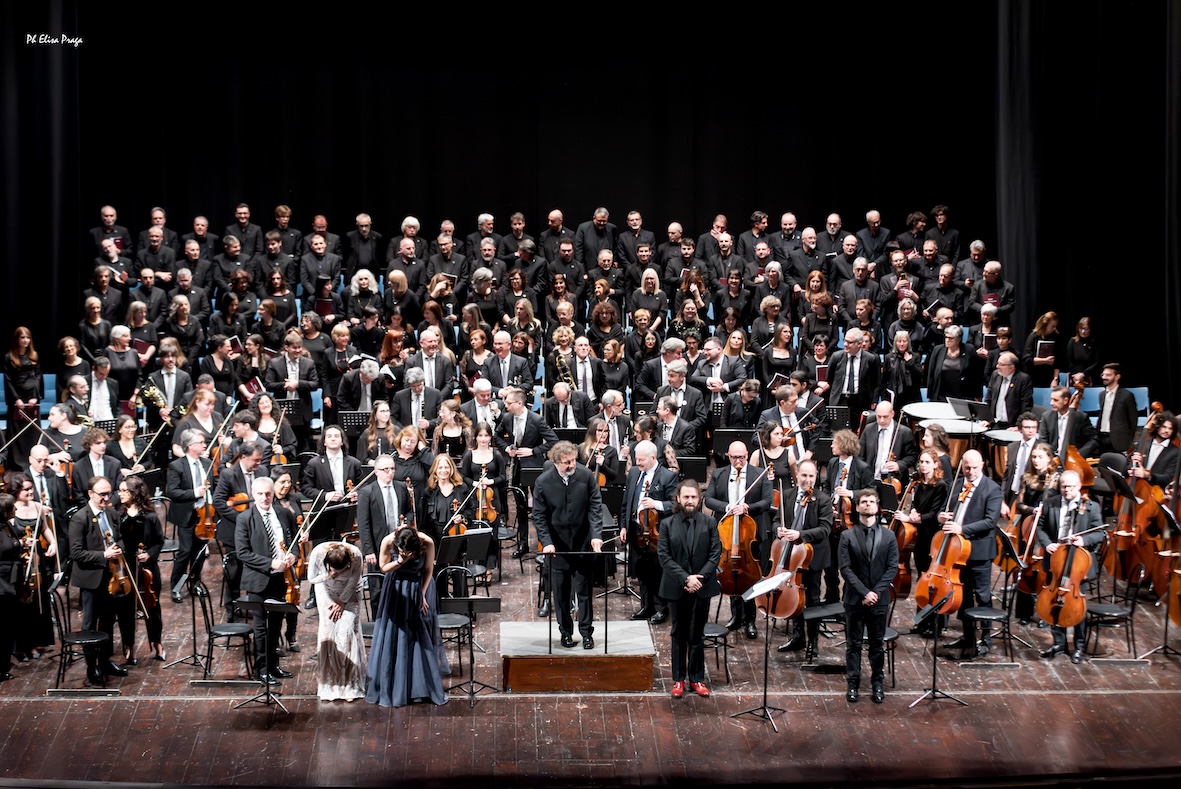
Saturday 28 March 2026, 2 hours1 – In the historical hall of the Teatro dell’Aquila di Fermo, the FORM – Orchestra Filarmonica Marchigiana, together with the Regional Choir ARCOM and the young musicians of the "Rossini" Conservatories of Pesaro and "G.B. Pergolesi" of Fermo, retrace under the direction of Manlio Benzi the great path of the soul that Verdi entrusted to his Requiem.
by Marialuisa Veneziano
«God never troubles the joy of his children except to prepare them for a more certain and greater.»
— Alessandro Manzoni
If the human soul was a land to be crossed, there would not be only bright plains and gentle slopes, but also sudden ravines, shadow valleys and cliffs from which the gaze struggles to detach. And it is perhaps from one of these inner cliffs that seems to be born Mass by Requiem by Giuseppe Verdi. Not as a peaceful music, not as a liturgy that goes down already consoled from above, but as a cry that rises from the depth of man, crosses the terror of judgment and slowly, almost with hesitation, seeks the way of mercy. Those who have had the opportunity to listen to her live know well that unique impression it produces: it is not only about attending a concert, but to take part in an experience that resembles a moral journey. So it was also in the performance of Saturday 28 March 2026 at the Teatro dell’Aquila di Fermo, where the FORM – Orchestra Filarmonica Marchigiana, enriched by students of the Conservatories "Gioachino Rossini" of Pesaro and "Giovanni Battista Pergolesi" of Fermo, together with the Regional Choir ARCOM and the quartet of the soloists Yulia Tkachenko, Mariangela Marini, Davide Giusti and Alessandro Abis, under the direction of Manlio Benzi, gave rise to an intense reading of this score that, at a distance of one hundred and fifty years, continues to question man more than comfort.
The Requiem was born in 1874 to commemorate Alessandro Manzoni. Greens, who was not prone to literary idolatry, nourished for the Lombard writer a veneration that aroused devotion. When he heard about his death, he wrote to the editor Remember words that reveal a seldom confessed emotion: «With him disappears one of the purest splendours of our glory». Now, those who are familiar with Verdi's temperament know how alien the composer was from all rhetorical sentimentalism; and yet that loss struck him as one gets hit when a figure disappears, which, despite not belonging to his own daily intimacy, represents a kind of collective moral consciousness. Manzoni had been, for many Italians of the nineteenth century, something like this: not only an author, but an ethical point of reference. It is not surprising that Verdi’s tribute was not just a musical commemoration, but a work of extraordinary spiritual complexity.
And here, if you look carefully, a consonance emerges that is not only literary but almost philosophical. The history of human consciousness — they knew well thinkers like Blaise Pascal or Søren Kierkegaard — is always suspended between two abyss: that of despair and that of faith. The man, writes Pascal, is «a thinking rod»: fragile in his matter, immense in his consciousness. The Requiem Verdiano seems to be born from this condition. We do not find a faith proclaimed with theological security, but a conscience that is questioned. Not a dogma, but a drama. In this sense Verdi’s music is surprisingly approaching the Manzonian vision of human moral history. In Wedding promises, the conversion of the Unknown represents perhaps one of the most profound moments of European literature: a man who, coming on the edge of the abyss, suddenly discovers that mercy can exist. It is exactly the same spiritual movement that crosses the structure of the Requiem.
This tension is already evident in the first lines of the Requiem aeternam. The entrance of the choir has nothing of the solemn proclamation: it is rather a breath, a prayer that is almost shy. The arches accompany with a suspended delicacy, as if the music itself feared to disturb the silence from which it emerges. Here Verdi demonstrates an extraordinary theatrical wisdom: faith does not appear as certainty, but as desire. The ARCOM Choir has returned this atmosphere, albeit with a pronounced shyness of female voices, keeping the sound suspended in an almost metaphysical dimension.
But who believed that this calm represents the definitive face of the Requiem He would soon be denied. Just wait a few minutes for the entire musical building to be shaken by one of the most impressive pages in the history of music: Dies. Here Verdi seems to want to evoke not only the day of judgment, but the moral earthquake that it represents for human consciousness. The brass explode with almost apocalyptic violence, the choir enters as a compact mass and the orchestra turns into a feverish organism. Many scholars have observed how this page possesses something profoundly Dante, and the reference to Dante Alighieri does not appear at all arbitrary. In the sound turbine of Dies it seems to glimpse the storms of Dante’s Hell, those souls overwhelmed by forces that can no longer govern.
But here there is also a deeper philosophical question. Judgment, in Christian tradition, is not only an eschatological event: it is also a metaphor for consciousness. Every man carries his own inner court. Immanuel Kant talked about «moral law within me and starry sky above me». Verdi, without any explicit philosophical claim, seems to transform this idea into music. The Dies It is not only the divine judgment: it is the moment when man is suddenly faced with his own truth.
The FORM has faced this moment with energy and compactness, supported by the enthusiasm of the students of the conservatives of Marche who have joined the teachers of the regional ensemble. But what was most striking was not only technical precision or sound power, but that rarer quality that could be called collective musical consciousness. The orchestrals of the FORM seemed to breathe together, as if each instrumental gesture was part of a greater thought than the individuality. In philosophy it would be said that here the individual is done in the community: not the sum of isolated musicians, but a living organism, able to transform the individual gesture into shared language. And this is one of the most silent miracles of orchestral art. The bows, compact and intense, possessed that timbre depth that allows green music to never become merely sound rhetoric; the brass, powerful but not brutal, sculpted the acoustic space with the almost liturgical dignity that this score requires; the woods, with their most intimate nuances, remembered that even in the heart of musical storms there is always a more fragile and more human inner voice.
The direction of Manlio Benzi has favoured a vibrant and theatrical reading, highlighting the dramatic dimension of Verdi's writing. If you would like to make a critical remark — and criticism, when it is sincere, must always maintain its freedom — some times of Dies Perhaps they could have adhered even more deeply to the narrative monumentality of the mature Green, which tends to sculpt terror with an almost sculptural gravity.
The choir, throughout the work, plays a role that goes far beyond that of simple sound mass. Verdi uses it as a sort of collective consciousness of humanity. In Quantus tremor est futurus writing assumes an almost declaiming character, as if the whole human species spoke with one voice in front of the unknown of the final judgment. The ARCOM Choir has shown here a compactness and clearness of remarkable joints.
In the Confutatis maledictis the drama takes on an almost theatrical form. The bass Alessandro Abis authoritatively pronounces the condemnation of the wicked, while the orchestra responds with a restless plea. Verdi builds this passage on a clear contrast between the serious and the acute register, between the sentence and the prayer. It is one of those moments when his operatic experience emerges strongly: the composer knows perfectly how to transform a theological concept into a musical gesture of immediate effectiveness.
Among the most moving pages emerge then the Lacrimo, where the invocation appears Save me, fons pietatis. Here music suddenly changes color. The melodic line of the soloists stretches with an almost disarming sweetness, as if the consciousness, after contemplating the abyss, finally found the strength to beg. But Verdi is not limited to this: it lets the choir enter over that melody, slowly, as a wave that wraps and exceeds the individual voice. The result is one of the most intense moments of the entire score. The solo quartet has found here a particularly successful balance: the soprano Yulia Tkachenko with a bright and penetrating line, the mezzo-soprano Mariangela Marini with a warm and deep timbre, the tenor Davide Giusti with a clear and well projected vocality and the bass Alessandro Abis with a strong timbre authoritativeness.
And when, after so many storms, the Pie Jesu, music finally seems to breathe. It is a simple, almost childish supplication, which asks mercy more than justice. Here the parallel with Manzoni becomes almost inevitable: as the Unknown who, after the night of conscience, discovers the possibility of forgiveness, so the Requiem Verdiano seems to arrive at a dimension of hope.
But Verdi does not give an easy conclusion. In Free me, Domine the solo soprano is back in front of the theme of Dies, returning as a shadow of memory. It is an extraordinary dramatic gesture. The composer does not erase the fear of judgment: he recalls it, reproposes it, almost to suggest that human consciousness can never get rid of it completely. Yet, through the final prayer, that fear seems to turn into something different: no more terror, but awareness.
And at that moment — while the choir suspends its voice between imploration and silence and the orchestra seems to hold the last breath — something happens that no musicological analysis can really explain. One has the feeling that that prayer no longer belongs to the Latin text, neither to Verdi's score, nor to the performers on stage. It becomes a question addressed to each of us. Not a question cried, but almost whispered, as happens in the most intimate hours of consciousness: if indeed, beyond the tumult of life and our fears, there may be a mercy capable of accepting man as it is, fragile, imperfect, but irreparably human.
When the last sound dissolved in the hall of the Teatro dell’Aquila, the audience remained for a few moments suspended in that silence that follows only the great musical experiences. Verdi, with his disarming irony, once said: «I don't know. Requiem be sacred or theatrical; I know only that it is true». And maybe this is the truth. — human before even religious — to make this work one of the leaders of Western music: a journey that, starting from the barter of conscience, stubbornly attempts to find the way to heaven.
30 March 2026


Photo © Elisa Prague


Leave a comment