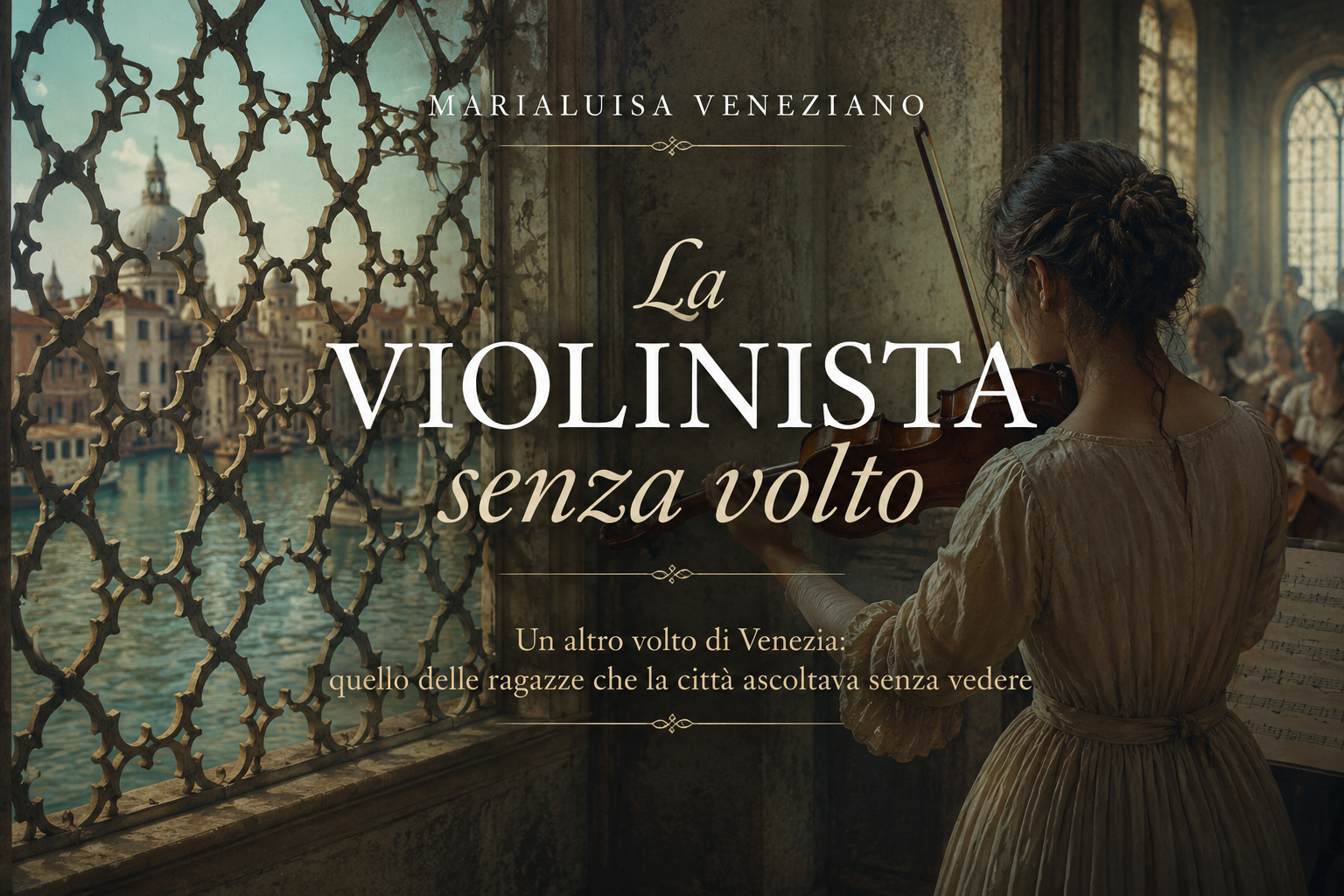
Another face of Venice: that of the girls the city listened without seeing
by Marialuisa Veneziano
**********
🎧 Music for reading
To accompany The faceless violinist, we recommend listening to Concerto in minor for four violins and cello, RV 580by Antonio Vivaldi. Four violins look for each other, stand out and come back to join the orchestra: almost the musical image of the girls of Pietà, different in their voices and finally united in uttering their name. Click on the arrow of the logo "cuffie", press play and start reading.
— Who's playing?
The question of a child passed through the church of Pietà, while the violin climbed to such a subtle note to look like a gold thread stretched over silence.
His father put a hand on his shoulder.
— It doesn't matter who he is. Listen to the music.
In the singing, hidden in the eyes of the public, Agata strinse the bow.
She was 16 years old, an ash dress and no last name. At the Pietà Hospital they called her Agata del Violino, because when a girl didn't own a family that was important enough to leave her a name, she often ended up receiving that of her instrument.
Agata had heard the answer of man.
It doesn't matter who he is.
He continued to play, but from that moment every note seemed to her a closed door.
At Pietà they lived girls from different places and sometimes from nowhere. Some had been left still in bands; others had known too soon poverty, illness or that particular solitude that begins when adults decide that a child has become a burden.
Music didn't erase their past. He offered him a language.
Catherine was talking to the cello. Seraphine was breathing through the oboe. Martha gave violet everything she couldn't say without blushing.
Agata chose the violin, or maybe it was the violin to choose her.
When he played, the world lost its boundaries. Venice was no longer made of walls, water and closed windows, but of ropes capable of vibrating together. Even the pain seemed to possess a shade and, therefore, a possibility of solving.
Master Vivaldi explained that, in a concert, the orchestra presented a theme intended to return. Between one return and the other, the soloist walked away, crossed unknown shades, faced difficult passages and finally found the group.

— The soloist can go as far as you want — he said, — As long as he can come back.
Agata thought it was easy only when someone noticed your absence.
One morning Vivaldi gave her the part of a new concert.
Agata quickly unleashed the pages. Towards the end he found some empty jokes.
— Have you forgotten to write them?
— No.
— And what do I have to play?
The master indicated the white space.
— What I can't write for you.
It was the cadence: the moment when the orchestra was silent and the soloist remained alone. The interpreter could show his skill, but also invent, transform, respond to the music received.
For many nights Agata composed in secret.
His cadence did not begin with a brilliant gesture. It was born from a single note, fragile and almost uncertain. That note was looking for another one, falling, climbing up and finally becoming an increasingly urgent question.
When she played her teacher Prudenza, the old musician remained still.
Prudenza had spent almost all his life at Pietà. He taught tens of girls, corrected hundreds of scores and learned to hide all emotion behind impeccable composure.
— It's too personal. — he finally said.
— Shouldn't it be?
— The audience comes to listen to the master's concert.
— Then why did the master leave those empty jokes?
Prudence closed the score.
— To give you freedom.
Agata lowered the violin.
— A nameless freedom resembles a secret.
The teacher looked at her severely, but in her eyes she passed something that Agata could not recognize.
Maybe a memory.
Maybe a wound he learned to behave well.
A few days before the concert came to Pietà the Marquis of Falken, a rich man who spoke of money with the tone of those who believed he invented it.
He promised a generous donation: wood for winter, medicines, new strings and tools.
But he had a condition.
No musician would appear on the program.
— The public loves the mystery — He explained. — Invisible girls, angels playing without showing... That's what makes your orchestra so fascinating.
Agata fixed him.
— What if we want to be considered people instead of angels?
The Marquis smiled.
— Angels are much more interesting.
— Why can't they contradict you?
In the room a sudden silence fell.
The governors also accepted the proposal. Without that money, many girls would suffer cold.
That night Prudenza reached Agata in the dorm.
— You must play without claiming your name is announced.
— Even the cadence?
— That too.
— But I wrote it.
Prudenza looked at the window.
— Sometimes we have to give up something of ours to help who we love.
Agata watched the other sleeping girls. One of them flat toxin under a too thin blanket.
— And how many times do you have to give up your name before you no longer remember having one?
Prudence did not answer.
For forty years the public praised his hands, the precision of his bow and the sweetness of his sound.
No one ever asked her who she was.
The evening of the concert, the church was filled.
Nobles, merchants, artisans and travellers looked up to the house. There were only shadows, bows and glows of instruments.
The concert began.
The theme passed from the orchestra to the violin and from the violin returned to the orchestra. Agata played with precision, but within her the phrase of her father continued to repeat:
It doesn't matter who he is.
The time of cadence came.
All water tools.
Agata was alone.
The first note was almost broken.
Someone in the audience moved into the chair.
The second note looked for the first. The third went up hard, like a girl trying to look over a wall too high.
Then the music opened.
The violin no longer asked for permission. He was running, falling and coming back up. Inside those jokes lived all the girls who had played without being nominated, all hands clamored without anyone wanting to shake them, all the voices that the world had found wonderful as long as they remained faceless.
Agata reached the last note and left her suspended in the air.
The audience expected the resumption of the orchestra.
But Agata did not lower the bow.
From the bottom of the church a voice asked:
— Who wrote this music?
The Marquis made an impatient gesture.
— Keep going.
Agata got up. His face remained hidden, but his voice crossed the wood and silence.
— My name is Agata del Violino. This cadence is mine.
A caterpillar filled the church.
The Marquis jumped up.
— If these are the conditions, my donation is withdrawn!
Agata closed his eyes.
He thought of the ropes consumed, the cold rooms, the medicines that would not have come. For a moment he fears that he has transformed his courage into a punishment for others.
Then, next to her, Serafina stood up.
— My name is Serafina dell’Oboe.
Martha did the same.
— Marta of Viola.
— Caterina del Violoncello.
— Elizabeth of the Horn.
One after another, the girls gave their name.

They didn't scream. They didn't need it.
Forty names, pronounced slowly, became more powerful than any agreement.
The Marquis came out of the church. The door closed behind him with a dry blow.
For a few moments no one moves.
Then the child who asked the first question approached the entrance. He looked in his pocket and laid a small coin on the floor.
— It's for Agata — He said.
His mother added another.
A gondolier left the evening gain. A seller offered few copper coins. An old man put on the table what he had kept for dinner.
Finally, the nobles also moved, who did not love to appear less generous than the gondoliers.
Money did not come with the superb noise of wealth.
It falls coin after coin, like a patient rain.
In the end, it was enough to buy wood, medicine and ropes.
Vivaldi lifted the bow.
— From the top — He said.
The orchestra resumed the theme.
This time, when the cadence came, everyone knew who was playing it.
And the music, while being the same, seemed different.
Because a gift changes when we finally know the hand that makes it.
The next morning, a few words appeared above the score:
Concert by Antonio Vivaldi
Cadenza di Agata del Violino
Performed by Pietà musicists
The audience continued to listen to them without being able to clearly distinguish their faces.
But from that day, before each concert, their names were pronounced.
And no one dared to say that no matter who was playing.


Leave a comment